







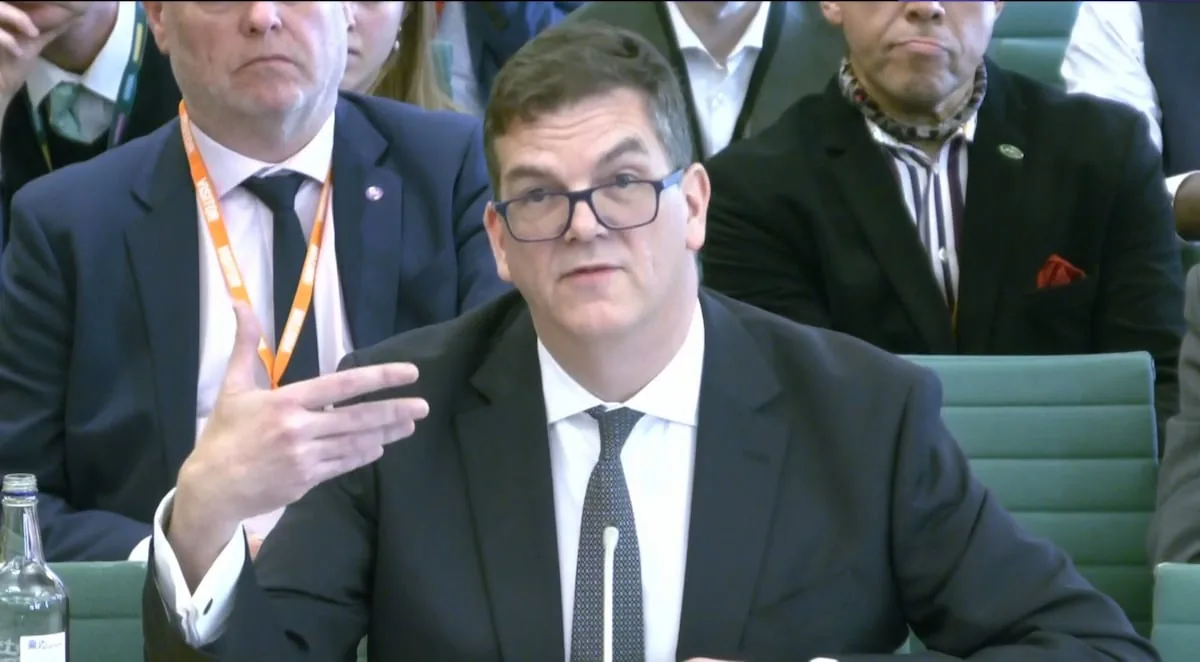
Keir Starmer has only managed to save the week after his appearance before the House of Commons, but he has not left the danger zone. The Mandelson case continues to haunt the prime minister and poses the greatest threat to the survival of his mandate. The appearance this Tuesday before the Parliamentary Foreign Affairs Committee of Oliver Olly Robbins, the senior official summarily dismissed last week as a scapegoat for the umpteenth blunder surrounding this case, has proven explosive.
Read more Ibiza completes the eviction of the largest shantytown settlement on the island
Robbins, a civil servant (the term used to designate the public service career) with decades of service behind him and prestige among his colleagues, has directly accused Downing Street and the team surrounding Starmer of having constantly “pressured” the Foreign Office to accelerate the appointment of Peter Mandelson as the new British ambassador in Washington. When he took up the post of permanent secretary of the ministry in January last year, he said, the Government was anxious for the former Labour minister to take up his post before Donald Trump’s inauguration ceremony.
“I arrived at a situation where the Cabinet Office had already carried out the audit regarding Mandelson, and they had analyzed both the reputational risk involved and his suitability for the position. His appointment had already been submitted to the King, publicly announced, and the US Administration’s agrément had been requested,” Robbins recounted. “There was a general attitude of disdain towards the security scrutiny [which had not yet been completed] and they were focused on [Mandelson] traveling to Washington as soon as possible,” Robbins recounted.
The final blow came when the senior official, irritated by the way Starmer had placed all the blame on him for the latest fiasco of the Mandelson case, suggested that Downing Street did not even think that the veteran former Labour minister, whose relationship with Epstein was public knowledge and who had resigned twice in Tony Blair’s governments due to his dealings with the rich and powerful, needed to undergo the mandatory scrutiny for all positions like his.
“The position of the Cabinet Office [the department that drives and supports the prime minister] had already been adopted: Mandelson did not need to be subjected to scrutiny. He was a member of the House of Lords, part of the King’s Privy Council, and the risks involved in his appointment were well known and had been explained to the prime minister before his appointment,” Robbins pointed out.
And yet, the process continued. When the UK Security Vetting (UKSV), the independent body that thoroughly examines the personal history of candidates for public office, informed Robbins that Mandelson’s situation “bordered on the limit” and that they were inclined to veto his appointment, the senior official, aware of the political problem this could cause the Government, used his prerogative and gave the green light to the security clearance, so that Starmer’s wishes would be fulfilled.
Read more Bieito, Rigola, Liddell and Anne Teresa de Keersmaeker, at the 50-year Grec
A legal dispute… and a last-minute bombshell
In truth, Robbins has not denied Starmer’s version, who on Monday assured that the permanent secretary of Foreign Affairs had “deliberately” concealed from the prime minister that the UKSV had vetoed Mandelson’s appointment. The discrepancy is of a legal nature. Robbins explained that the process must be carried out under the strictest confidentiality, to protect the privacy of the hundreds of candidates who are examined each year. This implies, according to him, that he could not communicate to Starmer or any of his ministers the existence of problems. His job was to give the green light or not to the appointment, he said, and that is what he did.
But Robbins dropped a final bombshell that again calls into question the prime minister’s good judgment, by revealing that Starmer asked him to place his former Director of Communications, Matthew Doyle, who had been dismissed from his post shortly after his relationship and support for a candidate convicted of child pornography handling became known, at the head of an embassy.
Although Downing Street, through a spokesperson, has vehemently denied all of Robbins’ accusations, the Conservative opposition has used its parliamentary prerogative to call an urgent debate on the matter this Tuesday afternoon and again accuse Starmer of lying to Parliament. All opposition parties, such as Liberal Democrats and Scottish Nationalists, have joined the call for the prime minister to resign. The prime minister has decided not to be present at that debate.
Aware of Robbins’ prestige and good name, Starmer, through a spokesperson, has acknowledged his “integrity and professionalism,” but has again accused him of “making an error of judgment” by concealing from the prime minister the decision of the internal security services to veto Mandelson’s appointment.
The Labour Party faces crucial elections on May 7 —municipal in England, regional in Scotland and Wales— in which all polls predict a collapse attributable to Starmer. Until then, none of Starmer’s internal rivals will decide to make a move, but the faces and discouragement among Labour ranks have been evident during Monday’s and Tuesday’s parliamentary debates, and the Mandelson case is on its way to being the millstone that will sooner or later crush the prime minister’s political career.