









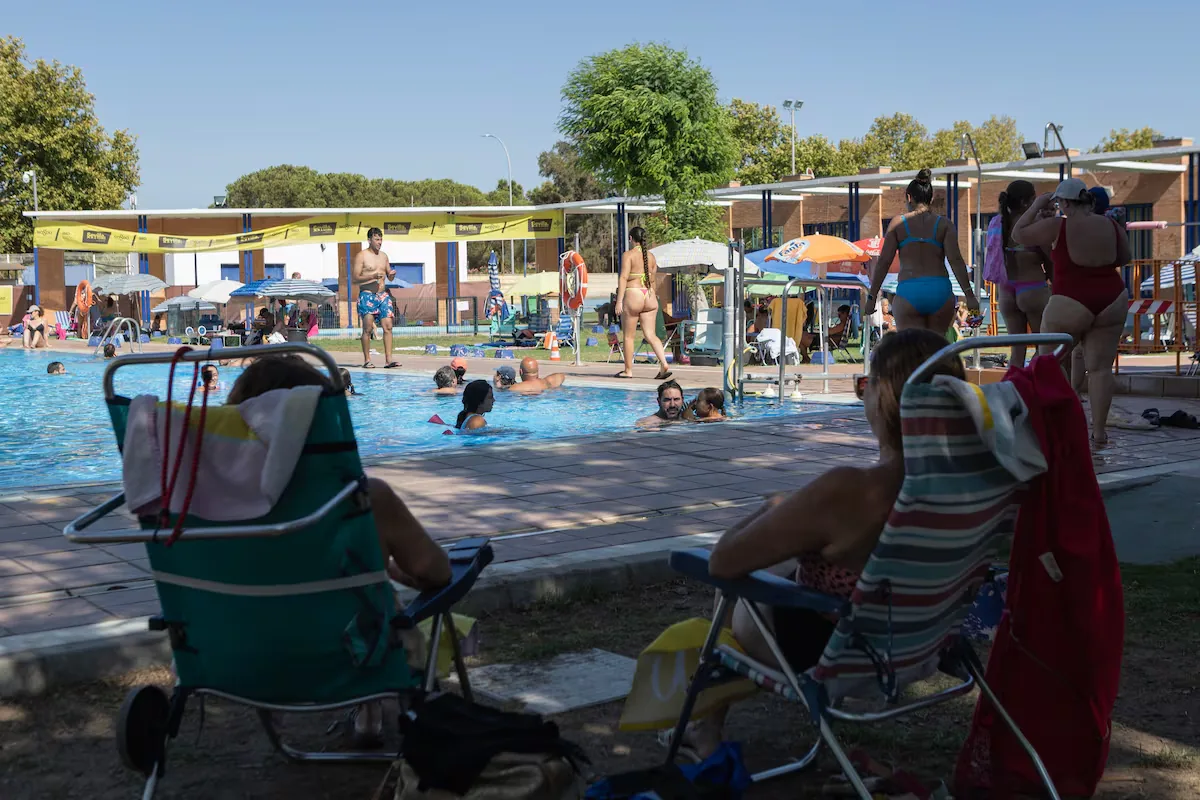
Seville only has five public recreational swimming pools for its 700,000 residents to cool down from the extremely high temperatures they endure every summer. That is, one municipal pool for every 140,000 inhabitants. It is the city with the lowest density of open recreational pools in the country along with Madrid, which suffers the same ratio (25 for 3.5 million inhabitants), although the Andalusian capital breaks heat records every year, only behind Córdoba or Jaén. Zaragoza, with the same population and milder temperatures than Seville, has 22 uncovered municipal pools to relieve the heat for its families, four times more.
As if that were not enough, there are numerous neighborhoods that suffer power outages of up to 24 hours every summer because Endesa’s distribution network cannot handle the demand. In the 21st century, residents have to survive without electricity and endure up to 40 degrees locked inside their homes because the streets are scorching. Preserving food in the cold, cooking, and cooling the home are all a torment for many households when the system breaks down, families who also have nowhere to cool off and whose household economy does not allow them to go on vacation. Almost half of Andalusians will go without vacations this summer (43.3%), according to the latest barometer from the Andalusian Studies Center (Centra), the Andalusian CIS.
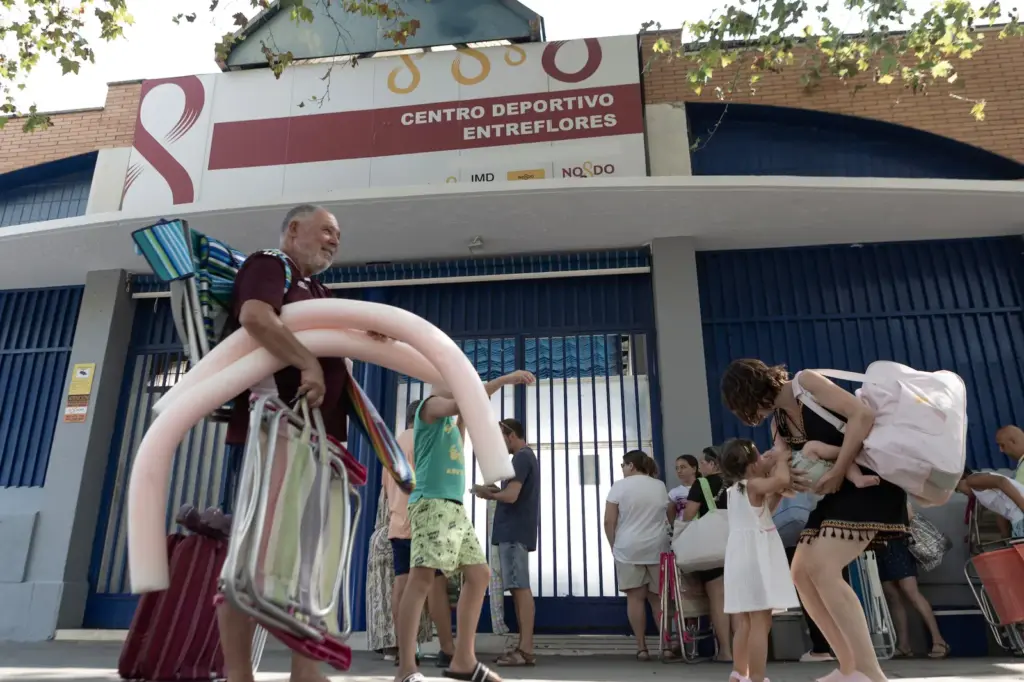
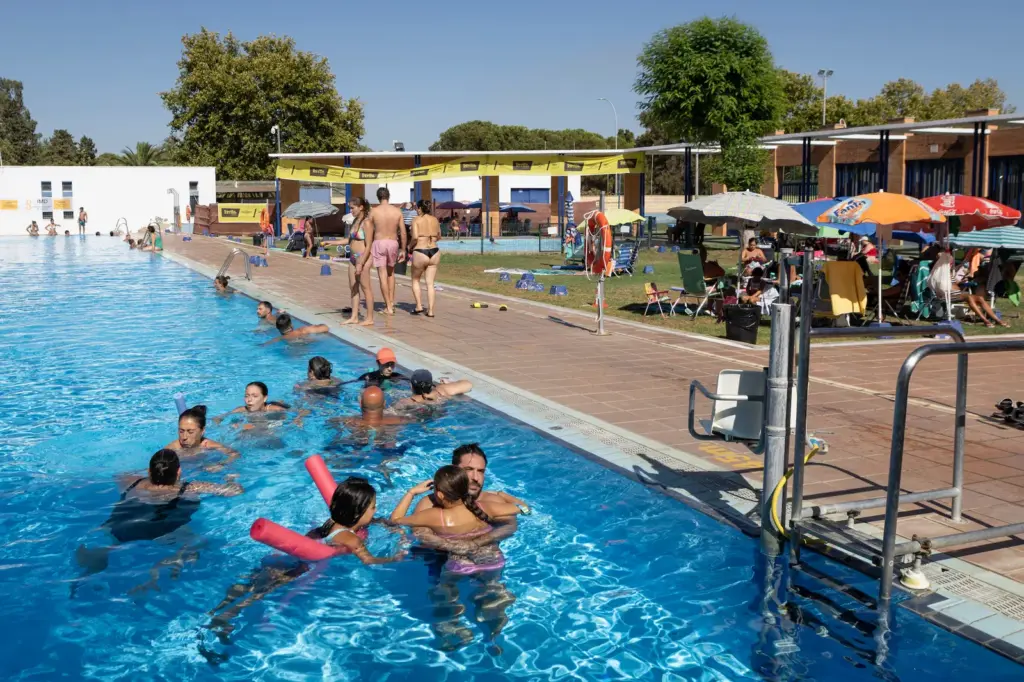
At 11:50, ten minutes before opening, Irene Pérez is first in line to take a dip in the Entreflores pool in the Sevilla Este district (107,000 inhabitants, more than Girona): “I haven’t gone on vacation to Chipiona for three years. I used to go to the San Pablo pool when I was little, 35 years ago. Why doesn’t the City Council open it now for summer? There are many children and elderly people in my neighborhood. We used to go to the pools in Coria and Gelves [municipalities near Seville], but over time they made them only for locals,” she laments. As soon as the pool opens, an Olympic format 50 meters, the temperature drops several degrees and the air feels better than outside. Last Thursday, walking through Seville, with 40 degrees and a heat index of 42, was like having a hairdryer blowing on your face all the time.
This pool, with a capacity of 525 users, was managed by the private club Nudión until last January, when it abandoned it and the City Council (PP) took over its management so it would not be closed, increasing the number of public pools from four to five in the city. “Before this pool, we went to Burguillos, Bormujos, Carmona and the experience was good, but now they are overcrowded and swimming is like in Japan, everyone squeezed together,” says Charo Villalba, who goes daily except Mondays, when it is closed. Due to medical problems, she cannot use air conditioning at home and only relieves the heat with fans with water mist “and the shower running all day,” she exaggerates with a smile. “I ask the mayor to keep it open next year because there are rumors it might be privatized again and there are very few public pools,” she pleads.
Juan Manuel Mellado, director of the Municipal Sports Institute in this district, clarifies: “There was a social demand for it, but its continuity is pending decision.” Adrián Suárez, the pool coordinator, adds: “We have often been close to full capacity. It is a service that must be provided, especially in a city like this, where it is hot on every corner.” The current capacity of the five public pools in Seville is 1,500 people, 0.2% of the population.
Susana Hornillo, Seville councilor for Podemos, criticizes: “It is hard to believe, but there is nowhere to stop. No pools, no climate shelters, no squares, which are harsh. Seville does not have a city model adapted to combat climate change. It is not about putting awnings on the streets, but about green areas, fountains, and recreational pools to enjoy green spaces. The minimum should be one pool per district [the city has 11] to prioritize the well-being of residents over tourists. The City Council has been focused on hotels and tourist apartments for 20 years, which is inexplicable.” In the streets of the Andalusian capital, the lack of public fountains for residents and tourists to hydrate when the thermometer spikes is very striking, a public health measure adopted by most major European cities in recent years.
The Seville City Council claims that next year it will build a new recreational pool for the neighborhoods of Triana and Los Remedios, but other pools underway, such as the one in La Macarena, will be covered and without grass around. The City Council admits that surviving the summer without being able to cool off in Seville is almost heroic. “It is not an accessory element, but a relevant infrastructure for homes and their quality of life,” acknowledges a spokesperson, highlighting how of the 6,134 social housing units under public and semi-public construction, 3,214, half, will have a pool. This newspaper has requested the opinion of the Sports delegate, María Tena, but has not received a response.
Read more Resist in Ceuta until obtaining asylum
The disparity between the Andalusian and Aragonese capitals, five pools versus 22, also rises to the total number of pools, including those of clubs and private ones, with 1,999 in Seville (one for every 350 inhabitants) and 4,348 in Zaragoza (one for every 161), double, according to cadastre data. Both cities have a similar budget, 1,096 and 1,039 million, but the political commitment is clear: Zaragoza spends 10 million every summer on its 22 pools and is now building the 23rd for the La Almozara neighborhood. If Seville has average highs of 36 and 35.5 degrees in July and August, Zaragoza reaches 32.4 and 31.7, almost four degrees less, according to the State Meteorological Agency (Aemet).
The pool in the Rochelambert neighborhood, with a capacity of 245 people and renovated in 2005, has a waiting list for passes and in August attendance drops compared to July for splashing around. “I haven’t had a vacation in 25 years because I am a housewife and my husband is disabled. In my neighborhood, Palmete, there is land and a pool would be very useful because there are people who cannot go on vacation or take so many buses. The City Council has many promises for Palmete, but it is terrible, especially with the power outages,” protests Erika Gamaza with her son.
The lack of recreational pools in Seville is historic. The city’s proximity to the coast, with the nearest beaches only 45 minutes by car, and the existence of private clubs with about 80,000 members, have often been used as an excuse for the lack of municipal investment. Most clubs have waiting lists and entrance fees soar from 10,000 euros at Náutico to 40,000 at Labradores.
Since 1999, the city has had five socialist governments and two from the PP. Socialist councilor David Guevara, formerly head of the Sports area for two terms, argues that the PP halted the pool projected in Polígono Sur in 2023: “In eight years we had to make very large investments and dedicated a lot of money to pools despite budget crises, but they need continuity over time. Raw material crises and Covid wiped out many projects and made us lose a lot of time.” Manuel Silva (IU), who led that area for five years, states: “We covered four pools at once, but public management has not prevailed over administrative concession [which favors covered pools]. It is a serious social problem and depends on whether the ruler has vocation.”
Alejandro Fernández, from the Regional Federation of Neighborhood Associations of Madrid (FRAVM), author of the report Madrid is not a city for dips, estimates that the cost of a pool for 500 people ranges between 5 and 6 million: “Now pools are climate shelters against high temperatures, which last from May to September, five months a year. It is not a big effort to build two pools a year and City Councils always cite lack of space, but what is really lacking is political will in the face of this alarming drama.” On this, Seville councilor Hornillo adds: “It is not true that there is no land, every month land is freed up to build apartments, what is lacking is political will.”
The lack of pools in the Andalusian capital reaches the point that residents rent tourist apartments in their own neighborhood just because they have access to a community pool. “The rest of the neighbors don’t complain, it is something that happens during heat waves. People find a way,” comments Guevara about this unusual situation that occurs in his development in Sevilla Este.