









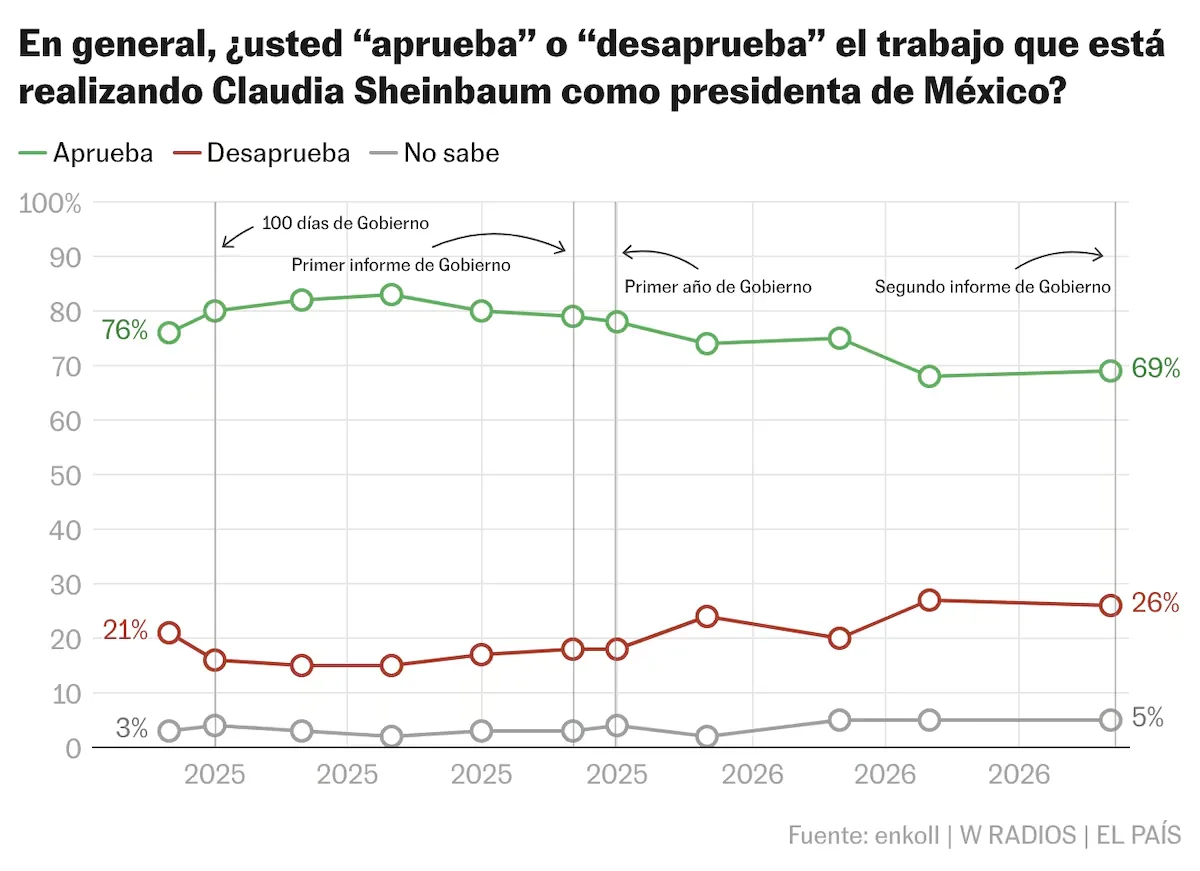
Internal and external crises surround Claudia Sheinbaum, but the president has reached her second Government report with an approval rating of 69%, according to an Enkoll survey conducted for EL PAÍS and W Radio. The president has barely recovered from the earthquake caused by the United States’ accusation against Rubén Rocha Moya for links to drug trafficking; however, it still affects her: her approval is now 10 points lower than exactly one year ago and is the second weakest since the beginning of the six-year term. Insecurity remains, by far, the main concern of Mexicans and is the only issue that has grown during her term. On the opposite side, social programs still clearly support Sheinbaum’s approval.
Read more The Shield of the Americas, a great opportunity if built well
The president experienced one of her most delicate moments of popularity in May, after the U.S. Department of Justice pointed to the Morena governor of Sinaloa and nine other officials for working with Los Chapitos. It was the steepest drop of her term and still results in a 26% disapproval of her Government (with 18% of respondents disapproving “a lot”), according to the Enkoll survey. Even so, the 69% approval figure keeps Sheinbaum as one of the best-rated world leaders: Donald Trump’s approval is 33%, according to the latest Reuters survey this Monday, and Javier Milei in Argentina or Lula da Silva in Brazil are below 50%, according to the polling firm Morning Consult.
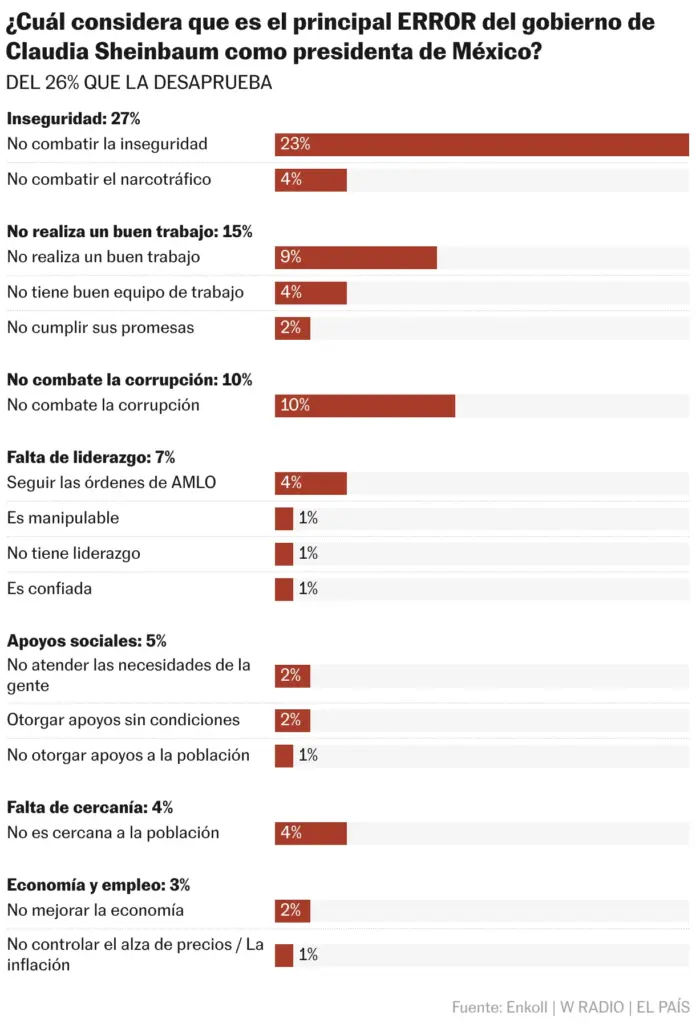
The president has personally intervened to tackle Morena’s latest major crisis, that of Rubén Rocha, especially after the brief rebellion of the governor, who returned to office for 33 hours. Sheinbaum, who initially entrenched herself — and incidentally the governor — behind the discourse of sovereignty against the United States, ended up publicly pressuring Rocha to leave the Government Palace of Culiacán and ordered the replacement in Sinaloa. Still, 10% of her detractors consider the worst mistake of her Government not to fight corruption; 15% identify it as not doing a good job, and 27% point to insecurity.
She did so this Tuesday, in her second Government report, but had highlighted it many times before: for the president, halving the murder figures is a great achievement of her Administration. The strategy, led by the Security czar, Omar García Harfuch, has been mentioned in morning conferences, in calls with Donald Trump, and at DEA events.
However, for 49% of Mexicans, crime remains Mexico’s main problem (in December 2024, for example, this perception was lower, at 45%). Most respondents associate that insecurity with thefts (on the street, in homes, of cars), but murders, disappearances, or extortion are also noted. In fact, the perception of general violence in the country has risen from 9% to 20% since May. Public security is thus what has worsened the most in the country since Sheinbaum came to power, according to the survey.
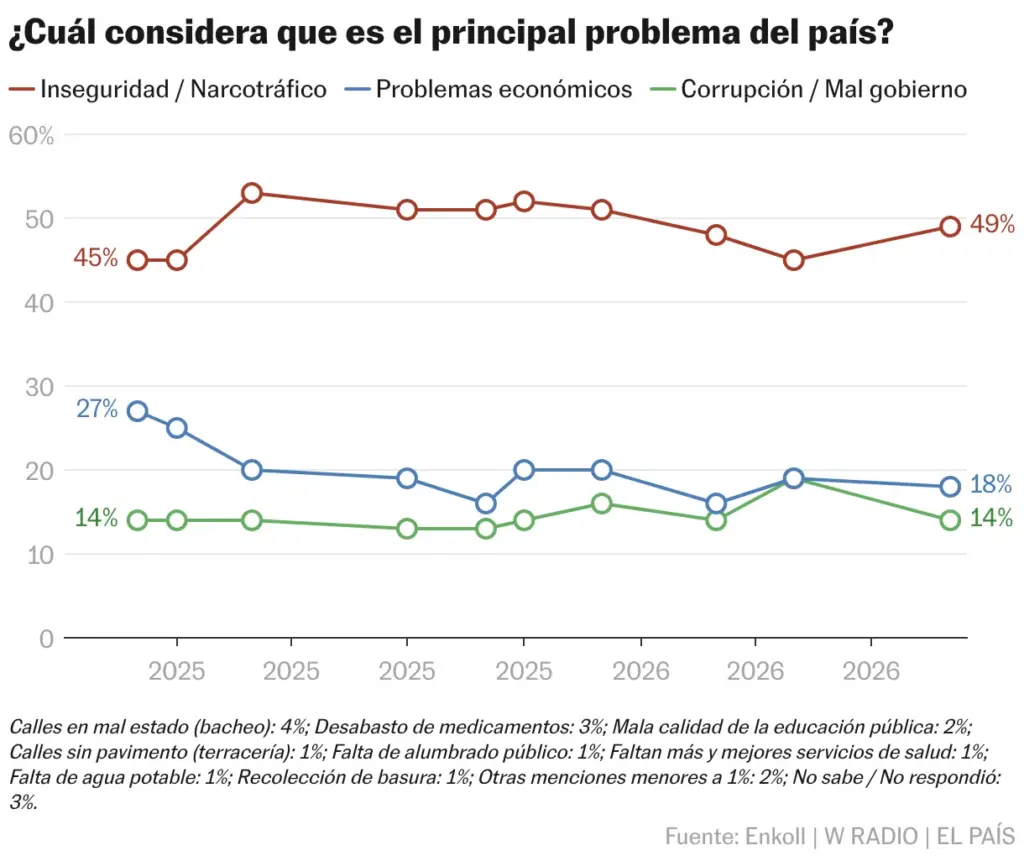
The economy is the other great obsession of the president and also of the respondents. Faced with the lack of economic growth — in 2025, GDP barely increased by 0.7% — and the failure of the Free Trade Agreement renewal, the Government is betting everything on boosting investment, both public and private, through the Mexico Plan. Here two data coexist at the same time: 42% of respondents believe economic development has worsened in the last two years; but also, in 2024, the economy was the main concern of 27% of Mexicans and now it is only for 18% of them.
Sheinbaum also improves in this survey the view of her relationship with the United States. After the tariff crisis, the CIA agents crisis, the Rubén Rocha crisis, and finally the visa crisis, 65% of respondents trust how the president handles Donald Trump. This percentage is the same as exactly one year ago, but 10 points below the perception in December 2024. No one comes out unscathed from dealing with the Republican president.
Trump has been a constant headache for Mexico, its main trading partner and territory with which it shares more than 3,000 kilometers of border. The American’s communications even include direct threats of military intervention in Mexico. Defense against interference has become the transversal axis of Morena’s speeches. Especially after Andy López Beltrán, son of former president Andrés Manuel López Obrador and former party organization secretary, announced that the United States had revoked his visa.
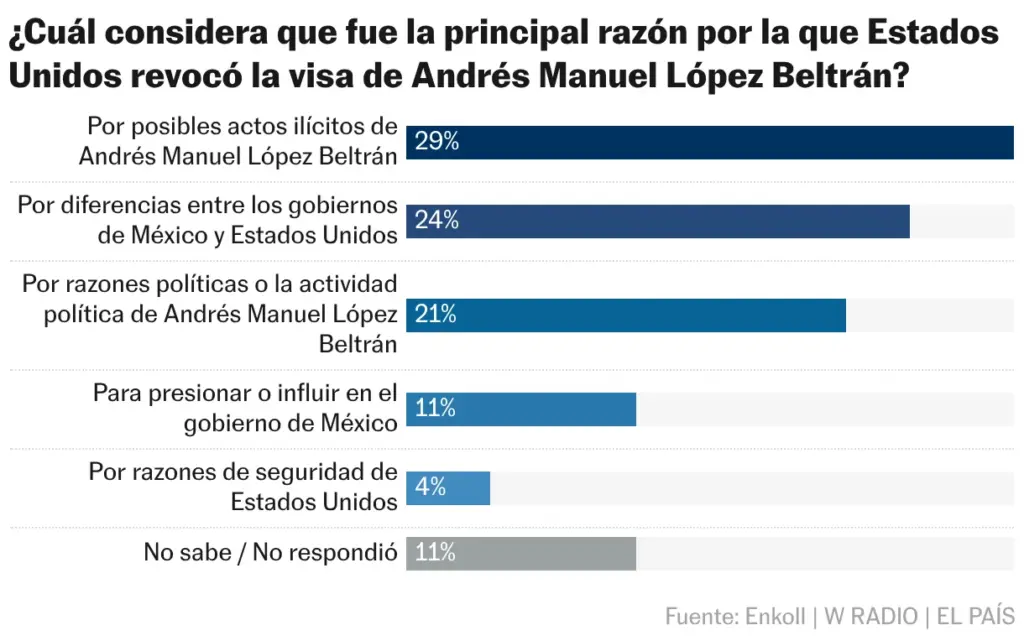
The Enkoll survey shows that 29% of Mexicans believe his migration permit was withdrawn because he had committed “possible illicit acts,” 24% point to differences between the two Governments, and 21% believe it was for political reasons. Whatever the reason, half of the respondents do believe it is a form of U.S. interference in Mexico.
Read more PcComponentes discounts monitors, laptops, and accessories for your home office
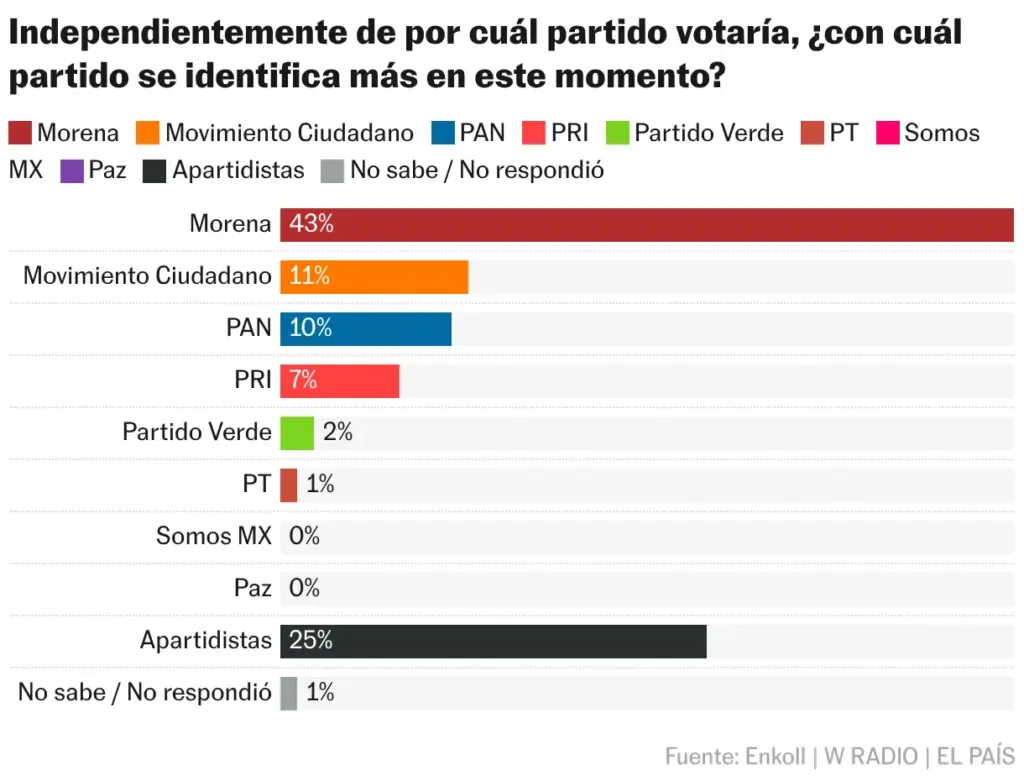
In the final balance, Morena wins. The guinda party takes 41% of gross electoral preference, compared to 12% for Movimiento Ciudadano and PAN, and 8% for PRI. However, since last year, Sheinbaum’s movement has fallen seven points in voting intention. Regardless of electoral intention, 43% of respondents identify with Morena. In that category, the surprise is the party led by Jorge Álvarez Máynez, which manages to position itself as the second force, not counting, of course, the non-partisans. That percentage has exploded in the last two years: it has gone from 13% to already a quarter of respondents.
Methodology
1,205 effective interviews with women and men aged 18 or older, with a valid voter ID from the Mexican Republic.
From August 25 to 29, 2026.
Face-to-face interviews in homes, conducted with electronic devices applying a data collection instrument (questionnaire) suitable for the study’s purposes.
Sample selection
The sample is representative of the Mexican Republic.
A probabilistic and multi-stage sample was carried out:
– Stage I. Electoral sections were selected with probability proportional to size (PPS) of the nominal list.
– Stage II. Blocks were selected in each primary unit in the sample using probability proportional to size (PPS) of the nominal list.
– Stage III. Homes were selected in each block with systematic sampling with random start.
For better population representation, quotas by gender crossed by age range are managed.
Precision and confidence
The results have a margin of error around +/- 2.83% with a 95% confidence level in the main indicators.
Read more Amazon deals that are getting the most attention: up to 57% off