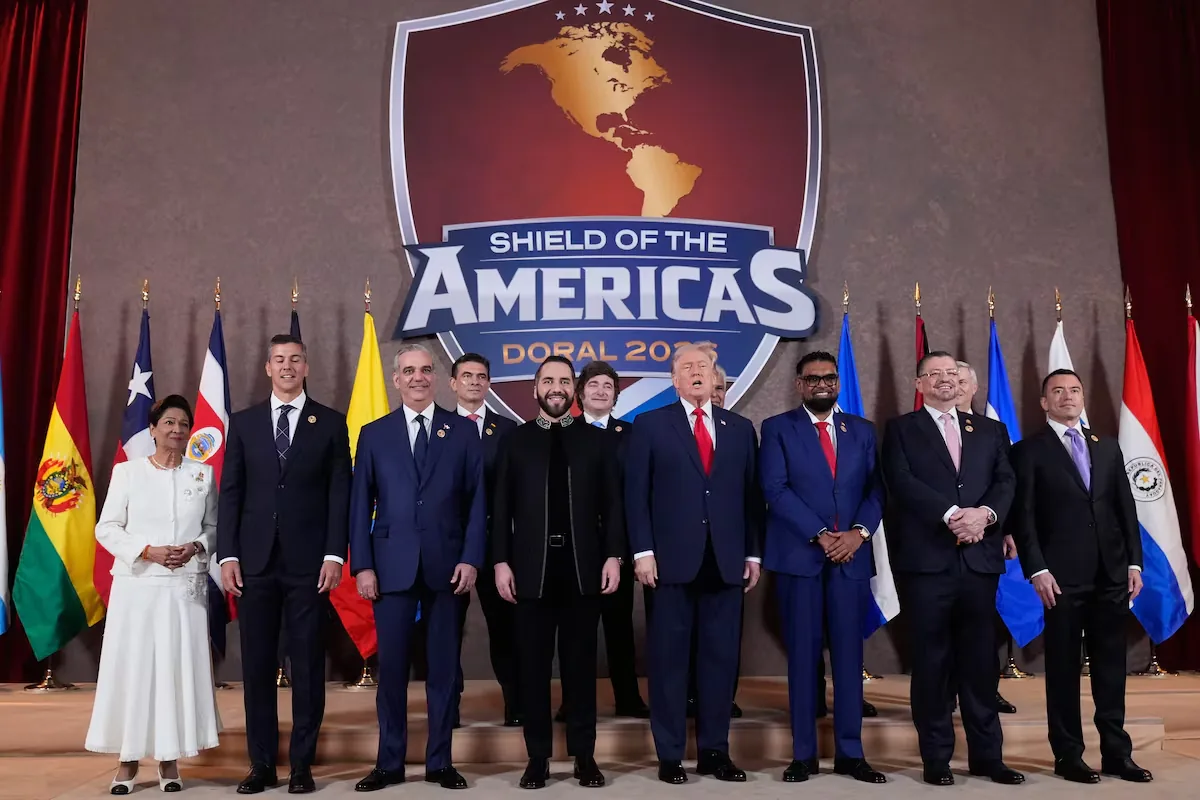
When Trump signed the Americas Shield proclamation at his Doral golf club on Saturday, March 7, the brief text with four general points was basically a statement of intent. Although a couple of days earlier the Defense ministers had met with their U.S. counterpart, Pete Hegseth, the Shield had no own budget, permanent secretariat, or mechanism to resolve differences. It was a good name and a photo of regional leaders with Donald Trump.
Read more PcComponentes discounts monitors, laptops, and accessories for your home office
Paradoxically, the announcement also served as a lifeline for the Secretary of Homeland Security, Kristi Noem, fired by Trump for her mistakes and lavish spending and immediately appointed as the Shield’s “special envoy,” an ambiguous position created at that moment that reports to the State Department.
Five months later, the Shield is beginning to have substance. Today it is the Americas Counter Cartel Coalition, A3C, which brings together nineteen ideologically aligned member countries. Therefore, Brazil and Mexico are not part of it, although the latter is the main land route for drug entry into the United States.
The A3C, led by Pete Hegseth, has already held two ministerial forums and must approve a campaign plan in November. At the one in Panama in early August, several countries offered to lead subregions and head operations against specific networks, showing they are taking the initiative seriously.
Operationally, the leadership of Southern Command lends credibility to the initiative: it has been the military interlocutor of the region for decades, including joint exercises and operational trust. On August 4, it activated the Joint Task Force Western Hemisphere (JTF-WHEM), which its commander, General Francis Donovan, called “the action arm” of the Command. At the helm was General Kevin Jarrard, who had led the U.S. response after the Venezuela earthquakes in June. While Southern Spear, which it replaced, was a maritime interdiction campaign, the new structure could expand to land operations.
The Northern Triangle will be key: Honduras, El Salvador, and Guatemala, which are A3C members, know the problem of transnational criminal structures from the inside. The Honduran case deserves particular attention. A founding country of the March declaration, it has been a logistical corridor for trafficking northward, and even more so since Nayib Bukele has been so successful in combating criminal gangs, which has displaced their activities to the neighboring country. Coordinated Central American leadership will be key.
In South America, the natural leader is Colombia, recently added with the arrival of Abelardo de la Espriella. Colombian security forces have been operating shoulder to shoulder with those of the United States for over a quarter of a century, following Plan Colombia, conceived under Andrés Pastrana. With this plan, Bogotá and Washington built since 2000 a relationship between the security forces of both countries that survived several government changes in both capitals.
Read more Amazon deals that are getting the most attention: up to 57% off
That foundation later allowed Álvaro Uribe to militarily defeat the FARC, the largest guerrilla group in the hemisphere, and led to the 2016 Peace Agreement signed by Juan Manuel Santos, who had been Uribe’s Defense Minister. Twenty years of continuity with three different presidents on each side make Plan Colombia the deepest hemispheric security initiative of recent times, Colombia the closest partner, and it is the example for A3C. I write this with the conviction of someone who was part of the bilateral team that designed that program, processed it in Washington, and accompanied its first stage of implementation.
However, there are two areas where the A3C will have to be especially careful: First, joint operations will have to comply with each national legislation. There will be intense internal political and legal debates in the countries, but that does not mean a viable and effective scheme cannot be built.
Second, there is the budget issue. The 1 billion dollars announced for Colombia are an example of the role Washington assigns to the region, but the resources required in this and other countries will have to be approved by Congress. Processing them before the legislative elections on November 3 does not seem viable, among other reasons because the A3C program will only be ready that month and because the White House has many open debate fronts in Capitol Hill. The process will take place in the new Congress elected in November.
That is where the outlook can change. Today, the Republicans control the White House, the House, and the Senate. Nothing is written, but many analysts see it likely that the Democrats will gain control of the House and it is not impossible—although more distant—that they will do the same with the Senate. The The Economist model—although from a few months ago—gives the Democrats an overwhelming probability in the House, while the Senate is uncertain. Cook and Sabato—two of the most cited electoral campaign rating agencies in Washington—moved races toward the Democratic side in August, including Iowa and Texas. A Democratic House or Senate reviewing security assistance to the region will set conditions and ask for the predictable, such as clear rules of engagement, judicial control, and human rights, beyond the military. It is not an obstacle, but it is the price of obtaining resources in that system.
In that context, A3C members will have to approve their action plan in November. Latin American capitals, especially Bogotá and those of the Northern Triangle, should contribute well-analyzed, realistic, and legally and politically viable proposals.
Today there is the rare opportunity for more than half of the countries in the region to be sitting at the same table and working in common cause with Washington. It is a moment that Latin American leaders must seize.