








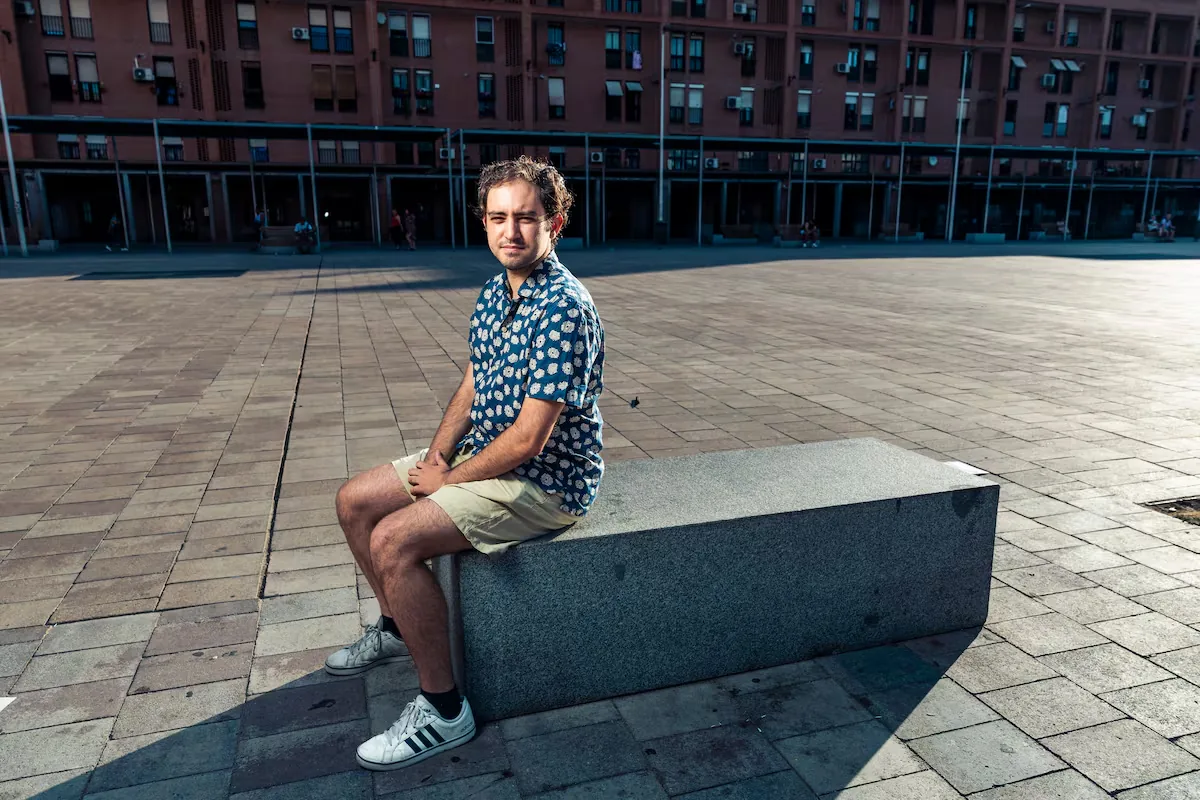
Carlos Martínez is a laboratory technician in a pharmaceutical industry and is 28 years old. When asked about the speeches that point to young people for their alleged lack of commitment to work, he responds: “My opinion, and generally that of all my group of friends, is that if we need a sick leave for health reasons, that’s how it is, the company is not our life. No matter how much we do, they won’t take it into account and the more we do, the more they will ask for the same in return.” The young man from Madrid adds: “I’m not going to inherit the company. Just as for the company we are a number, for me it is too.” This professional takes a strong stance against fraud in sick leaves. As much against “giving your time away to the company” and having your labor rights trampled on.
Read more Between crowded Spain and emptied Spain
His mention of temporary disability connects with a conversation that has been gaining volume for months in Spain and has exploded in recent weeks. One of the milestones that propelled it was a CEOE conference, solemnly held at its Madrid headquarters on June 16, about the increase in sick leaves, which have doubled in the last decade. A few days later, the leader of the Popular Party, Alberto Núñez Feijóo, labeled them as “a cancer” and the debate intensified. Once the reduction of the working day crashed in Congress, the business concern about this issue has become the central point of their discourse. Many speakers treated the topic with moderation, but others did not, such as the president of CEOE in Castilla-La Mancha, Ángel Nicolás:
—Now we have a sick leave not because the company mistreated him, but because his girlfriend left him. […] We have a young population that is not comparable to ours. No offense intended, but they are a bunch of fools […] That the boss tells him he has to comply with his schedule and work already constitutes workplace harassment.
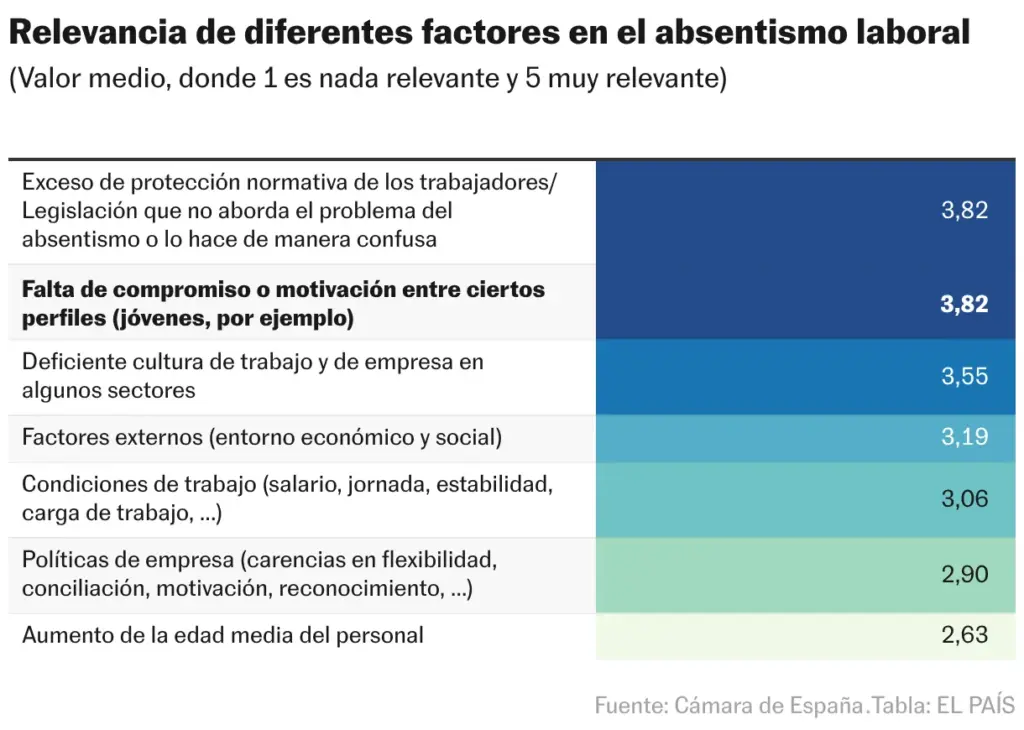
Nicolás apologized afterward, but made clear an idea that spreads in part of the business world: today’s young people are made of different stuff. In a much more orderly approach, a recent survey by the Chamber of Commerce of more than 2,000 companies asks about the reasons why they believe sick leaves are increasing. The most mentioned reason, along with “regulatory protection,” is the “lack of commitment or motivation among certain profiles,” citing young people as an example.
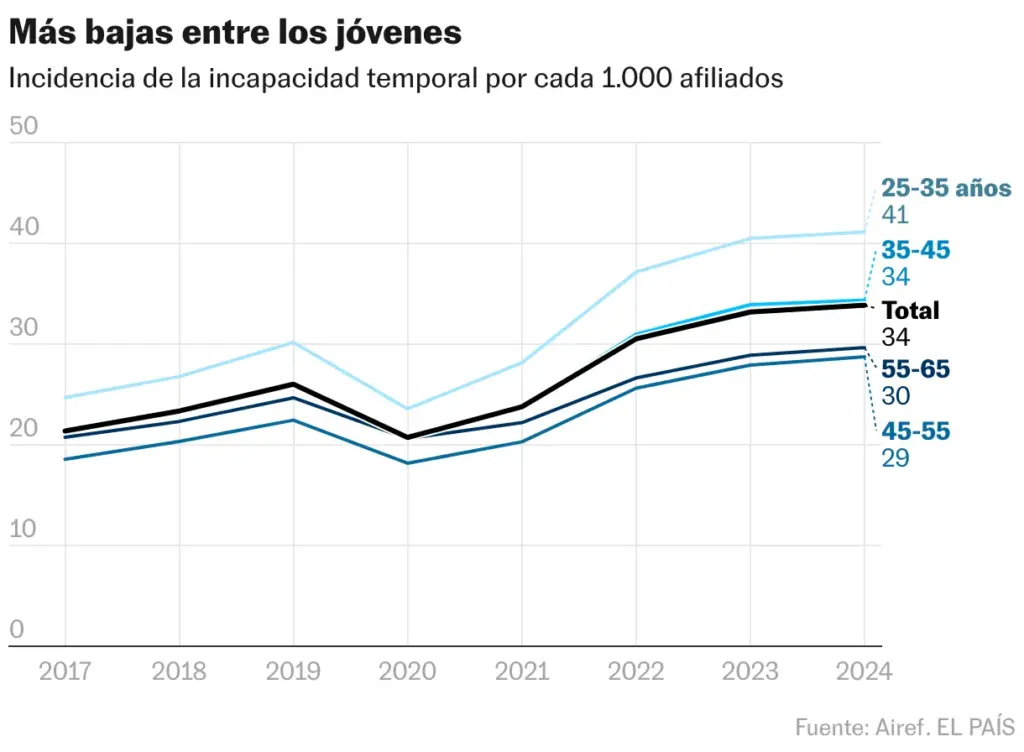
These employer discourses are also supported by a fact upheld by official data: the incidence of sick leaves is higher among young people than among veterans. The latest data from the Independent Authority for Fiscal Responsibility, based on those provided by Social Security, indicate that the incidence of temporary disability due to common contingencies is 41.1 per 1,000 affiliates in the 25 to 35 age group (and has increased by 66% from 2017 to 2024, with mental health playing a leading role) and 29.7 in the 55 to 65 age group (with an increase of 43%). At the same time, as highlighted by a recent CC OO report, young people’s sick leaves involve much less public spending than those of veterans, which are usually longer. The older the age, the more likely one is to get sick, but many occupational health specialists have been warning for some time that seniors are more reluctant to take advantage of this right, doubts less common among young people.
“For some time now, sick leaves derived from common contingencies have been growing at an alarming rate and reaching very worrying levels,” reflects Pedro Pablo Sanz, managing director of the Association of Mutual Insurance Companies for Work Accidents. “What is especially concerning,” adds the mutual insurance employers’ association (which arouses so much suspicion among many workers), “is the increase of this type of sick leave among younger workers since gradually, those cohorts will displace the rest of the workers in the labor demographic pyramid.”

Is there a different attitude towards work?
Those in charge of managing staff in companies believe so, that the difference in work approach between generations is evident. Jesús Torres, president of the Spanish Association of Human Resources Directors, believes this is “neither good nor bad, it is simply the reality we face.” The head of the socioeconomic area of the Youth Council of Spain, Javier Muñoz, also recognizes this difference: “I think in our generation it is considered that life does not revolve around work, that it is a tool to live, not to live for, and that we will not go to work sick as some people from other generations have accepted.” This specialist considers that, really, this trend is not extraordinary, but the natural evolution of society: “It has always been like this, generations advance towards more rights. It is normal for young people to be at the forefront, questioning the previous model.”
At 70 years old, José Manuel Lasierra, professor of Applied Economics at the University of Zaragoza, notices these differences in his daily life and analyzed them in the study Generational Differences in Work in Spain. A Review. In it, he distinguished between “a group of workers with a more traditional profile that corresponds to the Fordist worker profile and a generation of younger workers less committed to the company, less identified with work, for whom work is nothing more than a means of living and from which they do not obtain an immaterial value.”
This specialist believes much of the difference is explained by the context in which each generation has grown: “For people my age, who have gone through so many hardships, work was not abundant. That marks your whole life. Now young people have it much easier to get a job.” It is an idea echoed by Juan Ángel Alonso, who at 59 is a production manager at an equipment company: “I have detected a big difference in attitude towards work between young people and older people. I think it is because they have been educated in a very different context. Forty years ago, we had to fend for ourselves no matter what because our parents could not support us, not even to give us education.” Sanz delves into that reading: “There has been a change in values and preferences regarding commitment and responsibility with work, linked or derived from a very high desire for immediacy in achieving desired goals, which in many cases results in frustration.”
The human resources specialist, Torres, talks about an explanation linked to supply and demand: “Competition used to be much tougher, in a very populous generation and scarce jobs. The aspiration was to get a position and stay in that company as long as possible, and if you had to work 14 hours, you did.” “Now,” Torres continues, “the demographic pyramid has turned upside down. There are sectors with problems finding staff and young people have some confidence that if they leave a company they will find another position more or less quickly. They are not afraid of change.”
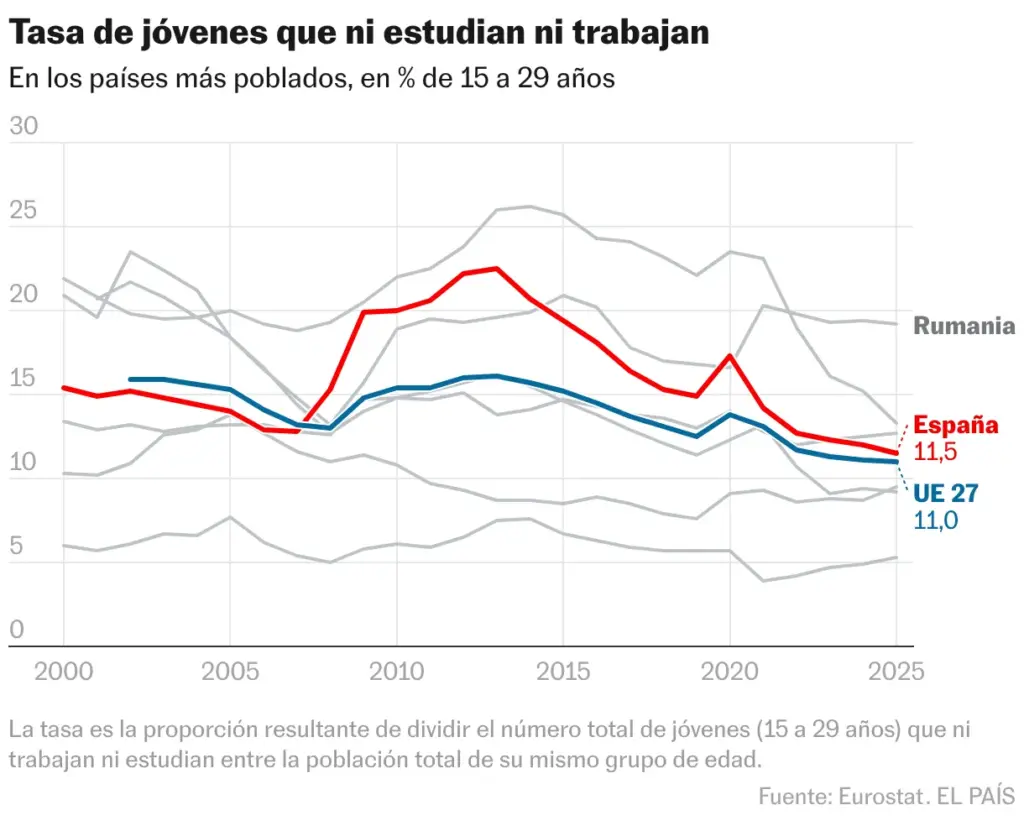
That the labor market is less hostile than before to young people is seen in the youth unemployment rate. It is still very high in Spain compared to other European countries (23.7%, versus the EU average of 15.2%), but it has halved since the Great Recession. Back then, there was constant talk about young people who neither study nor work (a phenomenon now at historic lows), but now Lasierra sees the yes-yes group as more relevant: “In my classes I see more and more who study and work.” According to the latest INE data, 1.11 million workers aged 16 to 29 are simultaneously studying, 33% of those employed in that age range. Just before the pandemic, it was 25%.
Boomers, X, millennials, Z…
Ángela Gómez, a 38-year-old researcher and PhD from UNED, has also specifically studied the different attitudes towards work by generations in her doctoral thesis, Labor Values of Generations in the Labor Market: Is There a Real Need for Radical Transformation? She details some aspects that characterize different age cohorts: “Baby boomers (born 1946 to 1964) are usually associated more with stability, commitment, and permanence in the company. Generation X (1965 to 1980) is characterized by valuing autonomy, adaptability to change, and work-life balance. Millennials (1981 to 1996) usually give more importance to professional development, flexibility, good work environment, and coherence with their personal values. And Generation Z (1997 to 2012) has grown up in a completely digital environment, so they usually feel more comfortable with technology, continuous learning, and more flexible ways of working.”
Read more The President of Hungary signs the Magyar Constitutional reform that removes him from office
“Even so,” insists this specialist, “these characteristics are general trends and do not define all people of each generation equally.” It is an idea supported by Pablo Martínez, a 27-year-old from the Canary Islands who is pursuing a PhD in Physics: “I think previous generations were more hardworking on average because they came from a different context, of greater scarcity. But neither young nor old want to work. I guarantee you that if my uncle could close the store and spend the day with his children, he wouldn’t open it. I think both generations see it as a necessary evil.”
Gómez emphasizes that there are many other factors that condition the approach to work, which transcend age. “Gender, social class, coming from a country perceived as having quality education, or having studied at a prestigious university condition labor opportunities, expectations, and priorities of each individual,” says this specialist, adding: “For example, someone who has grown up in an environment with fewer resources may give more importance to economic stability, while another person may prioritize professional development or flexibility.”
Given this scenario, Gómez considers it “important” not to attribute all differences “only” to generation. “These factors can have as much or even more weight than age. These kinds of beliefs can foster stereotypes that are not very accurate to reality,” she adds. And she emphasizes that these views change with age, that they are not stagnant: “As people gain experience and go through different stages of their lives, aspects such as job stability, work-life balance, or economic security usually gain importance as personal and professional responsibilities increase.”
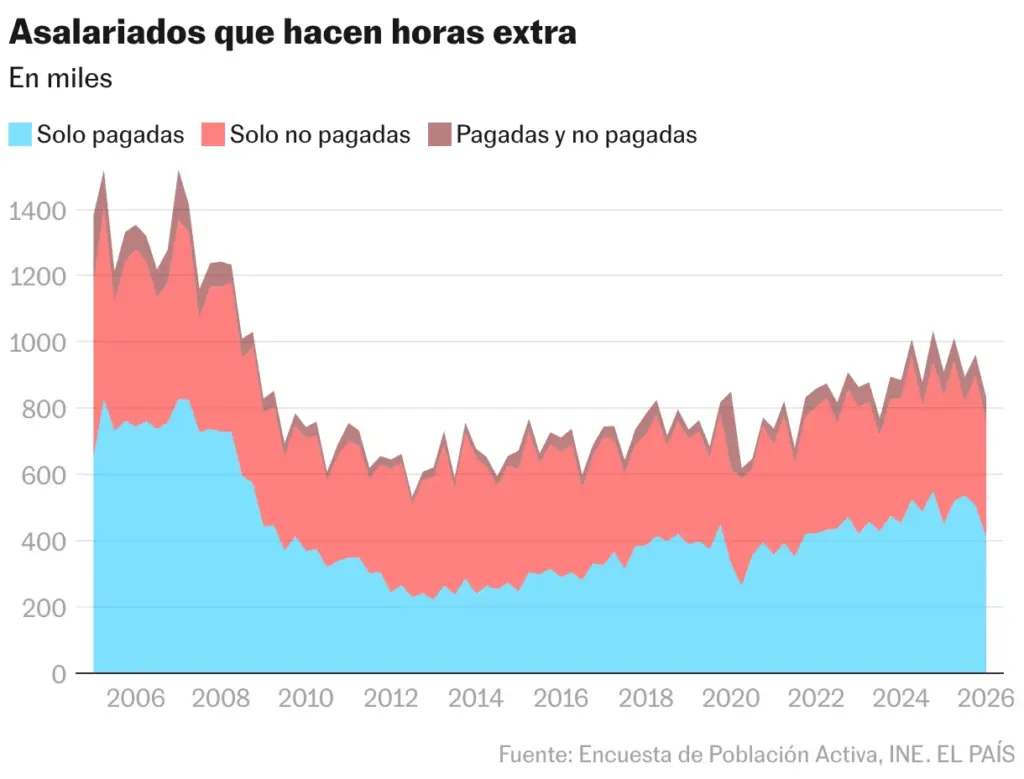
Sara Pérez, who at 22 has worked in customer service in several stores, focuses on this: “I have seen that older workers put up with more than we do because they are the breadwinners of their families, who do not take sick leave regardless of how they feel. We do not allow those abuses or unpaid overtime.” Her friend Paula Corral, 21, who works in an ice cream shop, adds: “I think we push ourselves more so we are not exploited, but it depends on each person’s need.” That is, she believes a young person who supports their family “puts up” as much as an adult, reinforcing Gómez’s idea: there are factors much more important than generational ones.
The confederal secretary of Youth of CC OO, Pau Garcia, sees an “advance” in many young people’s resistance to accepting labor abuses and, in line with the other specialists consulted, points to another key: despair about future conditions. “Effort at work no longer yields the same as before. If no matter how many hours you put in you cannot afford a house, if no matter how much you have trained that is not reflected in your material conditions, it is normal that you are not so willing to put up with anything.”
“A young person right now does not know if in a few years artificial intelligence will take part of their job away, even if they have very good training,” adds Borja Fernández, who at 28 works as an auditor and previously was employed in a supermarket. “A young person sees that the salary is worth less and less, that becoming independent is very difficult and, on top of that, if on a Saturday they go out for a drink, someone always appears saying that if they saved that money they could buy a house. And reality does not work like that.” Sofía Gimeno, a 23-year-old lawyer from Tarragona, insists on another idea: “Being able to stand out in your job is much more complicated than before, since back then it was not so common for people to have a university degree.”
The CC OO specialist believes that the mantra of “the culture of effort” has been “reversed,” that most people are clear that “it is better to set limits.” And she adds with a reminder of the ninis, in relation to the controversy over sick leaves: “Again, the burden of responsibility is placed where it does not belong. Instead of placing responsibility where it should be, it was placed on young people.”
Pilar Plaza, a 66-year-old retiree from Ciudad Real, rejects that relationship between youth and lack of commitment: “I think it’s great that young people prioritize work-life balance. I do not agree with the phrase that young people do not want to work. Young people have always sought their place. Before, we fought in one way with the tools we had and in the context we were given, and now I know young people who are just as fighting.”
Generational symbiosis
One of the phenomena in which the generational gap is concretized is the “double wage scale” in many companies, a case criticized by Garcia. It is common for large workplaces to have employees hired after the Great Recession whose economic conditions are worse than those of the more veteran ones. It is a difference that goes beyond seniority, connected to weaker collective agreements for new generations. “It is a big problem that we try to reverse. We do not want the conditions of those who are 60 years old to worsen, but we do want those of the 25-year-olds to improve,” adds Garcia.
Torres, the human resources specialist, points out that there are employers reluctant towards young people and that they are reacting by giving more opportunities to seniors. “In qualified professions, there is a tendency to try to extend working careers. If it is hard for the young person to have the same dedication, companies bet on what they already know. In less qualified ones, there is still a lot of ageism, but I think there is less in higher education ones,” says the president of the Spanish Association of Human Resources Directors. However, his advice to companies is to get used to this new scenario: “Generational tension is not as serious as it seems. The best thing is to establish a symbiosis between generations, take advantage of the best of each, and have them coexist as best as possible.”
Read more No one protests in Putin’s Russia, but the war is starting to take a toll on his popularity
With information from Jacobo González.