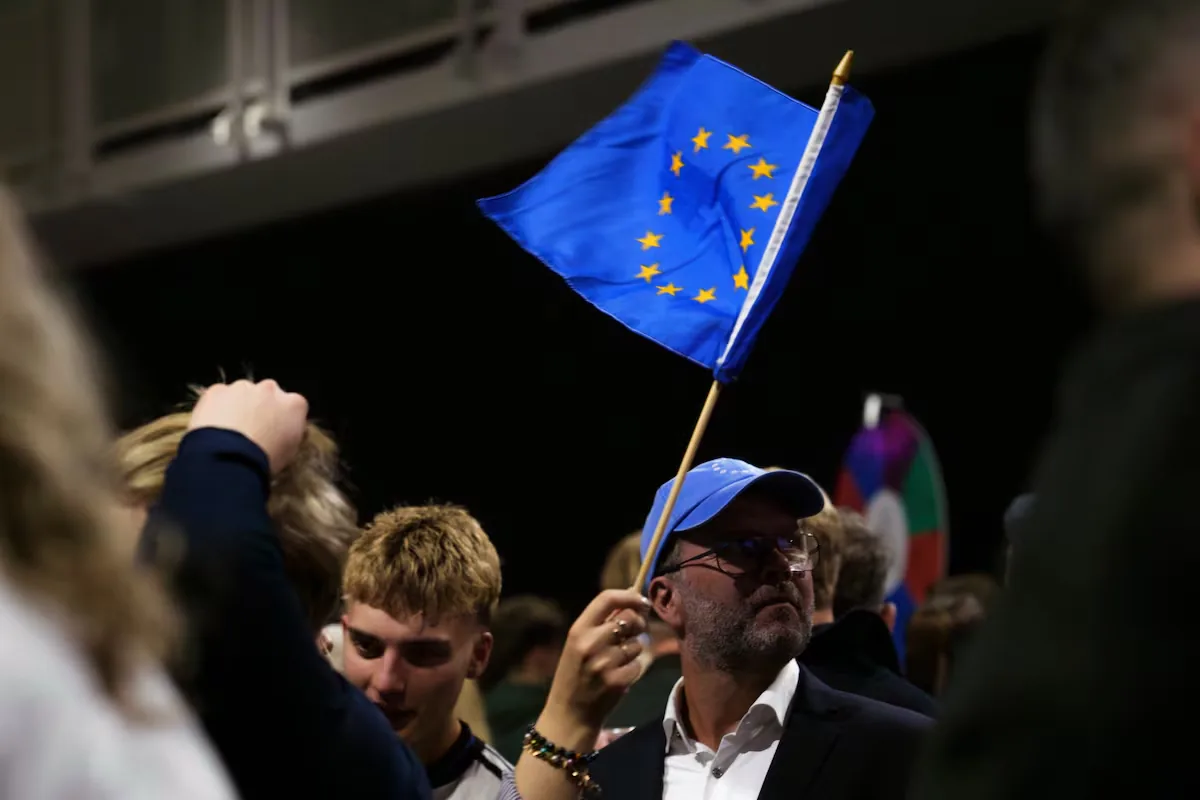
Now or never. And it was never. Almost 53% of Icelanders said no this Saturday to their country’s accession to the European Union. It was the second attempt in just 20 years, after the first, forged in the midst of the brutal financial crisis that almost took down their economy, faded even before being submitted to a popular vote. There will be no more in the short term, as their prime minister hastened to clarify. Perhaps not in the long term either: in the best case, it will take decades.
Read more Live video | Aimar Bretos interviews Pedro Sánchez on ‘Hoy por Hoy’
Despite the silence in Brussels, the door slam hurts a lot. The Twenty-Seven see the unique opportunity for a painless accession vanish: Iceland, with just over 400,000 inhabitants and a largely completed legislative path — it has been in the European Economic Area since 1993 and in Schengen since 1996 — would enter, would have entered, as a net contributor to the EU budget. Its accession also promised to push the community club towards another Nordic country — Norway — and the Faroe Islands — a Danish territory outside the Union — more than welcome to the club, but who have yet to take the step. Far from that, the Icelandic referendum deflates the pro-European movement in its neighborhood.
The timing could not have been more favorable to make a strong statement in a complicated moment, in which the Twenty-Seven are trying to find a space and their own voice against a United States thrown into the arms of the wildest isolationism and a swelling China. But the message sent is precisely the opposite: the Union misses out on a much-expected boost for a project in low spirits since Brexit.
Both the European Commission and the capitals had made it clear they would welcome wealthy Iceland with open arms. But neither wanted to enter the campaign. First, because they knew the risk they were taking: polls had been pointing for months to a scenario of maximum equality. Second, because the Icelandic government itself, timid and stubborn in detaching its own future from the referendum result, asked them to stay completely out to avoid any accusation of interference. They obeyed strictly: neutrality, needless to say, has been exquisite. But the result is far from expected.
It was, it was going to be, a modest but necessary boost of pro-European self-esteem. But the Twenty-Seven are not in the mood for many laments: their future, the future of the Union, is not played out in Reykjavik but in Brussels, where for some time there has been a noticeable lack of an important extra dose of boldness and courage; in Berlin, in Helsinki and in the other capitals that resist issuing eurobonds again and, in general, increasing integration; in Frankfurt, where the hawks, always punctual to the appointment, begin to show more than just a paw; and, yes, also in Washington and Tehran, because if anyone urgently needs the Strait of Hormuz to reopen soon, it is a Europe dependent on imported gas and oil.
Read more The holidays remaining in 2026 after the vacations: two long weekends and a bridge for all of Spain
All in all, the first victim is Iceland itself, where in the weeks before the referendum there was little excitement about the ballot and priorities different from what one might expect. Those who defended the yes did so, above all, thinking about their pocket, clinging to the promise of the euro as an antipyretic against a persistent overheating of prices that has just labeled it the most expensive country in the world.
The geopolitical argument was surprisingly secondary, if not tertiary. Of course, Donald Trump’s attacks against Greenland were worrying. Also the rift it has caused in a NATO of which Iceland, despite having no army — quite a paradox — is a founding member. But fishing, in the end, weighed more than the prospect of an economic and military umbrella from the community bloc.
The geographical implications of the door slam are also worrying. Accession allowed, was going to allow, the Union to expand a few thousand kilometers to the north and west, towards the Arctic, a corner of the world that has gone from being the periphery of the periphery to becoming a dark object of desire for anyone who prides themselves on being a power.
Its more than 20,000 kilometers of coastline north of the Polar Circle make Russia hegemonic. Trump does not give up his effort to annex Greenland. And China, which wants to double its fleet of icebreaker ships, has just opened the first regular commercial route through the north, bypassing one of the hottest points on the planet: the Red Sea, an unavoidable gateway to the Suez Canal. In the northern struggle, Iceland will have much to say. But it will say it outside the EU.
Read more In Madrid, we are all Latinos