








I have a habit of underlining phrases I like in books, as if putting a line under the words would prevent them from falling into oblivion. Last week, I was on the subway reading Juan Gómez Bárcena’s new book, Abril o nunca. I pulled out my pencil so much that it looked more like I was carrying a mandala coloring book than a novel. This man’s talent is absolutely insane. The thing is, one of the many underlined phrases stayed with me. It went like this: “Among the many possible fraternities, none is capable of uniting two strangers as much as the need to smoke.” It’s not the prettiest phrase, but it’s one of the most accurate. You don’t deny a stranger a light, paper, or a cigarette, as you might deny them almost anything else. Because vice and necessity make strange bedfellows, and anyone entering an after-hours club can confirm that.
I quit smoking seven years ago. I think it’s one of the best things I’ve ever done in my life, but sometimes, when I see someone light a cigarette, I forget. Not everyone has that power, but there are certain people who really know how to smoke, who inhale with an aspirational urgency. Smoking is a bit like sex: everyone can do it, but not everyone knows how to do it well. Those who have good sex go into porn, I suppose, and those who smoke well, into cinema. There was a time, in classic Hollywood, when being a star basically consisted of repeating your lines and smoking with a languid, mysterious air. Now no one smokes so beautifully. Since tobacco became associated with cancer, tartar, and wrinkles, smoking has ceased to be sexy and has become a shabby vice.
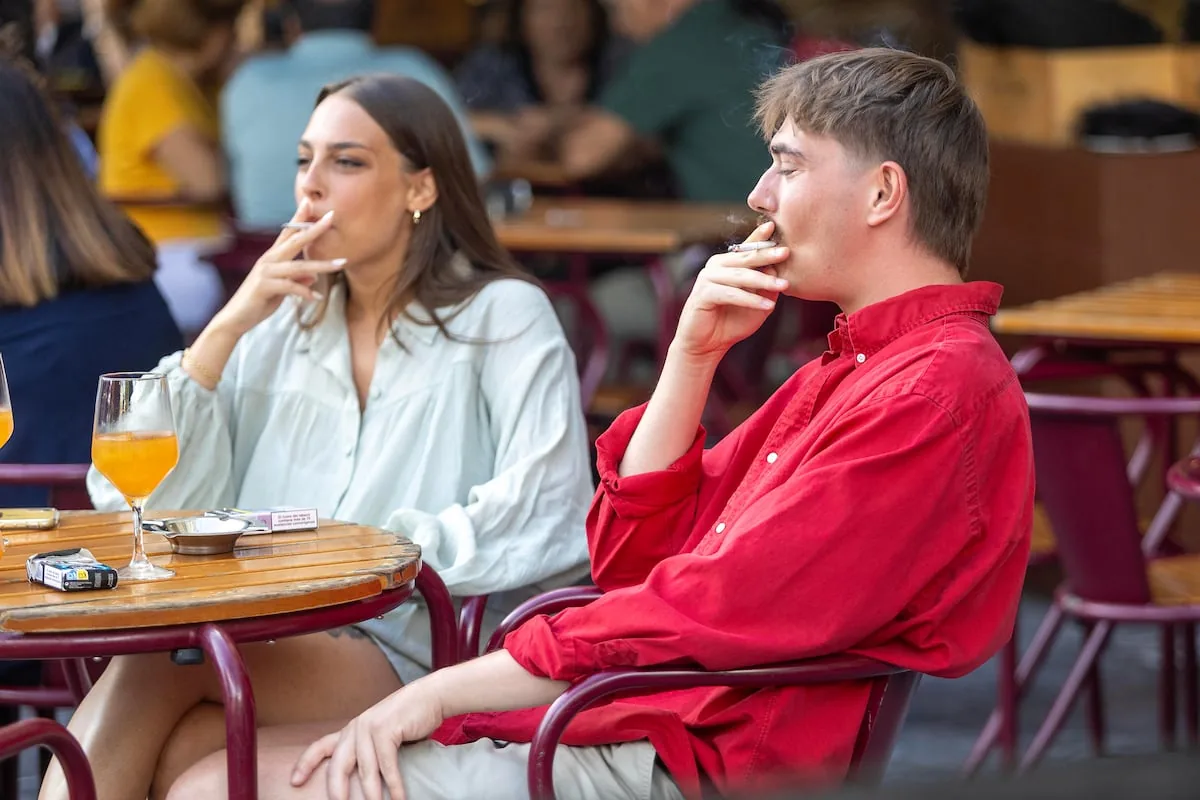
But no one can deny, despite its bad image, that tobacco created an invisible brotherhood among smokers. Detestable in health terms, admirable socially. Perhaps because sharing space, breathing the same air, unites; but breathing the same poison creates a much stronger type of union. I’ve made great ephemeral friendships at the door of a club or bar, with a cigarette hanging from my lips. I’ve lived love stories that lasted as long as it takes for a cigarette to burn out (an elastic measure of time that only former smokers understand). The cigarette keeps a university joy in my memory, like a post-coital pause, a revelry among colleagues and a cheerful digital pastime.
After underlining the phrase in question, I closed the book and started thinking about the possible fraternities with strangers that can arise for someone who has already quit tobacco. About those small gestures of solidarity that occur in a city like Madrid. I was with my young son then and I was able to witness many of them firsthand. Having a child is not only a great reason to quit smoking. It also means learning to trust the kindness of strangers. Dealing with the questions they ask the child, but you have to answer. Accepting unsolicited advice and receiving knowing smiles from strangers who are in the same situation as you.
I am a young man; I have been raised to be the one who gives up his seat, to help helpless elderly women with their shopping, and to ask lost tourists if they need help. I have been raised to be strong, or at least to appear so. That’s why holding a baby in my arms was a strange sensation, as if it repositioned me in another place in the world. Being a father makes you vulnerable in ways I could not have imagined (many of them, in fact, are discussed in Gómez Bárcena’s book). It makes you need the help of strangers. Suddenly, it is you who is offered a seat on the subway, it is you who needs someone to lend a hand to carry the stroller down the stairs. Everyone opens and holds the door for you.
Read more Having children is for the rich
This thing about the subway station entrance doors is something I’ve been noticing for a while. During peak hours, the doors are in a constant flutter, like in a saloon in the Wild West. But as the flow of travelers decreases, there’s that brief impasse where the person ahead of you waits, holds the door for a few moments so it doesn’t hit you in the face. Sometimes they even smile at you. It’s a brief, routine, unimportant gesture. Many people receive it with some indifference, but for me personally, it changes my day, which I already start on the right foot. Because it means discovering, in the midst of tedious routine, a gesture of genuine and selfless kindness, like leaving a tip at a bar you won’t return to or giving a cigarette to a stranger.
Sharing vices unites, but so does sharing miseries like commuting to work during rush hour, in a crowded carriage. Perhaps that’s why I see so many complicities on the subway. In cars, people feel miserably alone, which makes them aggressive and misanthropic. But on the subway, they feel miserable in company, which is a much more bearable misery. That’s why they insult there and here they give way and open the door for you and help you with the stroller. No one on the road will ask about your mother unless it’s to insult her, however, that’s the kind of casual conversation that happens on the streets and public transport.
Smoking and taking the subway to work are two horrible things for very different reasons. But it’s nice to detect flashes of empathy amidst the customary ugliness. Unexpected beauty is what impacts most, like the oleanders planted in the highway median.
Now that smoking is on the verge of extinction, one wonders what will happen to all the smoker’s empathy. Where will the cigarettes we won’t give go? The world has evolved, and we’ve returned to the Moon, sequenced the genome, and defeated the coronavirus, which is now as threatening as a common cold. But we haven’t managed to invent a tobacco that doesn’t kill, a harmless cigarette that doesn’t seriously harm health but maintains the social conventions built around it. Nor have we managed to establish teleworking.