

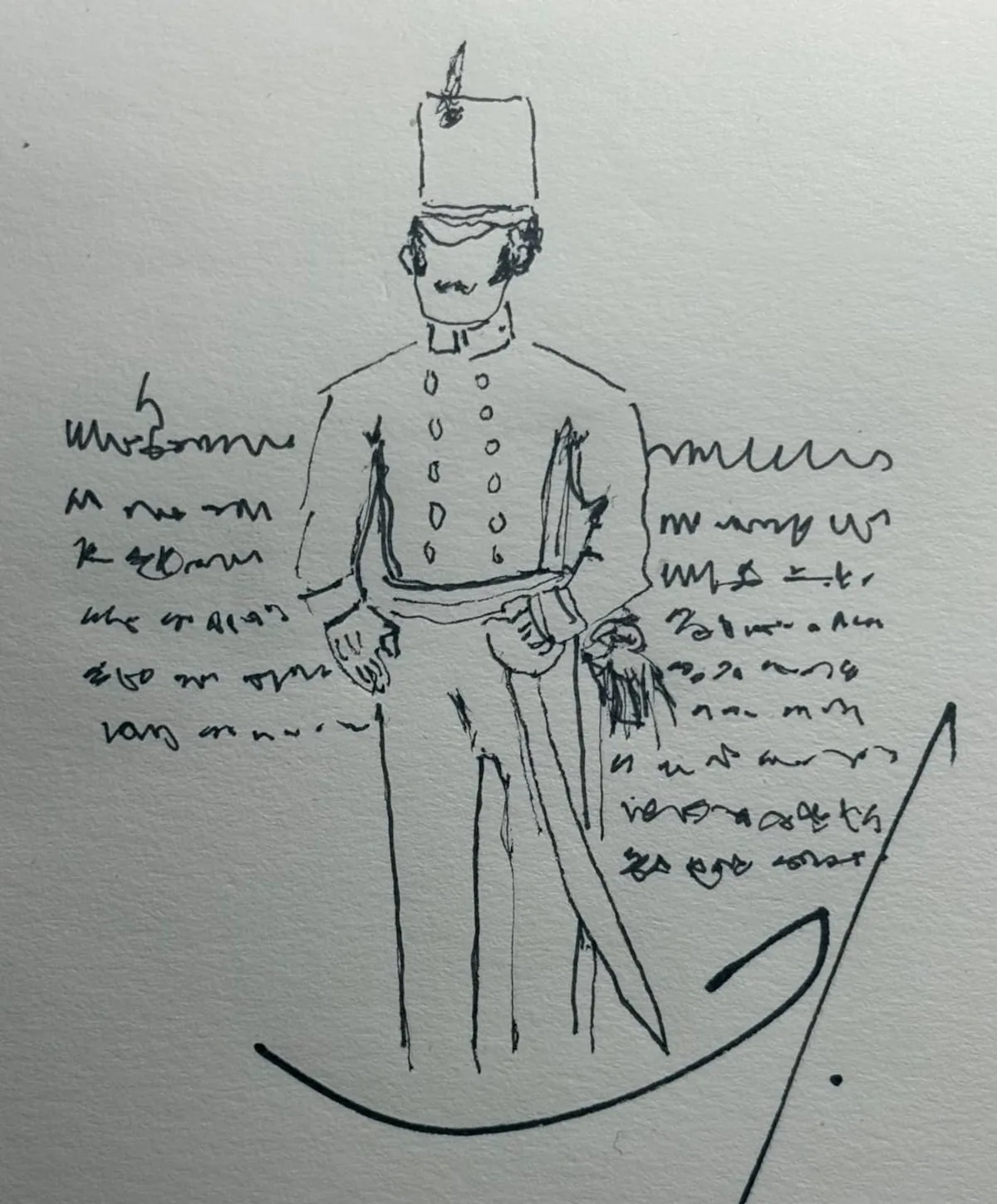
The Radetsky March is a masterpiece crafted in the form of a novel by Joseph Roth in 1932, whose title alludes to the contagious musical piece that has become popular every January 1st when wealthy Austrians applaud in unison as a finale to the traditional New Year’s concert. What concerns us here is to try to spread the magnificent novel by Roth, whose merits and invaluable narrative virtues cannot and do not fit to be written here, but in these grim days when so many empires and worlds of yesterday seem to vanish, I thought of rereading The Radetsky March as a breath of insomnia.
Joseph Roth, wordsmith, wandering Jew, and saintly narrator, crafted on a timeless screen the life of three generations of a family in the Austro-Hungarian Empire, and I do not intend nor could I summarize here the hypnotic mural of his plot, characters, and sharp paragraphs, so I focus on a key scene that appears in the first pages of the monument:
Joseph Trotta is a young infantry lieutenant who is at the front of the Battle of Solferino when he notices that Emperor Franz Joseph has approached with his entourage and aides-de-camp a few meters away. In a reckless move, typical of politicians or newcomers unfamiliar with the heat of battle, the monarch’s aides shield him so he can observe the battle from the stands with his imperial telescope. He is an easy target for enemy rifles, and at the moment a deadly bullet flies toward his royal heart, Trotta throws himself on the Supreme Chief and tackles him, pulling him down by the shoulders and receiving the bullet himself in his left arm.
The monarch visits him in the field infirmary and promises not only to decorate him but also to thank him with money for life for his lucky feat. From that first day, Infantry Lieutenant Joseph Trotta will be known as the “Hero of Solferino,” and his legend grows with time, which cruelly reveals to him a crushing truth about lies: a few years after the moment that made him famous, Trotta discovers that in his young son’s primary school history book there is an utterly fanciful account of his eventful participation in the Solferino incident. The Official History (that crazy one with a capital H) has taken care to distort the memory, and several generations of Austrian children have memorized as truthful and factual a false and unverifiable, implausible tale. School texts claim that Franz Joseph rode a white steed, surrounded by the enemy and valiantly defending himself with his imperial sword (and his sideburns as an extension of his mustache) when young Trotta saved him from a deadly and stealthy bullet fired by an enemy at close range, taking the explosion of that powder with his chest as the Hero of Solferino, violently dismounted from his own horse.
Trotta complains directly to the Emperor in an audience he obtains thanks to his letters of complaint in favor of the Truth (which deserves a capital letter), and Franz Joseph himself tells him that although he recognizes and remembers that the scene was not as the teachers paint it in kindergarten, both do not come out so badly from the capricious judgment of History, and the very Minister of Education and Culture explains to Trotta that the State and politicians have to sweeten, accommodate, and dress up that History with a capital H in favor of their Nation project, anchor of posterity or hinge for the future.
Joseph Trotta remains a thankless hero, renounces official rewards (although he keeps his medal on his chest), and becomes a silent bitter man who quits the military and takes refuge in a quiet country life raising his son and sheep, stubborn in propping up the Truth against the customary, cyclical, and generational cluster of Lies, and with that the great novel by Joseph Roth barely begins, which I applauded at the break of dawn as if hearing the rhythmic heartbeat of the Vienna Symphony unraveling by reading the saga of the Trotta descendants who seem to ride into our days.
Dear ladies who have contributed to the nefarious and useless polarization of the past; distinguished presidents of each who have taken sides and respectable ladies who have released opinions as axioms and so on and so forth:
I allow myself to suggest that in the fascinating attempt to write history, honesty and effort must prevail in reading, which seeks to avoid the subjective and proposes to respect the circumstances of the past as distant and foreign to the broths of the present.
Whoever glorifies one side to denounce another assumes that the mirror of the past is divided into sheets easily made politically useful, socially popular, and generating heated spirits (for or against) regardless of the expiration of time or the verifiable and truthful generational transmission of ideas or facts, but without formalizing the indispensable respect for the facts themselves, the knowledge of circumstances, true contextualization, and books, many more books, papers, papers, and more papers, not to mention silent stones and surnames passed down from generation to generation. Doing otherwise, even if practiced on both sides of the sea, caricatures the inhabitants of the past and reduces the facts to a damn laundry-room gossip.
The soldiers of Solferino are the anonymous inhabitants of the past, the blood mixed over temples and among adversaries who decide to unite their surnames, flavors, and adventures. We are also soldiers of Solferino who must witness a reprehensible exercise of stances taken in favor of miseducation like the bronzed pages they foisted on us in primary school and civic ceremonies or the whims of some unemployed person who from their hammock believes they can correct the historical past as if their grandmother really had a monumental Olmec-type head or like the busybody who believes herself the granddaughter of armor that transatlantic and transpeninsularized when her true ancestry has never left the Gran Vía or like the wink of carrying the Guadalupana on the flight of a burgundy skirt against the grain of the Star of David tattooed on the paternal surname.
My ladies: face or steer your public policies to the respective horror and mess each one has to deal with (with or without a telescope, inside or far from the trenches), but I suggest you avoid continuing in the useless breeding ground of little lies and whims, because with great dignity and in favor of the truths, the true Soldiers of Solferino quickly get bored of your memes, gossip, and back-and-forth, they stay awake night after night to read to travel properly to the past and even be alert to ultimately save your very life… with the weight and constancy of Memory that both seem to distort.
Read more Madness in Barcelona over the sale of a Swatch collection inspired by luxury watches