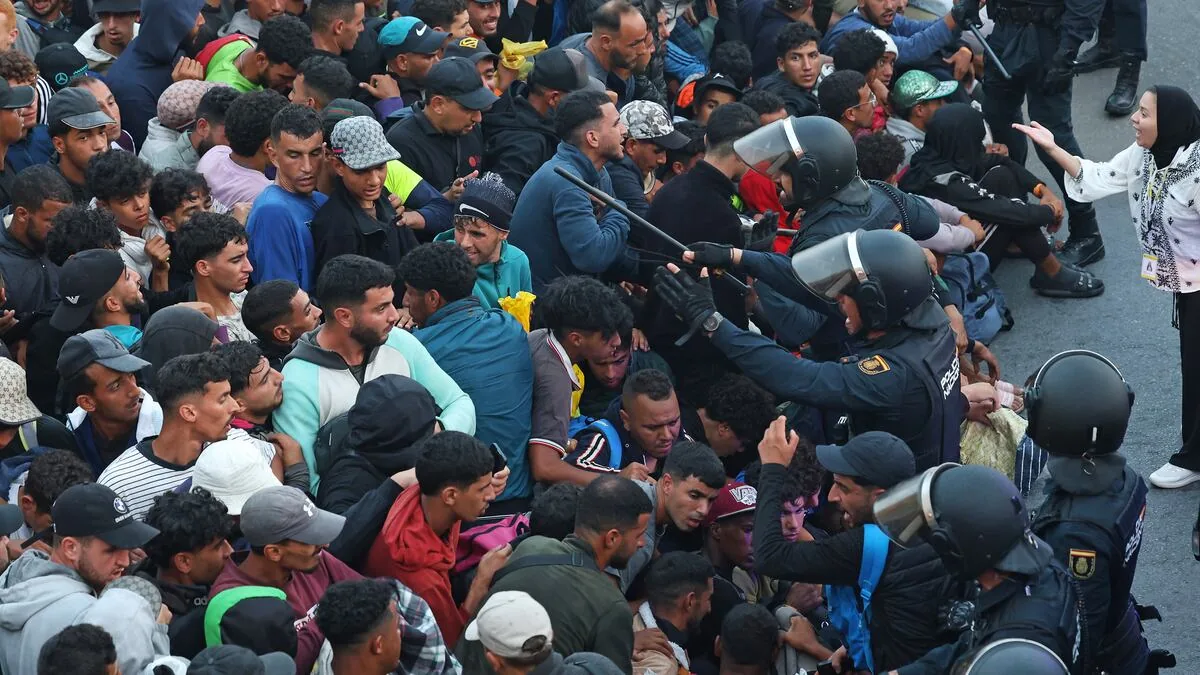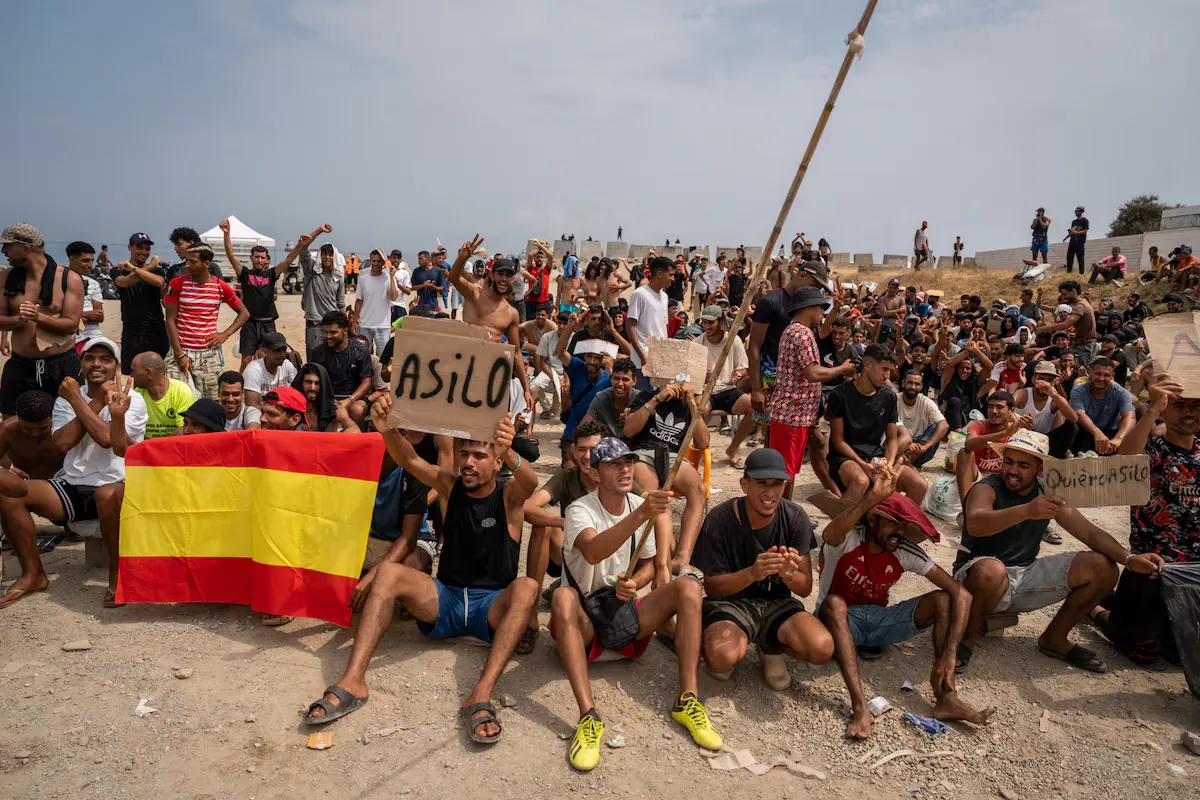
The Spanish Government continues to gather data on the jump of 80,000 migrants to Ceuta and on Morocco’s role in that crisis. And it continues to treat the neighboring country with kid gloves despite the increasingly widespread feeling that Rabat looked the other way at critical moments. Neither La Moncloa nor the concerned ministries foresee a shift in the relationship with Rabat, despite internal criticism — with varying degrees of severity among the opposition, the diplomatic corps, and analysts — and external criticism, mainly European. The Executive does not contemplate a change in strategy, not even a change in tone, especially when there are still thousands of migrants in Ceuta who must return to Morocco and this weekend has been extremely intense at the border. According to sources consulted, Spain will keep intact the keys to relations with the neighboring country, the approach to migration policy, and the general tone of its foreign policy “with its own identity,” despite the setback that Ceuta represents and the angry reaction of the EU in the early stages, which has left a residue of some irritation in several capitals.
Read more Three people die, one of them a minor, in a shooting in Isla Cristina (Huelva)
“The strategy with Morocco is what allowed the rapid exit of more than 70,000 people in a few hours,” explain government sources. And the Executive continues mapping everything that happened in the final days of July, which according to the Government’s account remains unclear: “There is no evidence that Rabat did anything wrong, beyond that for a few hours they let migrants pass to avoid even more deaths; once control was regained, they prevented thousands of entries [as they have done again this weekend], and collaborated in the rapid returns of tens of thousands of people,” add the same sources. A hybrid attack hardly fits with that collaboration, according to the Government’s thesis.
“There is still no conclusive diagnosis, many pieces remain to complete that puzzle. The possible consequences will depend on that diagnosis, but no changes are expected. The goal was and remains maximum collaboration with Morocco,” explains a second source from La Moncloa. Spain cannot afford a rupture in relations with Morocco, an essential partner for several core policies, according to the cited sources: “And Morocco neither with Spain.”
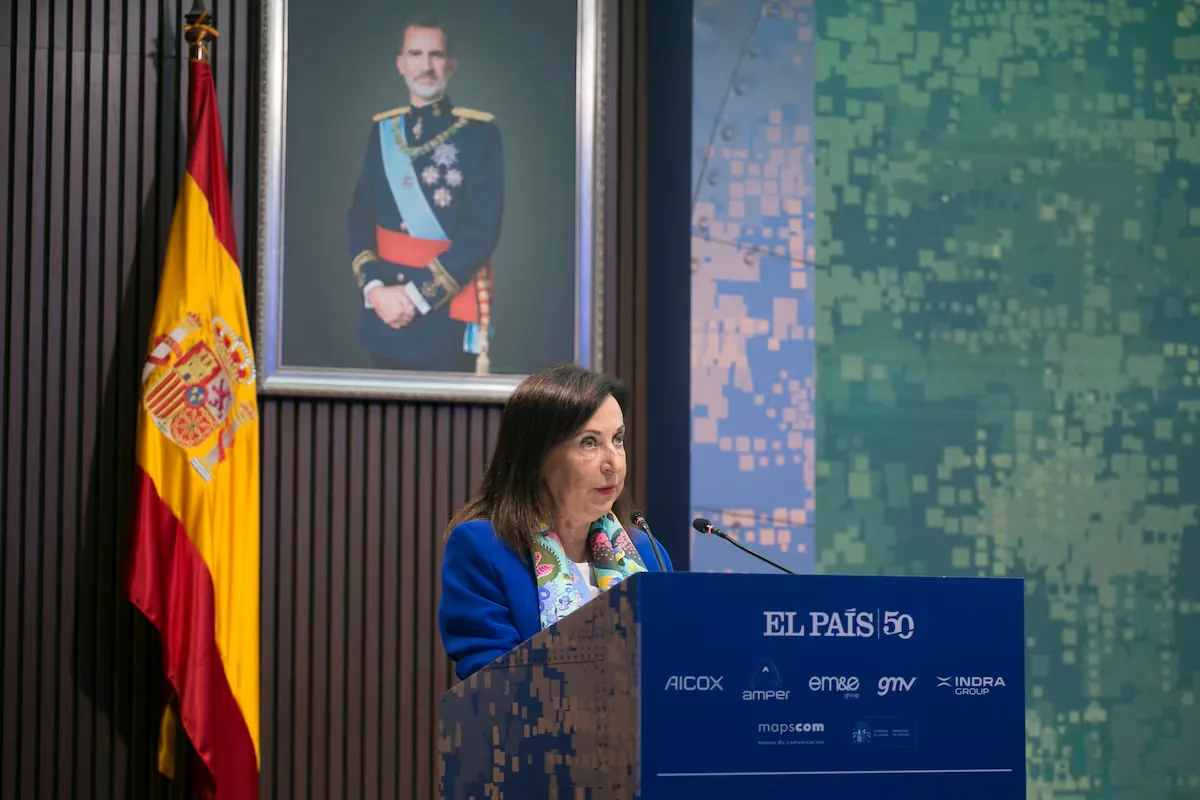
The Executive, in short, closes ranks during ferragosto given the seriousness of that episode. Spain’s Foreign Action Strategy, published in 2025 and valid until 2028, concludes emphatically: “Bilateral relations with Morocco are at their best moment.” Ceuta contradicts that complacent view. The Government has repeatedly emphasized that Morocco’s reaction was “exemplary.” President Pedro Sánchez blamed the mafias, something that can be ruled out, but left a sting in his statements: he spoke of “an attack on Spain’s territorial identity.” Sánchez and the Foreign Minister, José Manuel Albares, and the Interior Minister, Fernando Grande-Marlaska, have repeatedly praised the “cooperation” with Rabat; the Defense Minister, Margarita Robles, openly pointed to Morocco’s responsibility and assured that Ceuta and Melilla “are very Spanish” in response to continuous references to the sovereignty of the two enclaves by some Moroccan minister. The dozen or so diplomats, former ministers, and analysts consulted for this piece call for firmness from the Government, although some dissent and advocate for a relationship based on trust, not baring teeth. The opposition has gone even further: the Spanish PP has glossed over Morocco’s responsibility but harshly attacked the Government in Brussels for its handling of the crisis, something unusual in European institutions.
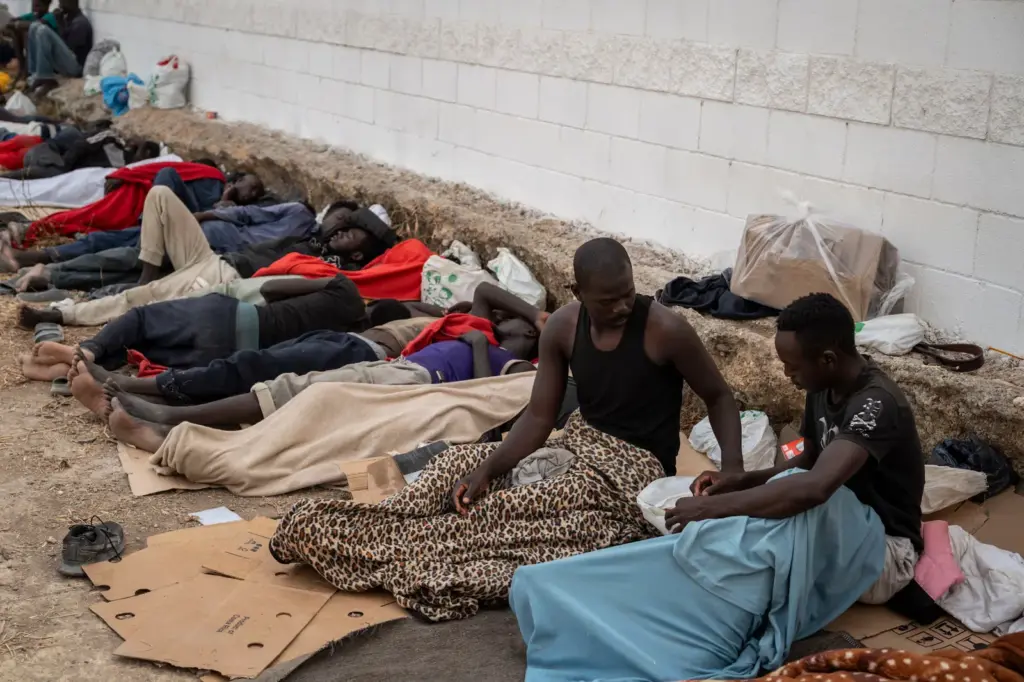
Partly due to those attacks, the fragility of the investiture majority, and President Pedro Sánchez’s prominence on several international agendas, from Gaza to Iran, the Spanish Government has not even found understanding in Europe for a crisis that remains ongoing. There are 2,500 minors, and 2,500 sub-Saharans who are potential asylum seekers, in addition to some additional thousands of Moroccans who are returning in dribs and drabs (between 50 and 100 per day, according to Government data) but who have left formidable stress on Ceuta’s public services. The Government’s framework, in short, is continuity to finish closing the wounds in Ceuta (and with Morocco) and achieve some stability ahead of the elections. Experts, diplomats, and the opposition advocate a less complacent, tougher tone, in line with the geopolitical context, although much of the sources consulted admit that shifts are unlikely until after the next ballot.
Diplomatic toughness. One of the characteristic traits of diplomacy is the use of the so-called wooden language, full of calculated ambiguities, euphemisms, and circumlocutions. With Ceuta, that rhetoric has gone out the window. “I don’t understand so much consideration for a neighbor who was complicit in what happened or incompetent in management,” Jorge Dezcallar explains to this newspaper in his dual role as former ambassador to Morocco and former head of Spanish intelligence services. “Morocco interprets Spain’s continuous gestures in recent years as weakness. Rabat has repeatedly challenged Spain with the 2021 jumps, continuous breaches of agreements such as the closure of customs, and again the Ceuta episode despite the Spanish position change on the Sahara.” “It is essential,” he continues, “in the fight against terrorism, drugs, and to control immigration, but Spain is equally essential for Morocco: energy supply depends on Madrid, the reliability of telecommunications, we are the main trading partner and the top investor. Perejil, in 2002, gave us 20 years of tranquility: if the tone of relations with Morocco does not harden, another crisis will follow the Ceuta crisis,” he adds.
Several former senior Foreign Ministry officials, and even some active ambassadors, also emphasize the need to raise the tone, although unlike Dezcallar under the umbrella of anonymity. “The Government has been trapped in the appeasement strategy with Morocco since 2022. It cannot turn now because that would require a change in the ministerial team and because the priority is the general elections,” argues one source. “The general tone has been too obsequious. Vassalage and submission have gone too far: distances must be marked,” points out another source who had responsibilities in a previous Government. An ambassador adds that all this comes from far back: “The crisis over the medical treatment in Spain of the Polisario leader, Brahim Gali, ended with a change in the ministry that simply sought to pacify relations. That was the goal since 2022: to avoid trouble. But the turn with the Sahara was made without counterparts, and without consensus. Now the priority is to definitively close the crisis in Ceuta, but once it is resolved a firmer tone is essential. Morocco is our neighbor and we want to get along, but it must be made clear that the next step, the sovereignty of Ceuta and Melilla, is an unbreachable red line. It is incredible that with Ceuta the Government has not even been able to call things by their name.” The Foreign Ministry did not comment on this newspaper’s questions.
Read more A fight between two groups in Lleida ends with one person arrested and five slightly injured
But there is no unanimity, far from it, in the diplomatic corps. “The relationship with Morocco has to be one of collaboration, of trust. Not of a hard hand. I find it hard to see that Morocco orchestrated that avalanche. And I think it is a mistake to think that such a complex situation is resolved with firmness, baring teeth: Rabat knows Spain has plenty of cards for deterrence, but they should not be shown morning, noon, and night,” concludes an active ambassador.
Experts: more firmness. “Everything possible must be done to get along with Morocco, but not the impossible,” criticizes Ignacio Molina, from the Elcano Institute, a Spanish think tank. “Spain has not gone as far with the Sahara as Trump and Macron: it still says the territory must be decolonized and that autonomy is the most realistic option, but it is waiting for Rabat’s plans at the UN in autumn. There is not even a need for a change in foreign policy: the Government could continue with the current one, but with a firmer tone. And without denying reality,” adds Molina. Academic Alberto Alemanno states that Sánchez does with Morocco “the same as he criticizes Von der Leyen for with Trump,” with “free” concessions despite Morocco’s continuous setbacks, “to the point of calling Rabat exemplary and loyal after the Morocco crisis.” “The appeasement policy does not work with blackmailers,” he adds. “Sánchez’s problem is not that he pays Rabat to protect his border: all countries do that. The problem is that he has positioned himself as the leader of the left who does not capitulate,” he concludes amid electoral-tinged criticism from several European leaders.
Harsh opposition. Practically the entire opposition has adopted as the framework of the crisis the same one proposed by Morocco and the toughest European partners: Spain is unable to control its border. The PP leader, Alberto Núñez Feijóo, spoke of a sovereignty crisis; his lieutenant Miguel Tellado attributed the jump to the extraordinary regularization of migrants, despite the lack of evidence. Neither of them called Morocco to account. José Manuel García Margallo, Foreign Minister between 2011 and 2016, states that “there has been a lack of strategy” and “building consensus” in foreign policy, although the PP Government also did not achieve this with the PSOE in the past on this agenda. “We must have friendly relations with Morocco. We need them in migration and anti-terrorism and anti-drug policies, but at the same time we are their main client, the top investor, and the gateway to Europe. The appeasement policy is no good: red lines must be set and it must be made clear there will be reprisals if they are crossed.” Morocco, according to García Margallo’s reading, has sensed Spain’s internal political weakness and international weakness. “It is not credible that a country with Morocco’s security forces and intelligence services did not see a movement of 80,000 people coming with social networks on fire,” he argues.
Criticism in Europe and criticism of Europe. In the EU there have been open criticisms of Spain, strangely explicit in relations between member states. From many capitals, even from Brussels itself, a bill has been passed for the recent regularization of hundreds of thousands of migrants. The Interior Commissioner, Austrian Magnus Brunner, did not hesitate to say that this regularization was “a bad signal” for the rest of the member states, although in the same sentence he had to admit that “no direct link is observed between the regularization and the incidents in Ceuta.” Diplomatic sources from the community capital point out that political narratives, with upcoming elections in Sweden and Finland, in Italy and France, in Poland and eastern Germany. The Italian far-right Giorgia Meloni and the Danish social democrat Mette Frederiksen (the two toughest on migration in Europe) led the criticisms, with a letter eventually signed by 22 heads of state and government whose first drafts were much harsher than the final result.
Spain has in turn shown its irritation at the lack of European solidarity, which contrasts with the hybrid attacks of 2021 on the Lithuania and Poland border with Belarus. Then, all countries reacted in unison. Now, however, no one in Europe has pointed to Morocco: the criticisms were for Spain. Partly because Sánchez is outside the migration consensus. Partly because countries closest to Russia and Ukraine see a lack of solidarity in Spain’s refusal to adopt a defense spending of 5% of GDP. And partly because of Spain’s harsh criticisms of Israel, which grate in Germany and several Eastern partners.
Josep Borrell, former head of European and Spanish diplomacy, says Spain’s problem is actually a European problem: “A strictly security policy weakens us.” Borrell has defended Spanish positions with the US, Israel, defense spending, and migration policies. In the case of Ceuta, he emphasizes “the harmful effects of the breakdown of European solidarity in the face of a threat on a common Union border.” And he points out that, regarding Spanish foreign policy with Morocco, “it is difficult to think of a change in strategy”; “later the tone could be reconsidered.”