








Aitor Garmendia, a rider for Banesto in the 90s, used to say that cyclists were from small towns and ugly because that’s how they got the prettiest girls, that city riders are posh, and Tomás Pombo, a youngster not yet 20 years old, is also from a small town, Carballo, which is a museum of murals that beautify the ugly middle sections of horrible blocks and walls, an unexpected beauty, from where the stage starts, but to see him off at the foot of the Movistar bus as he heads to the battle of the Gran Camiño, his first war, he is not farewelled by beautiful women but by his group of friends, young guys with bright eyes like his to whom he tells stories, perhaps exaggerated, and dreams of a champion’s future who still trembles when stepping onto the signing control stage. Loves will come later.
Read more Hungary denounces the destruction of confidential documents of Orbán’s Government
Only the veterans talk about the past, those who look at the sea with melancholic eyes, so many absences, so many battles, those who only promised, those who fulfilled. Those who still triumph, like Adam Yates, pioneering winner at the summit of Cabeza de Meda, a neveiro over the Sil never climbed in any race, and leader of O Gran Camiño who on Saturday will surely add his name to the illustrious list of winners of the Galician race following Alejandro Valverde, Jonas Vingegaard, and Derek Gee.
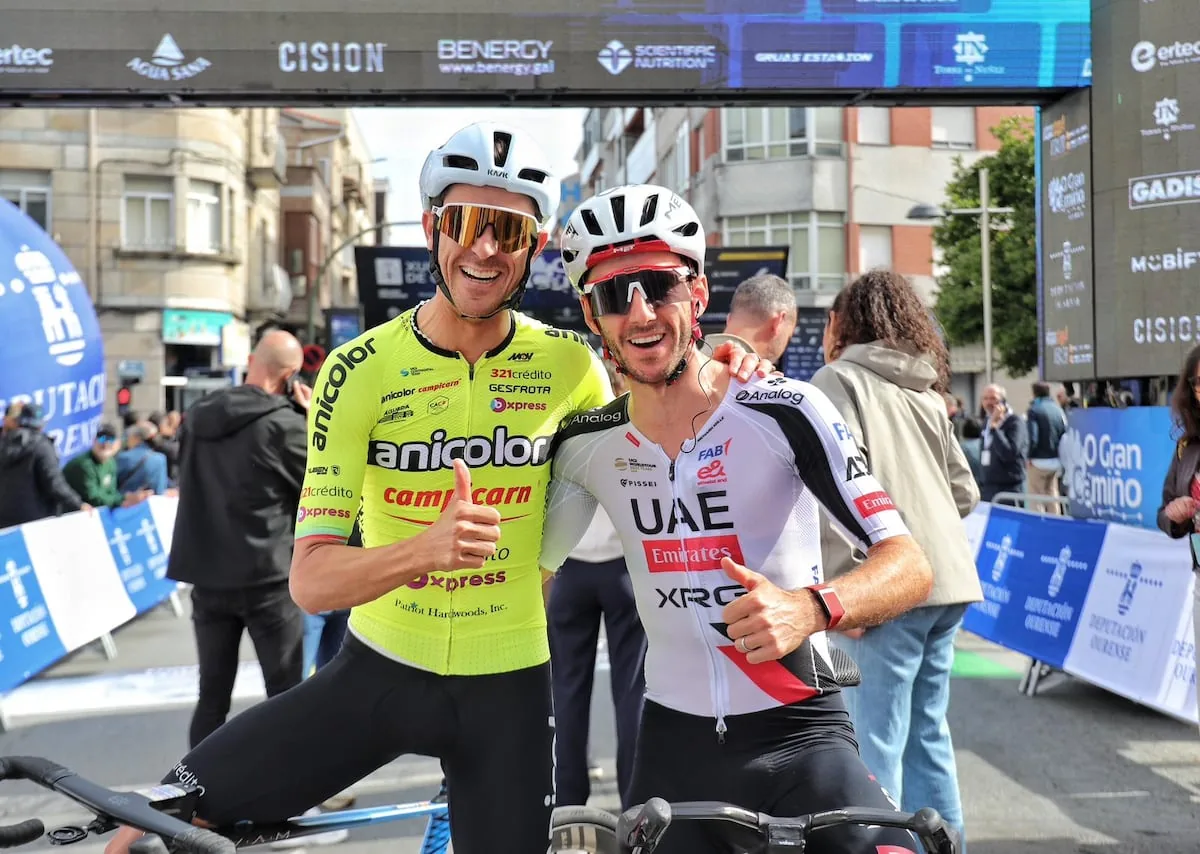
“Ufff, how much Adam Yates made me suffer,” Rubén Fernández wants to forget but can’t, who 13 years ago, at just 22, won the Tour de l’Avenir with a 55s lead over the English rider. “And not only him, also his brother, Simon. What a pair they made.”
The 2013 French under-23 race, an edition in which Caleb Ewan and Julian Alaphilippe also shone, ended up being the biggest victory for the Murcian in a race that still lives on in the Portuguese team Anicolor. And like Fernández, 35 years old, Adam Yates, already 33, is racing this week in Galicia’s O Gran Camiño. He no longer torments Fernández, who is not seeking more wins (he is five minutes down in the general classification) and will no longer have nightmares about him, nor about his twin Simon, who has already hung up his bike. The peloton loses one of the most characteristic images of the last decade with his retirement, the two brothers, even racing for different teams, chatting calmly at the back of the peloton during the easy stages while the rest of the world, stressed out, tears their elbows fighting to keep their position at the front. Then, when the decisive moments came, by mutual agreement, they would move forward and make sure not to lose time, and sometimes even gained it by attacking together, like the first stage of the 2023 Tour, past Viveiro in Bilbao. First and maillot jaune, Adam, the younger of the two by a few minutes; second, Simon, and further back Pogacar.
“Who do I talk to now in the peloton? Hahahaha,” Yates and the other riders at the race press conference laugh when asked if he misses the brotherly talks about the bike. “But I still talk to my brother every day, we are very close. He’s enjoying life, doing things he never could while competing. Obviously, he doesn’t ride as much anymore, but every time I come home to Andorra we go for a ride to have a coffee when I have a day off. It’s a new way of life for him, but he’s enjoying every second.”
Read more A ‘coliving’ in Madrid for military personnel
Adam Yates —32 victories, nine of them overall wins in one-week races, like Switzerland, Romandie, Volta, Germany, UAE, Oman…, and also the Klasika de San Sebastián— is the main figure of O Gran Camiño, and he has taken his participation seriously, even though the race invented and organized by Ezequiel Mosquera is not the highest level on the world calendar. “My big goal this year is the Giro d’Italia,” explains Yates, leader of UAE, who, despite not being a time trial specialist, finished sixth at the Tower of Hercules on Tuesday, and only the power of Iván Romeo on his terrain unsettled him on Thursday arriving in Padrón. “The truth is there aren’t many stage races in this period that resemble what you do in the Dauphiné and Switzerland before the Tour. So, back in December, when we closed the calendar, this was the perfect race to prepare for the Giro. And here we are.”
The Englishman from Andorra is more combative than Rubén Fernández and 90% of the O Gran Camiño peloton, leaving all behind, very thin ankles, slender calves, veins standing out under the skin, very little fat, accelerating on the Xunqueira wall, prehistoric asphalt at 22% just after leaving behind the Romanesque stones of one of the Cistercian monasteries, Santa María, which trace the line of the Ribeira Sacra over the deep canyon of the mighty Sil. Only the young Jorgen Nordhagen, from the Seixas generation, stubbornly tries to keep up but succumbs. When, 46s later, he crosses the finish line, head sunk between his shoulders, the old Yates approaches the Norwegian, 13 years younger, and consoles him, “you’re so good, the future is yours.” Sentence pronounced, Yates easily opens the sparkling albariño, showers the crowd and wets more than his lips raising the bottle. “It may not seem like it because it’s a minor race, but I race with a lot of pressure,” says the UAE leader. “Not so much from the team but from the fans, who took for granted that I would win today.”
Once the Galician race is over on Saturday, Yates will focus on Sierra Nevada with João Almeida, with whom he will share the UAE leadership in their expected fight for the maglia rosa of the Giro against Jonas Vingegaard, the Visma leader who has already won the Tour (twice) and the Vuelta. “Yes, well, it’s hard to win any race and not just because of Vingegaard. But I think, yes, we will win. We have a strong team and João will surely be in good shape. He always is.”
Adam Yates says his brother quit because he was more bored than having fun, but that he still enjoys himself, that he’s not at all jealous of Simon. “I’m younger than him, friend. I can go on for another 5 or 6 years,” he replies when asked why he doesn’t retire now and go have beers in Andorra. “How many years do you want me to keep going?”