






The parliamentary group supporting the British Government rejected late on Tuesday the Conservative opposition’s motion seeking to open an investigation into Keir Starmer in the Parliament’s Privileges Committee as a result of the scandal surrounding former minister Mandelson and his appointment as ambassador to Washington.
Starmer has been in politics for a short time, but long enough to understand that power is exercised without scruples. The prime minister has left Labour MPs no room for doubt or qualms. He ordered that parliamentary discipline (three line whip, or triple whip, in British jargon, which entails severe penalties for disobedience) be enforced with all consequences ahead of the crucial vote this Tuesday in the House of Commons.
The result of the vote (335 noes and 223 ayes), however, makes it clear that a significant number of Labour members were not comfortable with the situation. The parliamentary group has 403 members, meaning a good number of them ignored the Government’s directive to vote in favour of the motion, abstain, or simply not show up.
Starmer chose not to attend the House, to convey the message that he did not attach importance to a debate he had described as a political manoeuvre by the opposition, but he gave precise instructions to his group to ensure that no rebellious loose end remained and gave the Government a scare.
Downing Street’s confusing explanations to justify the appointment of the controversial former Labour minister as ambassador to Washington, after his relationship with billionaire paedophile Jeffrey Epstein became known, and especially the news that the Government’s internal security services had advised against the decision, have put Starmer on the ropes.
The Conservatives, who are not going to let go of such a juicy issue ten days before local elections in England and devolved elections in Scotland and Wales, successfully requested the speaker (president) of the House of Commons, Lindsay Hoyle, to open a slot in the agenda to debate that motion. They accuse Starmer of having misled Parliament in his account of how the decision to appoint Mandelson to the post was made. And Hoyle, to the Prime Minister’s surprise, agreed.
Read more Trump and King Charles resort to pomp to put the bilateral relationship back on track
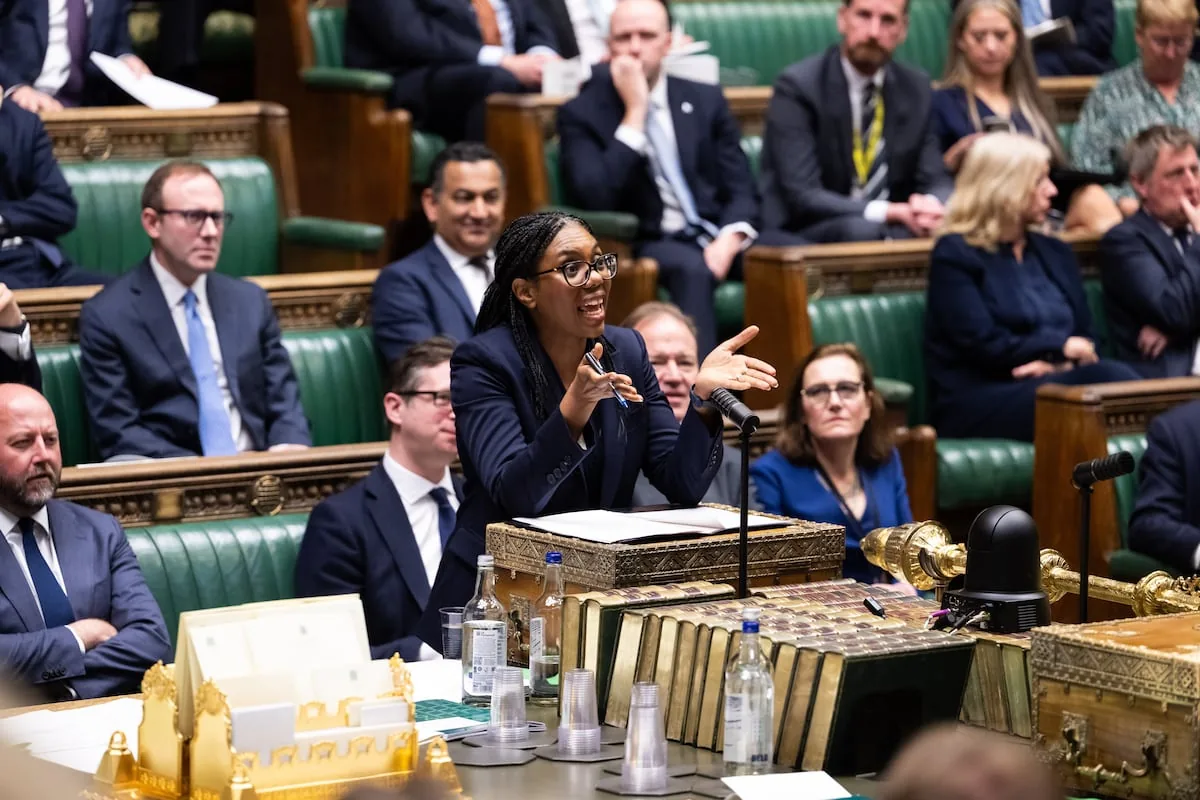
“It was very obvious from the outset that what the Prime Minister said at the dispatch box was not correct. Due process was not followed [in Mandelson’s appointment]. If Labour MPs allow their parliamentary group’s leadership to force them to block the consequences of that deception, they will not only be degrading themselves, but also this House,” challenged Conservative leader Kemi Badenoch in her speech to the opposing benches. The same tactic Starmer once used, when he was leading the opposition, to push for an investigation into Boris Johnson and his forbidden parties during the pandemic. “Why are they acting like sheep?” Badenoch rhetorically asked.
Not all of them have. Several MPs on the far-left wing of the Labour Party, who have already declared war on Starmer, used the debate to attack the party leader. “The way the Government has managed this vote today once again demonstrates how disconnected it is from the public’s sentiment,” said Labour’s Emma Lewell. “The fact that parliamentary discipline is being imposed on us is a wrong decision. And it conveys the terrible idea that we have something to hide and that all my decent colleagues are being accused of covering something up,” she protested.
Most Labour MPs, however, no matter how irritated they are with the way Starmer has handled the Mandelson affair, have bought the Government’s argument that the motion itself was a trap by opposition parties to keep inflating the issue.
“Let’s be absolutely clear that today’s motion is purely politically motivated. It is presented by the Conservative Party, backed by other opposition parties [the Liberal Democrats and the Scottish SNP]. It is not a neutral motion. That is why we have made the collective decision to reject it,” explained Lucy Powell, Labour’s deputy leader.
Starmer has once again saved an extremely delicate situation, but everything suggests that his victory may be somewhat Pyrrhic. Opposition parties will, in the coming days, have the beneficial argument of accusing the Government of having prevented an exercise in parliamentary transparency, at a time when polls are already predicting a significant debacle for the Labour Party in the May 7 elections.