





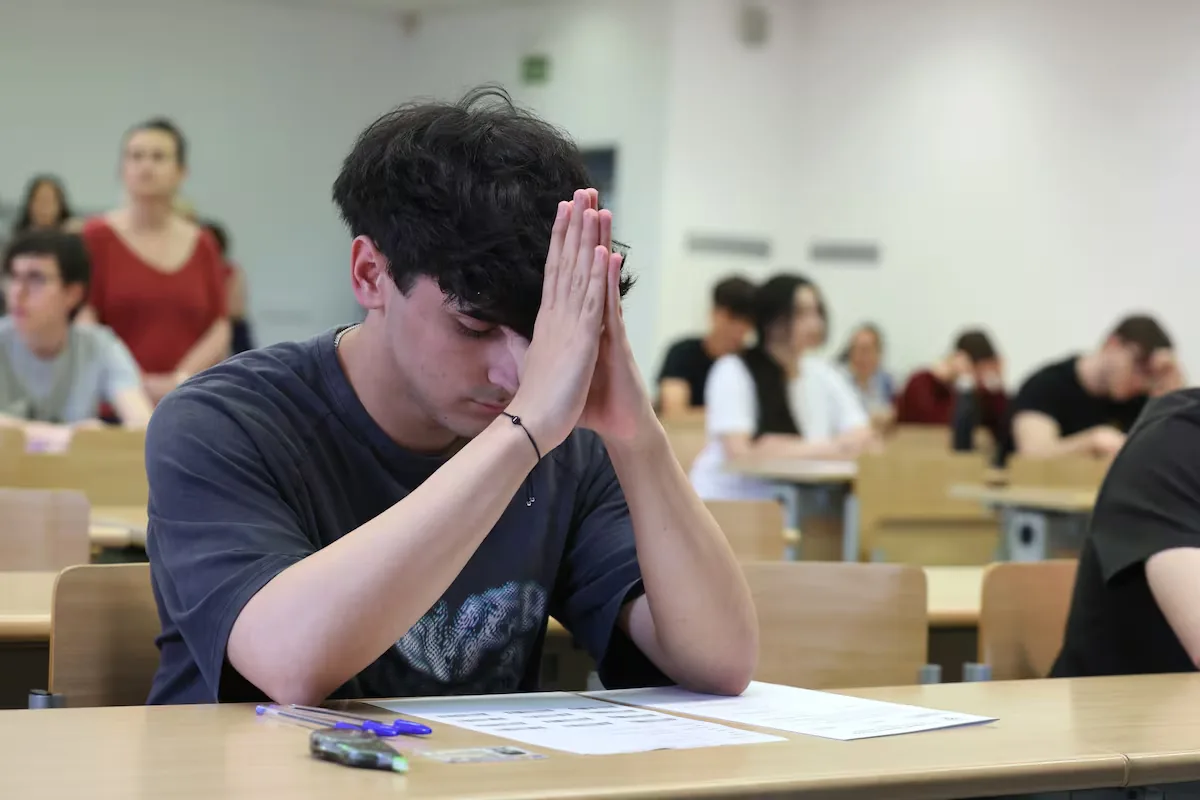
About 300,000 students are taking the University Entrance Exam (PAU) starting this Monday. The first autonomous community will be Madrid, followed on Tuesday by almost all the others. The grade inflation of recent years has raised the cutoff score for almost a third of the degrees above 10 (out of 14), while barely one in four can get in with a barely passing grade. EL PAÍS has asked eight teachers who are or have been Selectivity graders — most at least half a dozen times — for advice on what to do and what to avoid when sitting in front of the exam, and these are their answers.
Read more Hell on the land of Afghan women: from the ban on studying to the legal rape of girls
Start with the easy parts
Mercedes Pascual, an English teacher for 30 years in Galicia, recommends that students start with the questions that seem easiest to them. “And once they get going, they should tackle the others, taking more time to think about and answer them.” Ismael Murria, a teacher at a school in Sagunt (Valencia), suggests something similar adapted to the exam of his subject, Spanish Language and Literature, one of the four (five in territories with a co-official language) that all students must take compulsorily. “My first advice is that when they open the exam, they completely skip the text commentary, skip the grammar questions, and go answer the literature section. It’s like a mini-exam within the exam. And, in an exercise that is not very memorization-based, it is the section that is most so. One of the questions will always be something like: ‘State the characteristics and evolution of the Generation of ’27.’ It’s a way to start calmly, begin writing relaxedly, and once they have written down what they need to, boom, move on to the text.”
Don’t be overwhelmed by the competency-based approach
One of the changes the PAU has undergone in recent years has been the introduction of more competency-based questions, which, instead of asking students to solve, for example, dry operations or very brief problems, place them in realistic contexts, says Virginia Tomé, who has been teaching Physics and Chemistry in the Basque Country for 23 years. “They usually get scared seeing such long statements, and I would tell them to try to see which topic the problem is associated with, and think that the important thing, in the end, will be four data points. They should try to abstract themselves from all that additional information that places them in a company, on a planet, or wherever, and treat it like just another class exercise.”
Underline the verbs
A way to avoid careless mistakes, notes David Núñez, a Mathematics teacher at the public institute in Cantalejo, Segovia, is to use a highlighter: “My advice is to highlight the verbs in the problem statements in fluorescent color, so they realize exactly what is being asked of them. And to highlight the units in which the problem is posed, to quickly see if they are meters or decimeters, 12,000 or 1,200. These are obvious things, but on that day they might stop being so.”
Know how to manage time
One of the secrets of the PAU is knowing how to manage time, points out Mónica López, head of the English department at the public institute in Reinosa: “The exams last 90 minutes and they should make the most of them, not be in a hurry to finish. In English, they have to choose between two texts, and some do the first one they see or decide based on the headline, and the best thing is to spend five or seven minutes calmly reading both before deciding which one suits them best, because they have time.” On the other hand, Nuria Galicia, Philosophy teacher in Valladolid, advises that if a student sees they are taking too long on an answer and time is running out, be practical: “They should close it with a few summary sentences, even if they haven’t said everything they wanted. An incomplete answer on the last question penalizes more than a somewhat schematic one on the previous ones.”
Is it good to leave questions blank?
Most graders, like David Núñez, from Mathematics, advise “trying not to leave anything blank so the evaluator can score all the questions, and if they see they don’t have time to calculate it, at least say how they would have done it, indicating the procedure in writing.” The exception is Ismael Murria, from Spanish Language. “In our exercise, students can lose up to two points for spelling. 0.1 for accents and 0.2 for the rest. And there are students who make many mistakes, for example, with accentuation, and during the course they systematically lose those two points in exams. So they have to be aware of that: if they are not at all sure about a question, it might be more profitable not to answer it than to risk doing it and losing points.”
Better with a draft or outline
In exercises that require creating texts, it is highly recommended, several teachers agree, to rely on some kind of draft. “It can be a mental outline or sketched on the material they are given in the test, but it is important to think about how you are going to organize your exposition,” says Juan Pedro Serrano, History teacher in Zaragoza, who has been teaching since 1990.
Watch out for cross-outs
Juan Antonio Reyes, president of the Andalusian Association of Mathematics Education, emphasizes the importance of form. “They should take care of their handwriting and not make too many cross-outs. Teachers sometimes grade more than 150 exams. And when we find one very messy, with very small handwriting and numbers, with lines that sometimes look like an electrocardiogram… it makes it very difficult for us, and that, indeed, can affect the grade.”
Read more Florentino Pérez: “No one can doubt me. I don’t need the money”
Use the appropriate register
It is important, notes Juan Pedro Serrano, Spanish History grader, “that students use language appropriate to the subject and the historical periods they are talking about, and therefore not be too contemporary.” “They should use,” adds Nuria Galicia (Philosophy), “a vocabulary they know and can handle, and avoid colloquial expressions and abbreviations; the test also values expressive maturity and communicative competence.”
“Special” words
Related to the above, Mercedes Pascual gives advice for the English exam essay question that can be useful for other subjects: “They should learn some special vocabulary to stand out.” It is common, adds her colleague Mónica López, “for students to repeat the same adjectives many times, and the broader their vocabulary, the better; the use of verbs with prepositions, phrasal verbs, gives a higher level to an English test.”
Before finishing
Spending a few minutes reviewing before handing in the exam can avoid disappointments more often than it might seem. “They should spend them checking that they have answered all the optional questions and correcting spelling mistakes,” says Nuria Galicia, Philosophy teacher, “and make sure they haven’t written their name on any of the exam sheets, because the exercises must be graded anonymously.”
PAU data
When. The University Entrance Exams (PAU), which more than 300,000 students will take, start tomorrow in the Community of Madrid with the Spanish Language and Literature exam, and will end on the afternoon of June 11 in Catalonia, with optional subjects such as Chemistry and Art History. In 15 of the 17 autonomous communities, the PAU will have concluded by next Friday, in Castilla-La Mancha it will be the following week, and in Catalonia, the week after.
Exercises. The PAU has four compulsory exams throughout Spain: Spanish Language and Literature; History of Spain or History of Philosophy (to choose); Foreign language (usually English); the modality subject of each type of Baccalaureate (such as Mathematics or Latin), plus a fifth exam of the co-official language in the autonomous communities that have one. In the optional phase, students can take four more exams. The two highest scores are considered and they can never harm the student.
Grade calculation. The PAU grade, up to a maximum of 10 points, is obtained by combining the average grade of the Baccalaureate transcript (excluding Religion), which weighs 60%, and the scores of the compulsory exams, which account for the remaining 40%. Up to four points can be added with the optional exams.
Results. Almost all the autonomous communities plan to publish the scores between June 10 and 12. La Rioja will do so on the 16th, and Catalonia on the 23rd.