




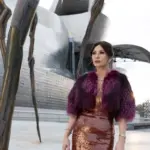

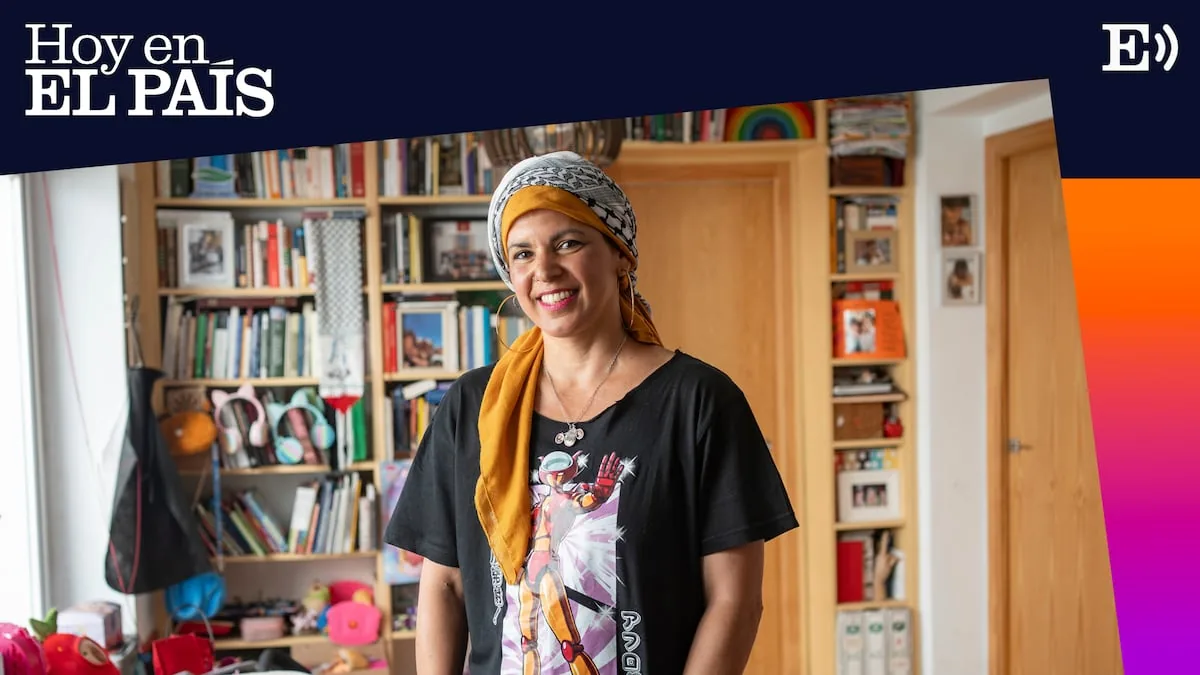
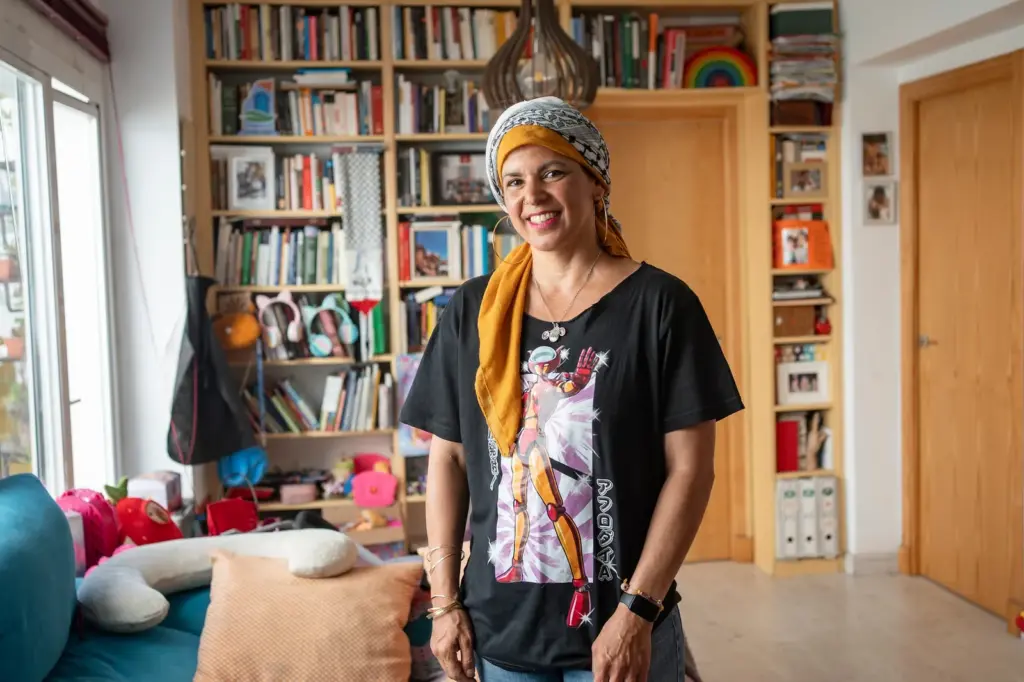
If you want to know what someone is like, take a look at their library. In the living room of the barely 60-square-meter house that Teresa Rodríguez (Rota, 44 years old) shares with José María González, Kichi, and their children in the heart of the La Viña neighborhood of Cádiz, a wall-to-wall bookshelf draws an approximation: her little Andalusianism or Carnival shares space with two Palestinian scarves. There, in her territory, the founder of Adelante Andalucía, a member of the party’s leadership, breaks her silence after a campaign in which she could not support her party because she was recovering from breast cancer, as she herself revealed on election Sunday.
Question. From two parliamentarians to eight, coming from a desert crossing including the loss of the Cádiz mayoralty. Beyond the epic, what do you think has worked?
Answer. It’s ant work. Let’s get rid of the idea that we, the 15M generation, have that communicative boldness does everything. It’s not true. We have a lot of grassroots assemblies that have been built little by little. Militants who already came from activism: in school, at work, in the neighborhood, and who have started to build political Andalusianism in this land. That daily work of convincing your comrades that you have to strike or mobilize isn’t very epic. Otherwise, we wouldn’t have gotten this far, not even close.
Q. Still, on election night you said the party did better without you, why do you think that?
A. Because without me, we sent two messages. One, that we fulfill commitments and are coherent people, which I think is one of the most missed values in politics and one of the great values of my organization, of which I am very proud. And the second is that, by disappearing from the public sphere, another profile could finally appear that ends the old phobia I might have carried, all the hate that had accumulated. It also allowed us to break with the ‘those are the ones who fought in Podemos, who broke and formed a faction, then joined with someone else and fought with someone else.’ We cut that off and started a path of kindness, inner peace, respect for difference, and healthy internal party democracy management.
Q. You didn’t participate in the campaign because you were undergoing chemotherapy for cancer. This was something you hadn’t made public until last Sunday, after someone made a blunder and confronted you on social media. Was it an impulse to have to say it like that?
A. It was an impulse. They put it on a silver platter for me and I also felt calmer because the campaign was over. I didn’t want to be the protagonist of Adelante’s campaign for all I said before and because it seems a bit ugly to use a personal illness. It was too easy and too ugly. And that hid the thousands of women who suffered the screening crisis, because we always tend to try to focus on one person a problem that is structural and social, which is the privatization of healthcare in Andalusia and the cuts. If we keep breaking the cancer control chain, it will keep happening from the system.
Q. The diagnosis and treatment coincided with that Andalusian screening crisis, has it allowed you to empathize much more with the suffering of those women?
A. For me, the worst moment was when I still didn’t know if I had it or not. Once you get the diagnosis and start treatment, if things go well, as in the breast cancer I’m fighting, which has a very good prognosis, you get a calmness trusting professionals you know are the best because they are yours and because I trust the public system a lot. But that wait for the missing test diagnosis, the CT scan that doesn’t arrive, the MRI, the waiting list, and the ‘we’ll call you’… These moments are absolutely distressing. It was very disconcerting for me that, since I live in downtown Cádiz, I had to go to San Rafael, a private hospital. Why do I have to go there if I don’t want to go to a private center?
By the way, about what Vox says about national priority and foreigners taking over our services, throughout this process, in chemo, in the queues asking ‘where is my MRI or CT scan?’, I haven’t seen a single foreigner. I’ve seen one as a doctor in the private hospital, probably because they pay him much less. That’s where they are, providing service, not taking advantage of our public service.
Q. About that impertinence someone said to you for X, we are seeing a wave of hate, especially on social media. However, you have run a positive, friendly campaign, and it went very well. Do politicians foster hate and society reproduces it, or is it the other way around?
A. During the 15M period, I thought all the world’s evils came from the political caste. But, in reality, there are basic things in human beings, like selfishness, greed, and arrogance, which multiply by 10 in politics. Also, in the entertainment field, the media, and places of public visibility, but they are inside all of us. Fighting it is a daily job. Everywhere there are power structures where people are envious and try to hate others. In politics, it’s more visible and from there you can fight, try to fight for a kinder, more loving, and tender society. I appeal to tenderness. I lost it in the European Parliament, in Podemos’ internal fights, in the fight with Susana Díaz in the Andalusian Parliament. Tenderness is like a battery that runs out and you have to recharge it to recover the original idea that leads a person to commit to the community, care, love, try to respect, try to generate empathy. That is harder to achieve in politics because it is more testosterone-driven and combative. Oxytocin is secreted little in parliaments and parties, but I think we have been able to bring it to the electoral campaign. José Ignacio has been able to project that tender and normal thing of people who don’t want to cause problems for others but try to help solve them.
Read more False memories: why memory reconstructs our past
Q. There is a lot of talk about the Rufián way. How do you see that proposal?
A. I have to praise the intention. It’s good and comes a bit from the fear that the far right will enter the government. But now is not the time. For once we stick our neck out, is it time to put the Andalusian flag away in the drawer after waiting so long to bring it out? The demands made by Andalusianism, like those made by feminism, are good for society as a whole because we are not going to defend right-wing policies for the rich. We will defend labor rights, public service, progressive taxation. Sánchez is governing because he reached a pact with Sumar, but who gave him the votes he needed for investiture? The community of historical nations with their parties.
Q. One of Adelante’s strongholds in the Andalusian elections has been urban neighborhoods hit hard by a severe housing shortage, what solution do you think the party should propose for this?
A. Intervention, plain and simple, by right, with sleeves rolled up, heavy machinery, and everything necessary. Housing is a right and as long as it is a commodity, it will never be accessible to working people. The housing market must be intervened and stop considering it a commodity, traded like other things, but not with people’s roofs. That means expropriating the homes of large holders, starting with financial entities. And now Juanma Moreno says we want to take the beach house. No, what we want to touch are the millions of empty homes owned by large housing holders, the tourist apartments. In Andalusia, apartments are bought in bulk for tourist rentals. This is happening here, in my neighborhood, leaving absolutely no income, just the girl who goes with the bedding cart who earns peanuts.
Q. It’s been decades since there was an Andalusianist party in Congress, what would Adelante Andalucía demand for this land?
A. The list would be quite long. Certainly, equal treatment in terms of financial policy, because here everyone blames the financing system. Also in infrastructure. The 12 largest cities in this country without a train are in Andalusia. The rest of the policies we would defend are good for the entire working class of the state: raising the minimum wage, ending precariousness by right, guaranteeing the right to housing, sufficiently funding public services, making a progressive tax reform by right. This benefits Andalusia, but also benefits the worker in Madrid, Valladolid, and Cuenca. Other lefts from the territories have done this too, not only defended Catalonia. Because an Andalusian PP deputy, or PSOE in few cases, has done it because they are the transmission belt of their party, not their territory.
Q. Ignacio García still refers to you as “the leader,” how do you handle this role?
A. That filthy lie of his, because he likes to call me ‘the boss.’ The organs I have retired from to heal are in charge. Fortunately, I am no longer the leader, nor am I the reference.
Q. On election night they asked if you would be a candidate for Congress for Adelante. You said no, but José Ignacio García replied, ‘we’ll see,’ has he asked you?
A. He hasn’t asked me.
Q. And would you accept?
A. No, no. My time has passed. I was there for eight years. Look how well we’ve done now. We go forward with what we have, which is young, super-prepared people; you’ll see what we’re going to send to the [Andalusian] Parliament. They will be lively and do cool work because they are fresh, just arrived, and will be eager to present initiatives. They will be called on the phone to say: “Hey, bring me this, bring me that,” and they won’t go. Blessed glory for the replacements and new airs.
Q. And what will your place be, then?
A. My place is my neighborhood, my family, my school, the teachers’ union. The fight to avoid the touristification of my city. The eviction of my neighbor somewhere or the association. If that work isn’t really done, the rest is useless. We have been in a position to reach power and not be able to change things because we haven’t built awareness from below.
How to listen to Today on EL PAÍS?
- You can listen every morning on the EL PAÍS website:
Today on EL PAÍS
- On your favorite podcast platform:
Spotify | Apple Podcasts | YouTube | iVoox |Podimo
- You can also ask your smart speaker:
Alexa
If you have complaints, questions, or suggestions, write to defensora@elpais.es or send an audio to +34 649362138 (does not answer calls).