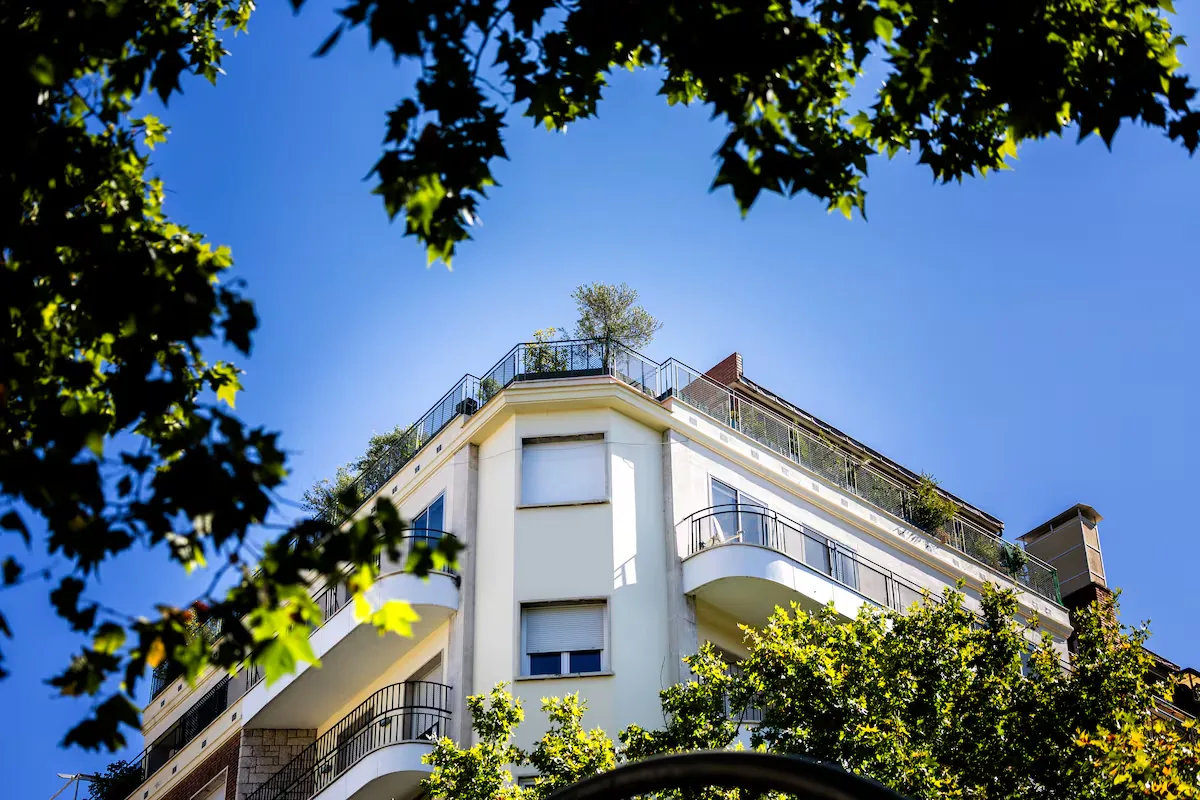
The 485-square-meter penthouse that the Government of Isabel Díaz Ayuso (PP) bought three months ago through the public company Planifica Madrid to use as “offices” cost 6.3 million euros, according to two sources close to the operation confirmed to EL PAÍS. The apartment, located at number 35 on General Martínez Campos promenade and which the Community of Madrid announced it would sell a day and a half after this newspaper revealed last week the strange purchase, was sold by an exclusive luxury real estate agency in La Moraleja that took a 3% commission: 189,000 euros charged to the seller.
Read more Sentenced to three years in prison the mayor of Guayaquil in the first of three trials he faces
The public company Planifica Madrid, which depends on the Presidency department, acquired the penthouse with a 200-square-meter terrace on April 14 and the operation is not recorded either on the transparency portal or in the company’s annual accounts. There is also no justificatory report or budget increase available for consultation, as . In fact, the final sale price had not been disclosed and whenever Ayuso has been asked about it, she has avoided the question.
Promora, the luxury real estate agency that intermediated the sale and is based in La Moraleja, published an ad with the penthouse at the end of January and the sale price was 6.6 million. Finally, the apartment cost 300,000 euros less. This company is dedicated to the luxury apartment and house market throughout the region and had to sign a confidentiality agreement and was asked for “privacy” and discretion throughout the operation.
The decision to channel the purchase through Planifica Madrid also increased the cost of the operation. To the 6.3 million that the penthouse cost, another 378,000 euros must be added as Property Transfer Tax (ITP), a tax ceded to the autonomous communities.
This last disbursement derives from the fact that the purchase was not made directly by the Community of Madrid, but by a public capital company. The legislation recognizes certain tax exemptions for the regional administration, although those exemptions do not automatically apply to public commercial companies that generally pay taxes like any other company, unless specific legal provisions apply. Since the tax is paid to the Community, at the accounting level the tax is paid, but in budgetary terms that money returns to the regional coffers.

Asked why the purchase was made through Planifica Madrid, a spokesperson responds that the public company “has the purpose of managing the real estate assets of the Community of Madrid” and that “it is within its asset management competencies.”
Read more Leagues Cup 2026: schedule, times and where to watch the first phase matches
In the ad published on Promora’s social networks, the penthouse is described as an apartment of “absolute luxury,” with five bedrooms, six bathrooms, and panoramic views of the Madrid skyline. It also includes AI-generated renderings of how the house would look if it were to be used as a residence: a design of the master bedroom, the living room with access to the terrace, and a hypothetical office. “Contemporary design, home automation, two parking spaces, and two storage rooms. Privacy, spaciousness, and a way to live Madrid from the highest point.”
There are still several unknowns about the purchase that neither the regional president nor the Presidency minister, Miguel Ángel García Martín, who also chairs the board of directors of Planifica Madrid, have resolved. “All operations carried out by this company and any other will also be in their activity reports. We do account, we are transparent,” said Martín during a visit to the area devastated by the fires last week. And he was the one who announced, a day and a half after this newspaper uncovered the apartment acquisition, that they would sell it along with four other properties on Gran Vía to help the “reconstruction” of the Sierra Oeste of Madrid, which was devastated by the fire. In total, they expect to obtain between 20 and 22 million euros, he assured.
Complaint before the Court of Auditors
“The most expensive path was chosen. Also the least visible. No one overpays by chance,” opines lawyer Javier Flores, who has filed a complaint before the Court of Auditors to investigate possible accounting liability for damage to public funds derived from the purchase and subsequent sale of the penthouse. That is, an alleged loss of irreversible costs derived from acquiring and then disposing of a property that has not even been used, such as notarial and registry expenses or fees to the real estate agency.
The operation has been carried out through a route that, in his opinion, is more costly and less guaranteed than the ordinary procedure. When the Administration needs a property for public use ―which would be the case of the penthouse, according to the regional government’s explanations― the usual procedure goes through the Directorate General of Heritage, which depends on the Treasury Department and requires the processing of a complete administrative file. That file would include, among others, a reasoned proposal justifying the need for the new premises and a report from the Directorate General of Heritage itself, Flores explains by phone and refers to the region’s Heritage law.
Furthermore, when the purchase is made directly and for urgent reasons, the legislation requires express authorization from the Treasury minister and a motivation of the exceptional circumstances. And the regulations, the lawyer details, only contemplate this type of direct acquisitions in very specific cases, such as the existence of proven urgency, scarcity of supply in the real estate market, the uniqueness of the property, or the need to acquire exactly that asset and not another. “Above all, it would be reported to the Regional Parliament. We learned about this from the press, but under normal conditions, we would have known months ago and all groups in the Madrid Assembly would have had the information,” Flores concludes.
Read more Youth Building the Future: how to apply and amount of support