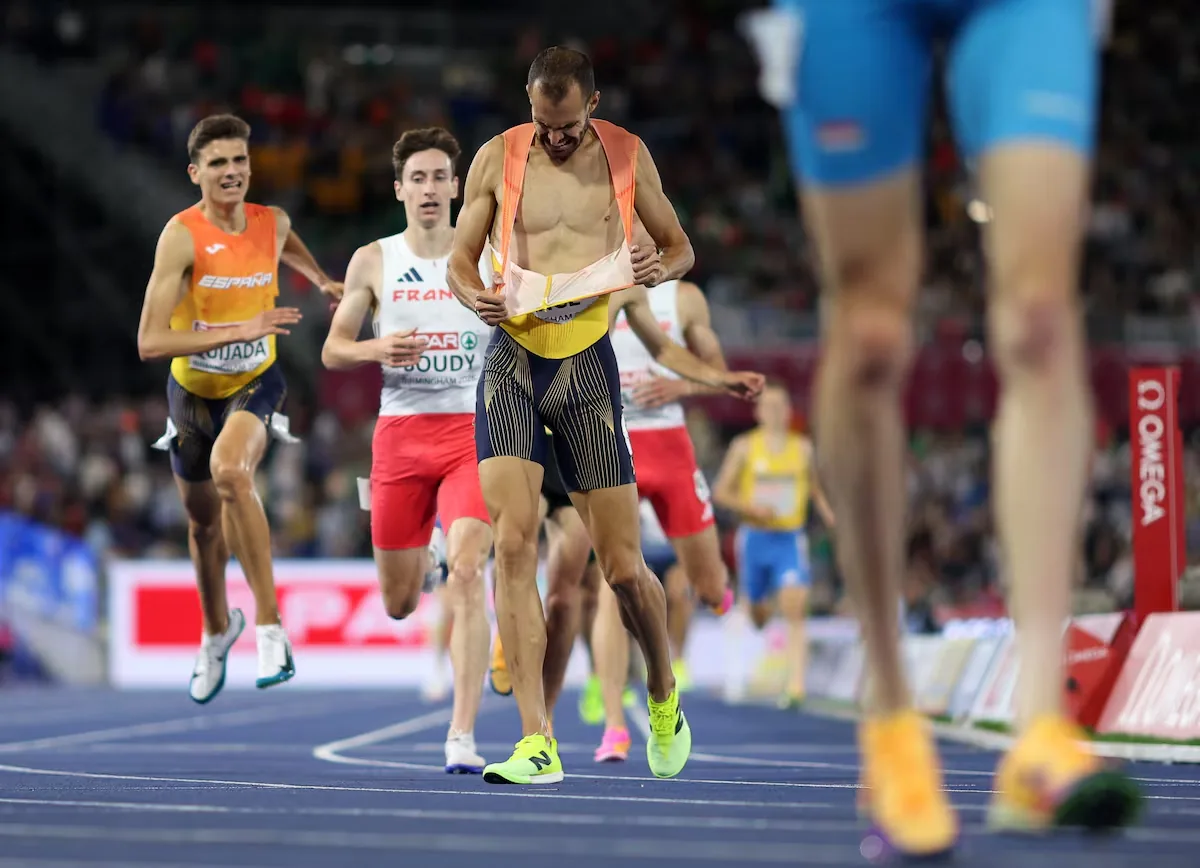
During the last decade, since they turned 20 and have not yet reached 26, Asier Martínez and Quique Llopis have illuminated Spanish athletics with their light. Two dominators of the treacherous high hurdles who have competed year after year in European, World, and Olympic finals. They have made people forget the great Orlando Ortega, who revived the specialty for Spain at the Rio Games. They have won medals (Asier Martínez was European champion four years ago, in a magical Munich, and bronze at the Oregon 22 World Championships; Llopis, silver at the Rome 24 Europeans and at the Torun indoor World Championships three months ago) and sprinkled their history with good placements, with Llopis fourth at a Games and a World Championship, challenging the untouchable Americans. In Birmingham, both together eclipsed themselves, so close friends in good times and bad, just as they had shone when both competed in the Munich 22 final. After a horrible summer, injuries, slumps, doubts, they arrived in Birmingham with a big question mark that was only resolved negatively. After 13 seconds and several tenths on the track that, on a hot Wednesday night, finally reached a level of noise and excitement worthy, the two said goodbye, failing to qualify for the final.
Read more Strengths and weaknesses of Claudia Sheinbaum
Asier Martínez, who felt like an elite athlete again after a few years of low spirits and performance, could not find reasons for his poor performance (fourth in his semifinal with 13.45s, far from his best mark, 13.14s in his great 2022). He felt weak, without strength, and did not know why. Enrique Llopis (third in his semi, with 13.47s, when in 2024, Paris and Rome, he lowered to 13.09s, and was already working to break the 13-second barrier) spoke of a strange summer after a good indoor season, of recurring injuries that prevented continuous work with his coach, Toni Puig. In the final, Swiss Jason Joseph (13.12s) finally achieved, at 27 years old, the European gold two years after the bronze with which he took Asier off the podium in Rome, ahead of French Just Kwaou (13.16s), 26, already bronze when Asier Martínez won gold in Munich, and Polish Jakub Szymanski (13.26s), 24, until now only a 60m indoor specialist.
Both Spanish hurdlers realized, like all athletes worldwide, how impossible it is to be at the top every year, and they accept it, as does the president of the Spanish federation and candidate for the presidency of the international body, World Athletics, Raúl Chapado, who speaks, without specifically referring to the hurdlers, about the inevitability of low years for Spanish athletics after a competitive cycle, the one after the pandemic, very intense and very successful.
Unaware of fatigue because they are in a growing phase of form, motivation, and stimulus, other athletes showed their class and ambition on the same track, the same day of psychosis and eclipse. Inés López, a lover of the discus, and the 800m middle-distance runners, Moha Attaoui, will compete in finals, as will the Canarian hurdler Jesús David Delgado, master of rhythm – what a great percussionist he would be in a symphony orchestra — of the 400m hurdles, under the baton of Àlex Codina, 13 steps and patience between hurdles until the seventh; 14 steps and acceleration until sprinting from the seventh to the tenth, who year by year, tenth by tenth, is already close to the 47-second barrier (his national record this summer is 48.11s), the one that separates the great from the very great. He qualified (48.37s) for a final that will probably be dominated by the great Karsten Warholm but in which the eight athletes arrive very close: only 63 hundredths separate their semifinal times, between the 47.81s of the Swede Oskar Erlind, and the 48.44s of the Italian Alessandro Sibilio.
After the passage of the moon in front of the sun, slight in British latitudes, Jaël Bestué shone more than anything else, the Catalan sprinter who, second in her semifinal (22.69s), will compete this Thursday (22:50), in her second consecutive European final in the 200m. A year ago, Bestué, in the best shape of her life, broke the Spanish record in Madrid with a magnificent 22.19s. “And this year I think I’m the same, at least,” says the Spanish speed gem, pupil of Ricardo Diéguez, Panter, who has improved running mechanics, start, and strength. “I have trained a lot to go full out on the curve, and then it’s about holding on to the end despite the drop in speed.” She likes the track for its hardness, ideal for sprinters, and she likes the heat, and that the stadium is open with separated stands, because when it is a very closed stadium, a bubble, she feels it absorbs her. Her rivals will be two local athletes. The fabulous Amy Hunt (22.37s in her semifinal), the young sprinter (24 years old) who is growing and already splendidly won the 100m, and the veteran Dina Asher-Smith (22.49s).