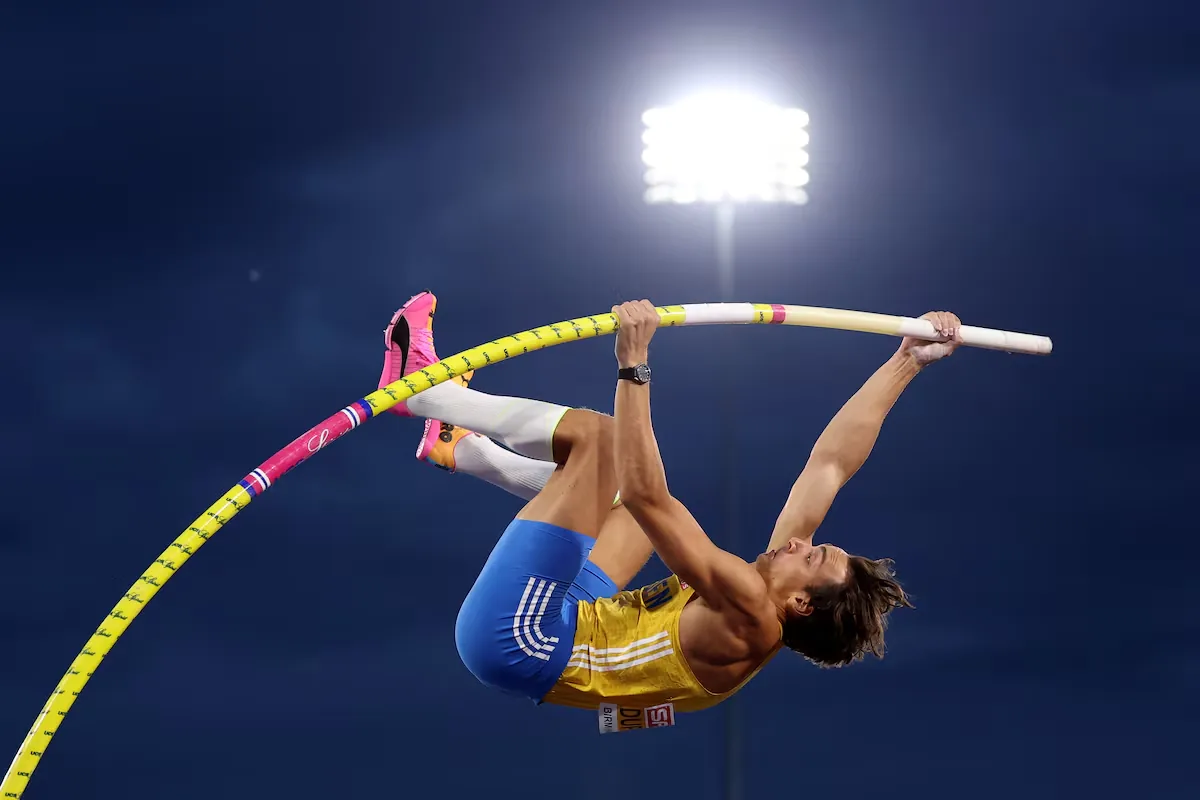
There is no show in the stadium like the pole vault in modern times. All the screens. All the eyes. Continuous startle of unexpected applause, and passion. A spectacle like those most liked by television producers who get lost in marathons and marches, what tedium and repetition. The pole vault advances quickly in the cathedral of athletics battered by its usual, more than fresh breezes, lateral winds loaded with humidity and cold. The bar rises quickly in high steps, from 15 centimeters to 5.85m and then one of 10 and another of five up to six meters, maximum speed to reach the decisive heights without hindrances, to reach the territory of Mondo Duplantis, who begins his personal duel towards the record there, and increasingly more pole vaulters, like his Greek friend Emmanuíl Karalís, who forced him once again, as in the Tokyo World Championship final, to dig into his reserves to prevail. The contest was resolved in a game of bluff poker from the moment Duplantis failed at six meters, a height that Karalis also passed on the second attempt. At the next height, 6.10m, the Greek failed, who moved on to 6.15m, and there, again, failed and moved on to 6.20m. Duplantis, religiously, accustomed to the game and brushing the bar, which trembled, passed both heights on the first try until he finally stopped, already wrapped in a blanket and fleece, at 6.20m, a new championship record.
It has been a tough summer after a winter in which he broke the world record for the 15th time. Duplantis composes music, gets married, organizes a big party in Monaco. His mind is no longer just the pole vault. He loses a competition for the first time in two years and then another, which he abandons injured. All is already past in Birmingham for the great star of world athletics, and beyond.
This is the fourth victorious European final, the 16th major final in Games, World Championships, outdoor and indoor, that the world record holder (6.31m) has competed in since, at 17 years old, he was ninth at the London World Championships. Since then he has won 13 (the first, at 18 years old, the 2018 European Championships in Berlin, 6.05m), and the one he did not win, the Doha World Championships at 19 years old, he finished second. In eight years he has annihilated the competition, turning the dreams of the most talented jumpers in the world into nightmares, like Tadej Pogacar, another enigma from another planet, who performs in the Tour, but unlike the increasingly isolated Slovenian at the summit, Duplantis’s charisma has made the pole vault more alive than ever, and not just because of him. His courtiers are not an army of second-raters, but the strongest elite ever, something like the knights of King Mondo, a bunch of handsome and brave Lancelots courting Guinevere.
Heights like 6.00m, once the ideal peak of many races, are now just a necessary step to be competitive. The exceptional is normalized by rivals trying to catch the alien. Karalis has trained even more strength and speed to successfully bend longer and stiffer poles by 15 centimeters or more. In Birmingham, two Europeans handle those bars, the Greek, who is already second in history on the world list with his 6.17m jump last February, and the Norwegian Sondre Guttormsen (6.06m in March), who jumped 5.95m in the last indoor World Championships and could only be fourth in the highest final in history.
Read more Kate Douglass makes an incredible breakthrough in the 50m freestyle record
Duplantis is the greatest at 26 years and 279 days, but alongside him have shone at the Europeans in dry England and forgotten green meadows the 18.15m of Andy Díaz in triple jump, Jakob Ingebrigtsen reborn in the 5,000m, and three women who revitalize athletics, and its image and fill it with charm, depth, and magic. And they strengthen Europe, capable of generating its own stars for the universe. One is Swiss from Fribourg, lives with her parents, is 22 years old and spoiled the championship for the locals, who only breathe for their heroine Keely Hodgkinson. She is Audrey Werro, French-speaking on the border, and her lioness claws, who on Friday beat the Olympic champion in the race of the century, the fastest 800m final in history at a European Championship (1m 54.81s).
The second is English from Sherwood Forest near Nottingham, like Robin Hood, and the other is Italian from Trento near the Dolomites, and they have more points of connection than differences. They are candidates in the next Olympic Games to fight head to head with the sprinters of the empire of speed and African long-distance runners. They are Amy Hunt, a 24-year-old Taurus, the goddess of speed, the first athlete to win four golds in the same European Championships (100m, 200m, and the two 4x100m relays), and Nadia Battocletti, 26, winner of the 5,000m and 10,000m with surgical precision and clarity. They run opposing distances at atomic speeds. One is arts — the Englishwoman graduated from Cambridge in Literature — and the other sciences — Battocletti is finishing a degree in civil engineering and architecture — but both live in northern Italy. Battocletti, daughter of Moroccan and Italian, with her father, Giuliano, a former athlete who told her he did not want her to be like him but ended up coaching her; Hunt, in a little house near Padua, in Veneto, where she trains with the group of Italian coach Marco Airale and where she has nearby the Peggy Guggenheim Museum in Venice, which she likes to visit. Both have hypotension problems and get dizzy when going up the podium, without which they also would not know how to live. And they were already second in the Tokyo World Championships.
Read more Three dead and new damage from flooding due to heavy rains in Venezuela