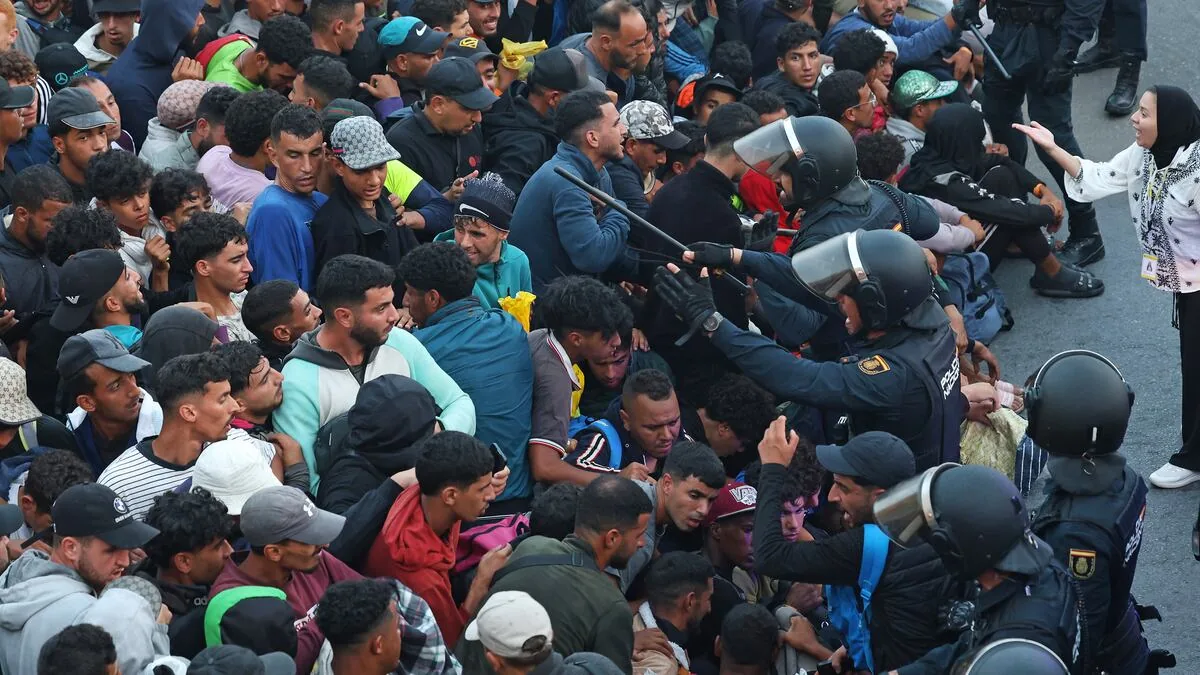
When I wrote Cannibals in 1999 [translated into Spanish as La patera, Akal2000], I believed I was narrating a tragedy. Today I realize that I only told the first chapter of a story that is still being written. The images of Ceuta — those thousands of young people running towards the sea to reach a handful of meters of Europe — have awakened the ghosts of my novel. The same looks. The same hunger. The same hope.
Read more The PSPV-PSOE denounces the elimination of judicial family meeting points in 10 municipalities
The traffickers have changed phones, social networks have replaced the rumors from cafes, the fences are higher, the cameras more numerous. However, the engine remains the same: despair.
There has been much talk about manipulations, diplomatic calculations, and rumors spread on social networks. All that matters. But no rumor pushes a teenager to risk their life if they have something to lose.
In Cannibals, my characters dreamed of Europe as an almost mythological continent. They did not know Brussels, Madrid, or Paris. They only knew the lack of a future.
We hear about “migratory pressure,” a bureaucratic expression that gives me chills: behind every migrant there is a name, a family, a broken childhood. I am Moroccan. I have met these young people in the working-class neighborhoods of Casablanca, the forgotten rural areas of the Atlas, and the cafes of Marrakech. They do not hate their country, they only suffer because they no longer have a place in it.
Morocco has changed profoundly in a few decades. It advances by leaps and bounds: the ports, the rail lines, the universities, and the factories are proof that it is a country in motion. It would be unfair not to see these transformations.
However, many young people have stopped feeling that movement. Or, to be more precise, they do not recognize themselves in it. They live at a much faster pace than the transformations. They do not judge their country by its projects, but by the place they believe they will have in it tomorrow.
Like all states, Morocco has the duty to protect its borders and its stability. But Europe is wrong if it thinks it can turn this unease into a simple police problem.
For decades, its reaction to misery has been to build increasingly sophisticated walls. And yet, the avalanche of those who want to leave continues. Why? Because there is no fence higher than despair. But it does not seem that anyone protects dreams.
That is precisely the moment when culture becomes essential. Because the development of a country is not measured only by its kilometers of highway, its high-speed lines, or its industrial parks; it is also measured by its ability to give young people a reason to live their future. And when there is no longer room for dreams in a country, they become makeshift boats.
My friend Nabil Ayouch and I have been dedicated, for more than 15 years, to opening cultural centers in the heart of the poorest neighborhoods, marginal districts, and forgotten outskirts. There we do not hand out visas or promises of Europe. There we teach young people to use the most difficult freedom: that of dreaming in their own country.
Read more Social sciences and their enemies
Because the future is not built only with concrete; it is also built with imagination. I have seen teenagers discover theater, music, dance, painting, or cinema and regain a dignity that poverty denied them. Culture does not fill the fridge. But many times it prevents despair from becoming a destiny.
Leaving is not a mistake. Seeking a better life in another country is a right. The tragedy is believing that there is no other option.
Art will not retain all those who want to leave; that would be a lie. But a country that gives its youth the means to create also gives them a reason to believe in themselves. The true fight against forced exile does not begin by building walls, but by opening the doors to imagination.
Those who have died in Ceuta are not only victims of the sea. They are victims of a world that has come to the conclusion that there are lives desperate enough to accept almost any risk.
In my book Cannibals I chose that title because I thought the true cannibalism was not that of human beings devouring their peers, but that of societies devouring their own youth.
Today I am even more convinced. We continue to create generations convinced that the only opportunity they have is to disappear elsewhere. Then we are surprised to see them cross borders. As if their departure surprised us. As if we had not been preparing their escape for years.
The events in Ceuta do not constitute an exceptional crisis. They are a mirror. They expose the immense gap between those who have nothing left to hope for and those who still believe that a few fences will be enough to contain despair.
That is today, perhaps, the true lesson of Cannibals. The novel was not only about those who leave. It was, above all, about our responsibility towards those who stay.
As long as there are children who grow up believing that their future begins on the other side of the sea, we will continue counting the dead, the bodies climbing fences, and the sunk dreams. No wall will change anything. Youth is not retained with barriers; it is retained by giving them reasons to believe that they can also invent their future in their own country.
Our responsibility is not to prevent young people from leaving. Our responsibility is to do everything possible so that, finally, they have the freedom to stay.
Read more The migration alert leaves the civil guards of Ceuta and Melilla without new permits