







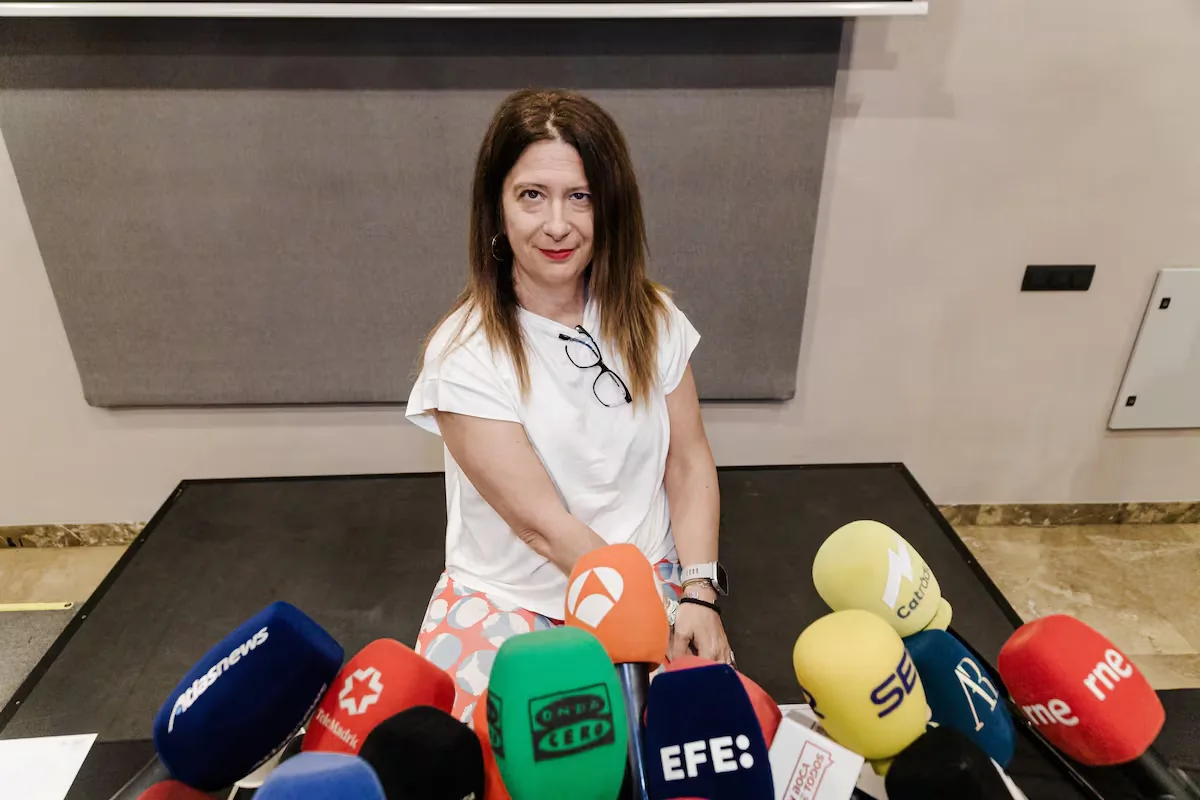
This Wednesday, May 27, just after eight in the morning, a 50-year-old woman was traveling on a train from Bilbao to Madrid. In her carriage, there was a school trip, boys speaking in Basque about the experiences that awaited them, and several men who at some point, the woman noticed, were ranting against independence. Could it be because of the boys speaking Basque? The woman thought about it; she says that, in any case, she found the coincidence amusing. An acquaintance of hers calls her Antoñita la Fantástica also because of these things, her strong ideological stance: there is never a truce.
Her musings were soon interrupted near Valladolid. She received several calls from journalists, too many. “I always find out things from them.” She didn’t answer the phone. “I don’t like talking on trains.” But alerted by the WhatsApps, she checked the newspapers and read that the UCO had taken over Ferraz, the PSOE headquarters, her former party (she resigned a year ago when she was charged), in an operation led by Judge Pedraz within the framework of investigations into the Leire case, her name, Leire Díez.
She spent the rest of the trip to Madrid calm, no one recognized her, and upon arriving at Chamartín no one was waiting for her. She took a taxi and disappeared into the city. All the radios and televisions were talking about her, all the newspapers had updated their front pages urgently with her name in the news. And the order known that day from Judge Santiago Pedraz placed her in a more serious role than that of a reckless intermediary, whose role could surrealistically be justified as that of an “investigative journalist.” According to the judge, Díez had coordinated, on behalf of Santos Cerdán, an operation to sabotage judicial and police investigations affecting the PSOE and the Government. Bribes, blackmail, payments to companies. “I’m tired,” she murmurs on the phone.
–And what do you think when you hear your voice in the audios? [she presents herself as someone sent or placed by the PSOE, suggests that her task was to investigate or limit actions of the Police, UCO, Prosecutor’s Office, and Anti-Corruption, talks about Santos Cerdán as a political or organizational reference, links the operation to the president’s environment, appears seeking compromising information about a UCO chief]
–That I’m a blabbermouth. I’ve called myself a blabbermouth a million times. You say those things because you need to gain the trust of the person in front of you.
She speaks on the phone from Portugalete, the Basque city where she was born. Her parents come from a working environment far from professional politics. Her mother was a sewing teacher and later worked as a manager in a cleaning company. Her father was a professor at the Higher School of Civil Marine. Both are still alive. Her father’s personal situation weighs heavily in her story: he has suffered three cancers, two in the mouth and one in the liver. To her close ones, Leire laments that now, instead of being worried about him, they have to be worried about their daughter. Although her name is often associated with Cantabria, her link to that community mainly comes from Vega de Pas, a municipality where she has had a house for about 25 years and where she was a councilor. Her daily life is divided between Portugalete and Vega de Pas: during the week, more connected to Euskadi; on weekends and free time, to Cantabria.
She has two daughters, aged 23 and 21. She says she always told them that a failing grade could be recovered, but a bad behavior grade was much more serious because the only thing that truly depended on them was being good or bad people.
Díez studied Social Sciences at the University of the Basque Country. She describes her childhood in Portugalete as normal, with a school opposite her house and a strong connection to sports. Her first major activity was judo. She started at the gym at barely three years old, in an environment very close to her family: her father was a black belt in karate and had relationships with martial arts teachers. She became federated in judo at five years old and was close to testing for a black belt but had to quit due to a back injury. She also played handball, although more secondarily.
Her interest in politics was born from family influence. Especially from her paternal grandmother, an admirer of Felipe González. Life takes so many turns that it’s strange that so many people are still standing. She joined the PSOE, although she has always maintained that her organizational activity was limited and that she never felt comfortable in the party’s internal life. She worked as manager of Bilbocar and later as communications manager at Nissan Marel. But her entry into local politics came suddenly in Vega de Pas. With an 18-month-old daughter and another newborn, one summer she was left without water. She went to protest to the mayor: “I understand this happening in Almería, but in Cantabria?” She says the mayor replied: “Well, take your children to bathe in the river.” Whether the story is true or not, the documented facts are that Leire Díaz entered politics, allied with the PP, and in 2008 ousted the mayor from the Cantabrian Regionalist Party (PRC), and filed a lawsuit for prevarication and embezzlement that disqualified him nine years later. The following year, El Diario Montañés reported that neighbors from a Vega de Pas neighborhood accused Leire Díez of alleged threats and insults. According to them, the then local socialist leader “showed up at the house uttering insults such as ‘whore’ and ‘son of a bitch,’ as well as death threats ‘I have to kill you,’ while pulling out a large machete.” The complaint was dismissed a year later.
In Vega de Pas she has chickens, goats, sheep, and rabbits, and takes care of flowers, plants, and a vegetable garden. She describes herself as a person who goes out little, devoted to her farm and a quiet way of life. That image of animals, countryside, and domestic life contrasts with the political, media, and judicial dimension that her name carries. And in the dozens of meetings in Madrid documented by Judge Pedraz, her movements around the capital among businessmen, police, and party leaders to extract dirt from the sewers and confuse investigations against the PSOE. “All this simply overwhelmed her. She wanted to play against tremendous state powers with her own weapons, and she has no idea. And between that and her imagination…” says an acquaintance of hers.
From Vega de Pas, she emerged in national politics thanks to Rubalcaba, who noticed her to be responsible for Rural Environment in his primary campaign that he won against Chacón. In the following ones, Díez supported Eduardo Madina over Pedro Sánchez, to whom she directed harsh messages on social media, as documented by El Diario Montañés, where a former high-ranking official said: “She may lack other things, but she moves like a lizard. She knows many people and has always gone her own way.” Three years after ranting against Sánchez to support Madina, in 2017 she was already the biggest Sánchez supporter. But this Friday she told EL PAÍS: “I am loyal. But I distinguish a lot between blind loyalty and loyalty. For me, loyalty and blind loyalty are different things. If Sánchez does something I don’t like tomorrow, I will say it. There are things about him that I don’t like at all.”
She had a big leap: communications manager at Enusa, and from there, her arrival at Correos. By then, according to the judge, she was already involved in operations and plots of Santos Cerdán, a socialist leader, in connivance with different sectors. About that relationship, she tries to minimize it: she says that until the meeting on April 24 she had treated him very little “organizationally.” At the same time, she acknowledges that the PSOE was her party and that if she could help as a member, she was not “going to help Vox.” Her version is that in the audios she said imprudent and compromising things, but she presents them as bluster to gain the trust of interlocutors; she denies having bribed, published material against anyone, or acted as part of a plot; and frames everything as an investigation into sewers, a media hunt, and a judicial battle over whether she was doing journalism or working for PSOE interests.
The seized material, recorded conversations, and documented meetings account for a different and much more delicate version for the criminal horizon of a woman who, mired in the sewers for reasons that justice must illuminate, says she is happy lost among sheep, away from the noise, in her Pasiegos house in Vega de Pas.