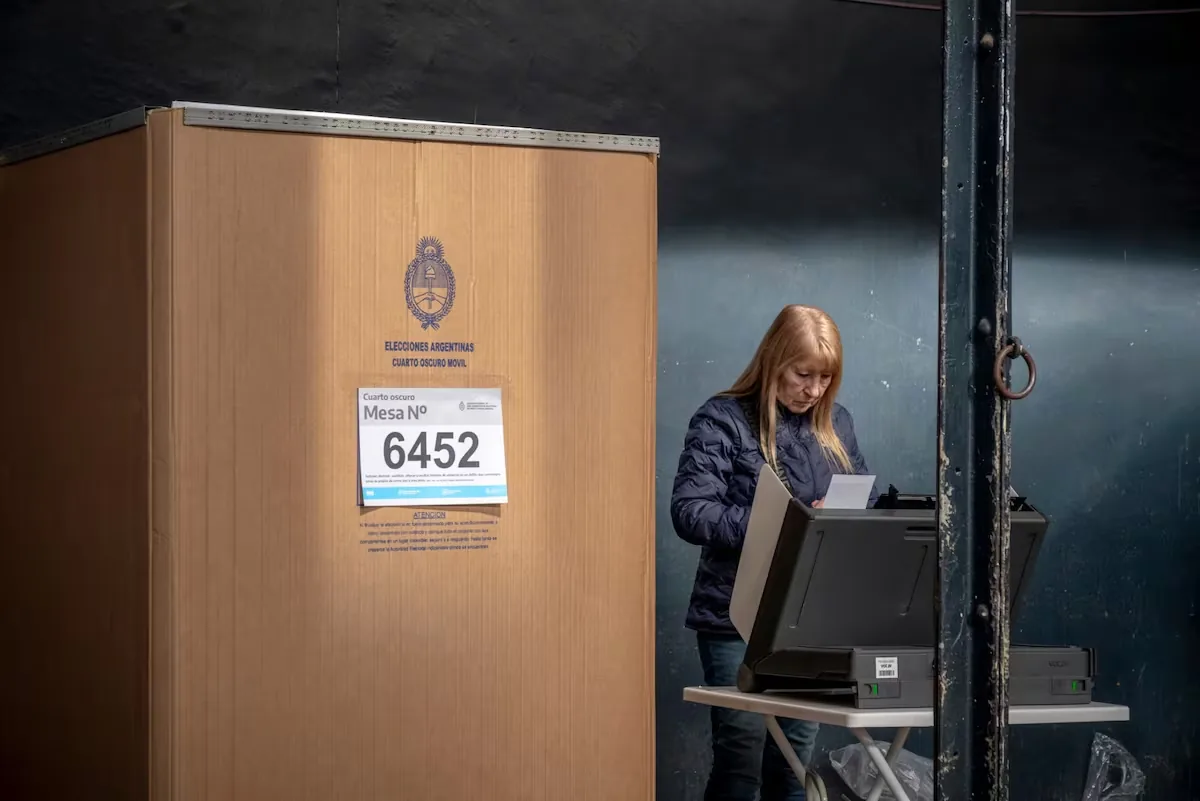
“Alternative for Germany” won the Saxony-Anhalt elections this Sunday with more than 40% of the votes, double what it had five years ago and the best result for the German far right since World War II. Alice Weidel did not wait a day to demand early federal elections and a “mandate to govern” the country. If that happens, the four largest economies in the world, which together account for about 40% of the population and half of the planet’s economy, will be governed by leaderships to whom democracy matters little or not at all.
Democratic consensus is eroding and it is not just a German phenomenon. According to the World Values Survey, compared to the beginning of the century, the global population that prefers a strong leader without checks has doubled. The loss of trust is more pronounced among the younger generations. Half of them say they support authoritarian governments or are indifferent to the political regime, and 75% of those under thirty, according to the United Nations, feel that politicians do not take them into account. They vote less and hold politicians responsible for this disconnection. What is at stake goes far beyond a German region. Incredibly, today it is debated whether democracy is a community aspiration and whether it remains a pact worth sustaining.
That is why it is necessary to renew the votes. Votes in the most concrete sense of the word, those of convictions and the effort that the whole society decides to put back into play, because we are at risk of losing it. And renewing a commitment always requires remembering how it was built in the West over the last century. There is precedent that this pact can be rebuilt after a catastrophe. The Great Depression in the 1930s and the world wars shook society and changed the rules of the game. The human and economic cost was so high that it paved the way for a new political sense. Capital began to join the democratic contract, accepting regulations and higher taxes as a reasonable cost to ensure stability and social peace.
Multilateralism became the mechanism to coordinate policies, set common rules, and manage conflicts in a world marked by deep asymmetries. Liberal democracy reached its fullest form in countries where the state managed to control big capital, regulating its excesses and demanding a contribution to collective welfare.
Ibero-America, for example, built its own consensuses. After decades of bloody dictatorships, politics agreed on common rules of the game: returning the military to the barracks, respecting universal human rights rules, and clean electoral processes. In Argentina, the “Never Again” of 1983 and the trial of the juntas founded a collective commitment to freedom of expression, rejection of state terrorism and forced disappearances, and the value of living in democracy, with broad repudiation of the use of armed forces within the country. Some politicians even campaigned claiming that with democracy you could eat, get healthcare, and education. Organizations like the European Union, the Organization of American States, and Mercosur included democratic clauses that make the validity of institutions a condition for commercial integration. Far from being ideals, these were huge advances, which today are at risk.
The democratic contract in the digital age
That pact today seems broken. In this era dominated by financial-digital elites, the challenge is to govern socio-technical systems that reconfigure work and decisions. The most dynamic sectors of the economy generate super-rich individuals and exclude the majority. We have record sales of luxury yachts, but not many opportunities for young people. Work thus loses its central role in social recognition and in building collective identity. Digital platforms, instead of generating democratic dialogue, destroy it. To achieve greater connectivity and economic gains, they seek to generate addiction, polarization, and trap us in algorithmic bubbles. Their business model is, centrally, to destroy community ties. This is the breeding ground for the emergence of political expressions that exploit this context, promoting agendas based on hatred, discrimination, and building societies for a few. Big digital financial capital provides them with resources and technologies to deploy their political agenda. At the same time, multilateralism has also lost its power to promote global agendas by rewarding and punishing behaviors that violate democratic agreements. Moreover, presidents like Trump or Milei have withdrawn their countries from dozens of multilateral organizations.
The electoral result in Germany, and potentially in Brazil, Spain, and many others, warns us about the need to rebuild social pacts to sustain democracy. The main challenge is to bring big capital, in this techno-feudal version, back into the democratic contract.
A daunting task, it cannot be the same as that of the last century. First, because unlike before, democracy is not a priority for any of the current powers. Also, this pact must include a new relationship with nature and move beyond the North-South relationship of global capitalism. The postwar order was designed for industrial capitalism with a national base and did not foresee platforms, capital that escapes state jurisdiction, nor a digital transition that returns the South to the role of supplier of minerals and energy. Southern countries occupy a marginal place among investors and artificial intelligence companies, but concentrate the energy, copper, lithium, and rare earths that sustain it. The data centers that arrive in our countries do without significant technological transfers, because demand to the South is limited to energy to maintain them and access to minerals. Territories are reconfigured as geopolitical dispute arenas for strategic resources, with a digital transition that reproduces extractive and domination logics.
To get out of this mess, other types of coalitions are required that include protagonism and leadership from the Global South. These agreements must be broad and generous because they must be capable of promoting rules able to govern complex socio-technical systems, redesign institutions that can govern intangible economies of global reach, and explore new frontiers such as the fight for cognitive sovereignty. We still do not know how it is written, but we know that no force can write it alone.
To discuss these challenges, we invite you to participate in the Democracia Viva festival, from September 15 to 17 in Buenos Aires.
Read more The judge admits the Government as a plaintiff in the investigation into the mass entry into Ceuta