









It is not easy to imagine how long 120,000 years are. 1,200 centuries. 100 times the duration of the Roman Empire. That is the time during which, according to a study published this Wednesday by the journal Nature, the Denisovans repeatedly occupied the Bianfu cave in Yunnan, southwestern China. Between 190,000 and 70,000 years ago.
Read more Marius Borg Høiby, in the background but a protagonist at the funeral of King Harald of Norway
Many things happen in 120,000 years. Sophisticated rituals can develop, repetitive dances created by the tribe to impose meaning on the world or soothe the terror of dreams. The first babblings of language may appear only to disappear later, in a sleepwalking path toward consciousness that is never one-directional. And stones can also be carved to cut animal meat for survival.
One can fall into the error of thinking that the physical remains left by humans who inhabited the deep past, or those we can recover, were what mattered most to them or what best defined them. That is why the work of paleoanthropologists is so difficult, as they try to reconstruct the existence of those ancestors with small miraculous findings: a stone axe, a scratch on a cave wall, a protein in a bone. The life of entire lineages over unimaginable amounts of time from just a few vestiges.
Today, Nature publishes two articles that add a few pieces to the enormous puzzle of human evolution and begin to give physical presence to a species until now ghostly. The Denisovans were the first species among our close relatives to enter history without the need for large fossils to get an idea of what their skull or skeleton looked like.
The extraction of ancient DNA from teeth and phalanges found in the Siberian Denisova cave served to determine the existence of the species, but for a time no fossils were found to reconstruct their appearance and history. Later, remains probably belonging to the same group were identified. A jaw found in the Baishiya cave on the Tibetan plateau, remains from the Taiwan Strait, and the spectacular Harbin skull in northeastern China are the most notable.
In the first of today’s articles, a team of scientists led by Qiaomei Fu from the Institute of Vertebrate Paleontology and Paleoanthropology in Beijing, China, expands our view of the Denisovans with work that seeks needles in a haystack of bones. The researchers examined more than 60,000 bone fragments from the cave, mostly animal, in search of human remains unrecognizable to the naked eye. To achieve this, they used a technique called ZooMS, which allows species identification based on small differences in collagen proteins.
Then, they performed more detailed proteomic analyses and identified three fragments they attribute to the Denisovans: two parts of parietal skull bones and a fragment of the arm’s radius. This bone, like others associated with the species, shows a mix of features. Some dimensions and the orientation of certain structures resemble Neanderthals, and the general shape of the bone brings it closer to modern humans.
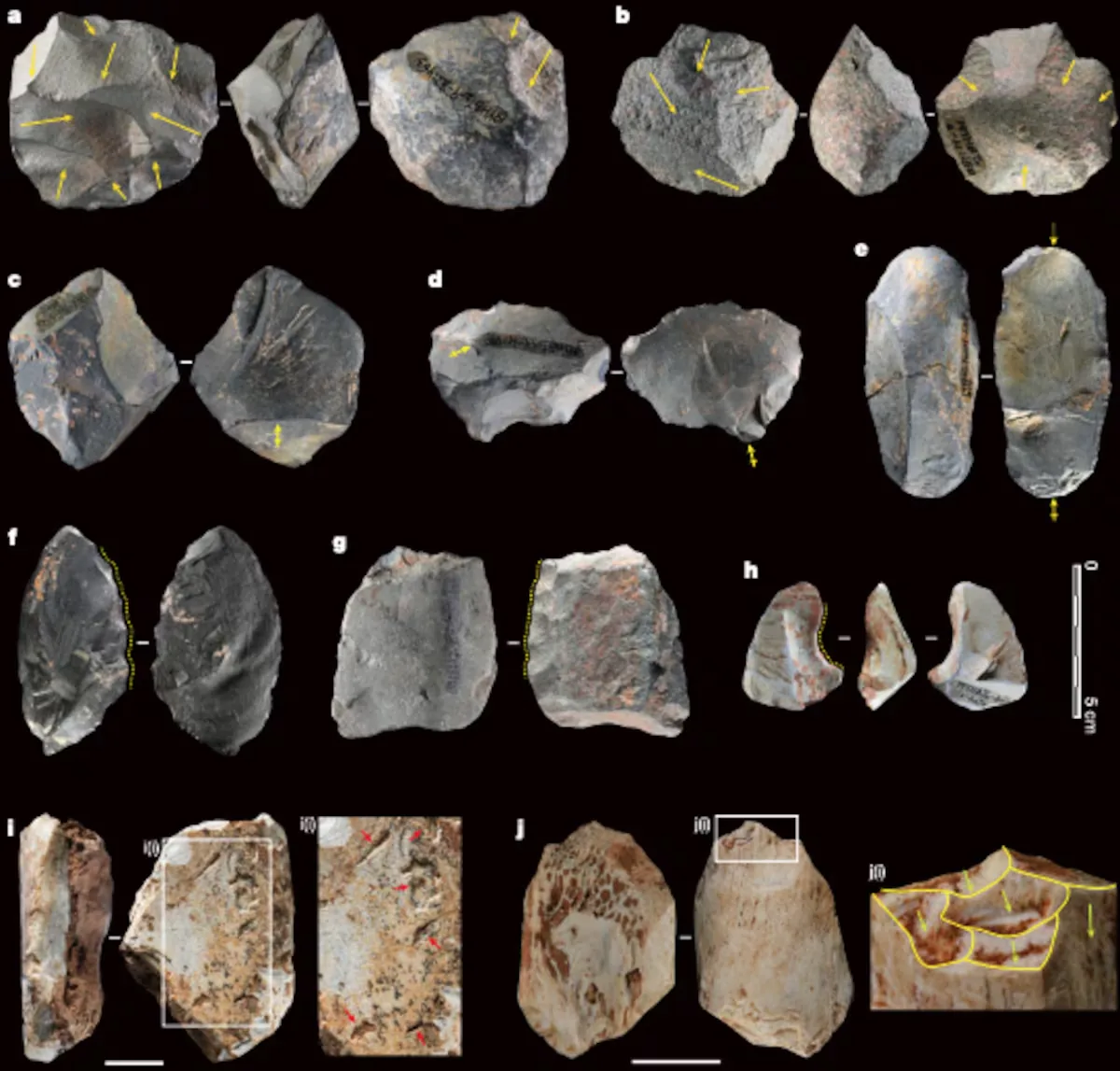
If the first study offers information about their appearance, the second article published today by Nature begins to reconstruct their way of life based on the tools and animal remains found in Bianfu. The Denisovans of that region adapted to their landscape, forests first dominated by conifers and later by steppes. They did not hunt just anything. They had a clear preference for medium and large animals, such as deer and bovids, and chose young adult or mature individuals because they were more profitable prey. When they had killed them, they used everything, down to the bone marrow.
An interesting aspect is that the lifestyle of those people did not require very sophisticated technology. For millennia, the Denisovans settled for simple stone tools. “They made effective use of the resources around them. The available stone could provide useful cutting edges with relatively little shaping, while animal bones could have offered a quite useful complementary set of tools,” explains Bo Li, professor at the University of Wollongong, Australia, and co-author of the study.
If the technology fulfilled its function, and they lived like this for tens of thousands of years, why invest more time and energy in producing complex instruments? The question may surprise modern humans and is another example that human history is not necessarily a path of continuous improvement.
This does not mean that all Denisovan groups were the same, something that should not surprise us given the usual human diversity if it were not for the homogeneity bias we tend to apply to strangers. “Other contemporary sites in southwestern China have provided a more advanced toolset, although it remains unknown if those sets were made by Denisovans,” Li clarifies.
On the Tibetan plateau, in the Baishiya cave, conditions were very different, and their subsistence strategies seem to have been more varied in response to a much more extreme and unpredictable environment. Therefore, Denisovans do not seem to have had a single way of life and could modify their strategies according to the territory.
Surprising parallels with Neanderthals also appear. Some bone tools from Bianfu resemble those found in Neanderthal contexts in western Eurasia. This raises a fascinating question: human populations separated by thousands of kilometers could independently develop similar technological solutions to similar problems.
The reconstruction of the Denisovan lineage is also a task of understanding our species. Yunnan is in a strategic position, between the Tibetan plateau, Eastern China, South Asia, and Southeast Asia, the area along with Oceania where people have the most Denisovan DNA. The pieces presented in this study show a species that had occupied a large expanse in Asia, adapting to very different environments, from the Altai mountains in Siberia to the Tibetan plateau and the subtropical regions of southern China.
In reconstructing such an ancient world with so few remains, the Chinese team did not use DNA because it has not yet been recovered from the Bianfu remains. Identification was made through ancient proteins and molecular variants characteristic of Denisovans. The five fossils present, for example, a variant of a collagen protein that consistently appears in known Denisovan remains.
This also explains why the discovery is methodologically important. For some, the future of human paleontology may depend less and less on finding skulls or tibias and more and more on learning to extract information from thousands of seemingly insignificant fragments.
Not everyone agrees. María Martinón-Torres, director of the National Research Center on Human Evolution in Burgos, praises that the study “begins to put bones, face, and even behavior to this ghost that the Denisovans were.” “That also allows cross-checking the molecular signal of proteins with anatomy,” she adds. However, she warns that fascination with one tool, as happened with ancient DNA sequencing, may lead us to overestimate our knowledge or abandon other less modern methods of acquiring it.
“In this study, we see that a molecular signal associated with Denisovans appears in fossils with quite different morphologies, and we also know other variants shared by Homo erectus, Denisovans, and modern humans. So the question is: what are the proteins telling us? I think we must be cautious and not turn them into a barcode to identify a species,” she explains.
In her opinion, there is a temptation to consider this type of evidence above fossils when they should be taken into account together. “Sharing a mutation does not automatically prove that two fossils belong to the same species. That mutation may be inherited from a much earlier common ancestor or reflect an adaptation to a specific environment, and there is not yet enough research to distinguish between these possibilities,” she states.
In studying the past, the scarcity of information can lead to more rounded stories because imagination can work without needing to fit many pieces of information. Antonio Rosas, paleoanthropologist at the Spanish National Research Council (CSIC), acknowledges that sometimes, when there is more data, the story becomes complicated, but in the case of Denisovans and human evolution in Asia, this will not be so because there is not yet a clear story to complicate. “Asia is a vast territory where we have Homo erectus populations with quite clear anatomy. Now we are beginning to define the world of the Denisovans, and then we have another more complex one, that of the possible arrival of sapiens 120,000 years ago, something we do not have clear and that we will clarify when we have more information,” he explains.
In this region with three overlapping and poorly defined worlds lived the Denisovans who occupied the Bianfu cave for tens of thousands of years. Findings like the one presented today begin to turn them into something more than a signal hidden in the DNA of modern humans or in the ancient genomes of Denisova. We can now imagine them hunting or making tools and adapting to changes in their environment over thousands of generations.
It will be much harder, if only the surviving remains are considered, to know what truly mattered to them and not impose our inclinations on them. About the simplicity of the tools in Bianfu, Rosas reflects: “We could turn it around because maybe that simplicity shows a sophisticated character: why complicate my life if I already have it almost done and at hand?” It is possible that those Denisovans only devoted to survival what was necessary to be able to dedicate their time to the things that truly interest humans and that are not usually found in archaeological sites.