









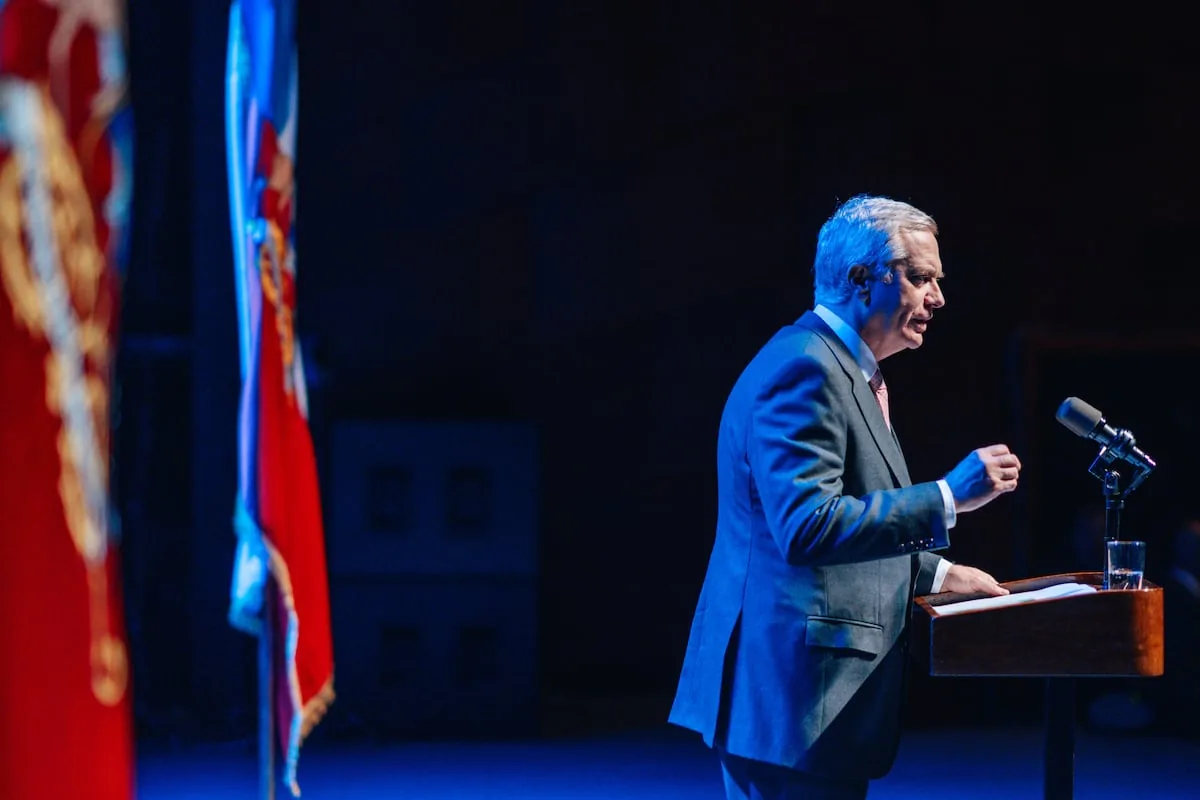
By celebrating the Madrid Forum in Santiago just days after various Argentine military institutions once again relativized Chilean sovereignty over the Strait of Magellan, President José Antonio Kast places two loyalties that should remain strictly separate on the same level this week: the one owed to the Republic he governs and the one maintained with an international network of leaders, parties, and foundations that share his ideological project. The international scenario is also that of a war that the United States and Israel have extended against Iran for six months, restricting transit through Hormuz, raising energy costs, and demonstrating to what extent control of a maritime passage can once again determine the security and economy of countries far from the conflict.
Read more The second years of the 4T
In this scenario, the repeated statements coming from Argentina about the Strait of Magellan, one of the natural passages between the Pacific and the Atlantic, can no longer be viewed lightly or naively, but require careful handling. Chilean sovereignty over the Strait is not in question: this was established by the treaties of 1881 and 1984, but another representation reappears in the Argentine state apparatus. A defense directive proposed in 2021 to strengthen its “joint control” and, this year, the head of the Naval Hydrography Service stated it was Chilean “except for the mouth,” the Air Force chief attributed Argentine sovereignty to Magellan and the Drake Passage, and a Navy publication presented Chilean internal channels as part of their country. Each episode admits an explanation of a particular error; their repetition forms a pattern that can no longer be attributed to isolated mistakes.
The controversy also occurs when the concerns of the Chilean public move away from the Government’s celebrations. The economic reform ended up being discussed before the Constitutional Court, employment is going through its worst moment in five years, and, faced with a population expecting concrete answers on security, La Moneda opened another constitutional discussion on presidential powers. It is amid these concerns (work, income, and peace in the neighborhoods) that the president has decided to turn Santiago into the scene of a party of the Ibero-American far right.
The Madrid Forum is not a summit between States, but the space where an international far right, organized by Vox’s Disenso Foundation, will come to celebrate that the latest elections turned Chile into a reference for their forces. This network is articulated around the leadership of Donald Trump, whose tariff policies have fragmented trade and whose offensive against Iran turned Hormuz into the center of a global energy crisis; the president does not observe that world from outside, since when he was still president-elect he supported the attack and traveled to meet Trump, so the rise in fuel prices affecting Chilean households comes from the same political project that the Forum now presents as a victory.
Read more Colombia seeks who will finance the highest debt in its history
Suez, Panama, and the Red Sea had already shown the vulnerability of global routes to accidents, climate crises, and wars. But Hormuz turned those scattered warnings into a new reality: when passage through which about a fifth of the world’s oil circulated can be interrupted, the shortest route ceases to be necessarily the safest, and the existence of alternatives takes on another value. That is why Gulf countries invest in ports and pipelines, while Arctic thaw opens new routes. The Strait of Magellan will not regularly replace Panama, but its strategic importance lies in belonging to the small number of natural passages capable of connecting the great oceans when the usual routes face higher levels of uncertainty.
From this perspective, acts coming from the Argentine armed forces take on another tone: recognizing this does not require turning a neighboring country into an enemy or questioning sovereignty resolved by treaties, but it does prevent reducing repeated assertions about an asset of growing strategic importance to mere sloppiness, especially when Milei is not only the president of Argentina but an ally of Trump and one of the main references of the international network to which President Kast belongs. Here appears a contradiction of the patriotism that the far right claims: facing their internal adversaries, their leaders do not limit themselves to discussing arguments but discredit the legitimacy of their objections by presenting their authors as frivolous, disconnected from citizens’ anguish, or turned into obstacles to act, while building a transnational organization whose members celebrate, protect, and grant each other support they would never offer governments of another kind. Affinity ends up turning into indulgence precisely when national interest demands greater clarity.
The president can resolve this contradiction and order his loyalties by incorporating the Strait into his conversation with Milei and obtaining a public and institutional ratification of Chilean sovereignty, along with the correction of documents and doctrines that have allowed this interpretation to reappear. He is not asked to break a relationship or cancel a meeting, but to order his responsibilities. Before being host of the Madrid Forum, ally of Trump, or travel companion of Javier Milei, José Antonio Kast is the president of the Republic of Chile. The Republic was not entrusted to him to turn it into the stage where an international network celebrates its victories, but to defend the country’s interests, even against its friends.
Read more Mexicans divided over the causes of the visa cancellation to Andy López Beltrán