









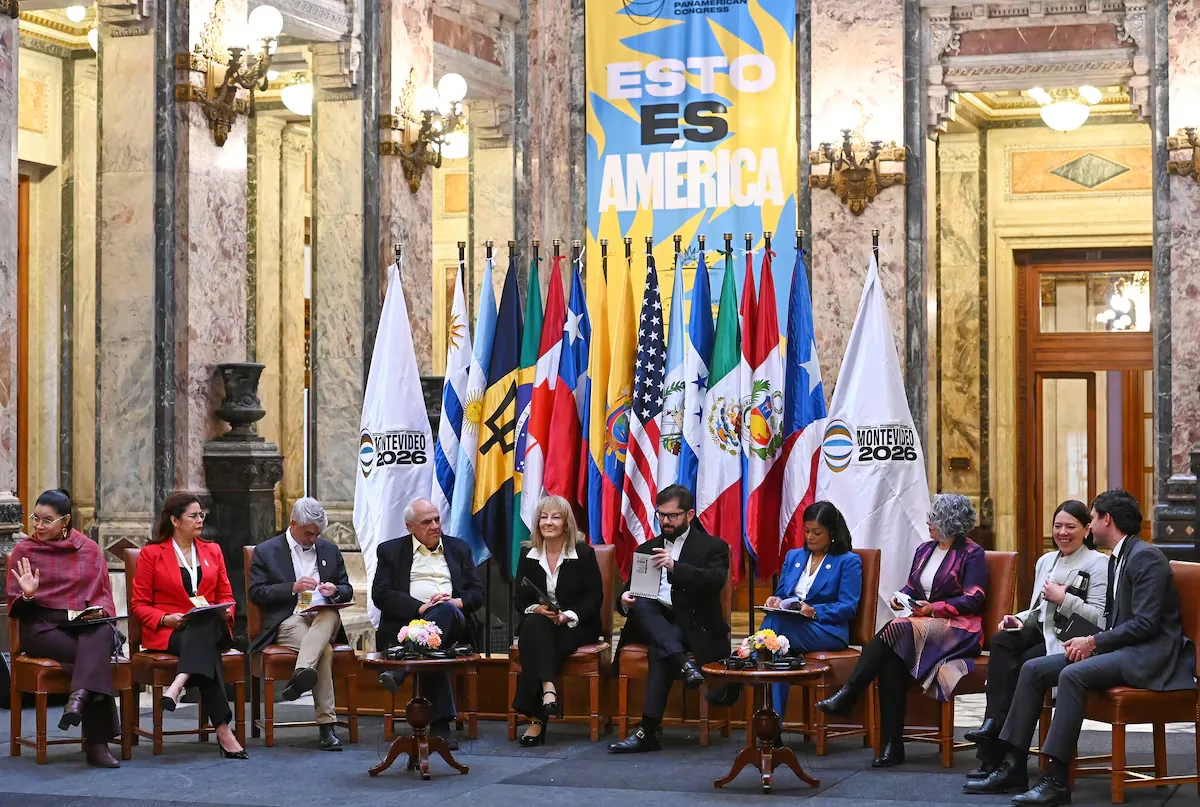
Montevideo aims to be a political laboratory of American progressivism this weekend. The nearly 150 leftist leaders participating since this Friday in the third edition of the Pan-American Congress have arrived with similar concerns: the right is advancing on the continent, the United States seeks to impose its old logic of subordination on Latin America, and progressive forces appear too fragmented to coordinate a joint response. At the inauguration, held at the Legislative Palace of Uruguay, the speakers committed to confronting the discourses that demonize the State and seek to undermine social achievements, but they also called for building future projects that go beyond resistance to the far right.
Read more A lawsuit for pollution and against extractivism: what the peoples of the nine Amazon countries seek
Under the motto “solidarity among peoples, sovereignty among nations,” the left gathered in Montevideo recognized the legacy of former president José Mujica as a source of inspiration and a light in these dark times. Faced with conservative programs that propose reducing public intervention, the participants defended the need to increase it to guarantee rights and build more egalitarian societies.
One of the central voices at the opening was that of Uruguayan Vice President Carolina Cosse, who defended the importance of politics in the face of the climate of social polarization, verbal violence, and despair spreading worldwide. Cosse also focused on the competition for attention at a time when we are subjected to constant stimuli and fake news that make it difficult to distinguish what is real or not. “Disinterest in the truth inexorably leads to totalitarianism,” she warned.
U.S. interference
Another major axis of the Congress is geopolitical. Progressive leaders denounced the growing interference of the United States on the continent — as shown by the military intervention in Venezuela to capture Nicolás Maduro, attacks on boats in the Caribbean, the economic strangulation imposed on Cuba, and the pressure to reduce Chinese influence — and called for greater autonomy.
Ernesto Samper, former president of Colombia, urged the recovery of Latin American integration and the pursuit of greater ties with the so-called Global South. Samper argued that the region possesses strategic resources such as water, food, and minerals but lacks the political coordination necessary to defend its interests.
U.S. Congresswoman Pramila Jayapal brought the discussion inside the United States and emphasized capitalizing on the growing discontent of a society that rejects its taxes being spent on bombs abroad instead of improving their quality of life and health. Jayapal also advocated for a foreign policy based on dialogue and diplomacy as the only way to guarantee “lasting peace.”
Read more The cheap accessory that helps keep the oven clean for longer
A new agenda
From Mexico, Morena’s Secretary General, Carolina Rangel, advocated combining economic growth and social rights in contrast to the neoliberal recipes applied decades ago. “We were told that the free market solved everything, that the State should shrink until it disappeared, and that inequality was the inevitable price of progress,” Rangel denounced before calling on the left to build a new agenda that includes care policies, energy transition, productive integration, and digital sovereignty.
Former Chilean president Gabriel Boric emphasized that the left must recognize its own mistakes and abandon hollow slogans. “It is not enough to say we want more State. More State, for what?” he questioned. Boric also touched a sore spot when speaking about Venezuela: he defended the country’s sovereignty against Trump’s aggression but also demanded that progressivism admit that Maduro’s presidential mandate was illegitimate due to fraud perpetrated in the last elections.
“Pepe Mujica never sank into nostalgia; even at almost 90 years old, he kept talking to us about the future,” Boric continued, calling on the leaders present not to turn their backs on the technological and cultural transformations that are changing society. The former Chilean president was again a protagonist a few hours later when he read a letter to his daughter Violeta in front of the audience: “We are happy and radiant. Also dismayed and angry.”
The participants still have two more days ahead with the challenge of building a less nostalgic left and one more capable of imagining an inspiring future. They face many questions to resolve: how to recover a Latin American integration that is currently weakened, what to do with artificial intelligence, how to transform economies without deepening extractivism, and how to face population aging while also regaining the trust of young people.
Read more Do you have the washing machine on the terrace? This outdoor cover protects it from rain and dust