









The economic opening and the necessary reconstruction of neighboring Venezuela represent a huge development opportunity for Colombia, and this premise holds despite the national emergency itself. This idea has been present in several conversations at the Colombian Business Congress, held in the Caribbean city of Cartagena de Indias the same week a 7.4 magnitude earthquake shook other regions such as Chocó, Valle del Cauca, and the coffee-growing zone. The summit, convened by the National Business Association, ANDI, has ended up becoming a great gathering of solidarity.
Read more Pope Leo XIV calls for strengthening the protection of migrant minors
“Venezuela and Colombia are the most important corner of America; together they have the largest proven energy reserves in the world, 330 billion barrels of oil,” said Jorge Jaller, the ambassador in Caracas appointed by President Abelardo de la Espriella, in one of the talks at the event. He is one of the few officials who have made it to Cartagena, as the new Colombian government, recently sworn in, has had to focus on attending to those affected by Monday’s earthquake, which left at least 281 dead and more than 300 missing.
Venezuela should be one of Colombia’s economic engines and could represent a point of the Gross Domestic Product, the now diplomat has argued in a rally to invite businessmen to look across the border. “It is a reality that already worked,” he argued referring to the 7.2 billion dollars of trade exchange in 2008, the historical record, before the successive binational crises and years of irreconcilable differences with the Bolivarian Republic. In the best scenarios, this year will close with the figure of 1.5 billion dollars. The reconstruction of Venezuela, he recalled, costs 19.6 billion dollars. “Why can’t we have an integrated border of 83 million consumers?” he asked, referring to the combined population of the two countries.
“We have to study Venezuela rigorously,” has been the main message of the new ambassador. “Does it take courage and bravery to do it? Yes, but it has never been easy for us,” he said to encourage his fellow businessmen. Jaller was swimming in familiar waters. A lawyer from the Pontifical Bolivarian University of Medellín, he had a career of more than 20 years at Grupo Éxito, which includes the traditional supermarket brands Éxito and Carulla, where he became vice president of Retail. His appointment anticipates the commercial emphasis that De la Espriella wants to give to diplomacy in general, and to relations with Venezuela in particular.
The opportunity is still there, despite the ongoing crisis in several regions of Colombia. “What we have is a new priority, which is the humanitarian attention to what is happening, but we also have to attend to the rest,” points out Bruce Mac Master, president of ANDI. The association even created a division called Plataforma Venezuela, with the purpose that its Norte de Santander branch allows Colombian businessmen to do business in Venezuela, invest, sell, and buy. “There are many things to do,” whether in food, public services, energy, health, or even the oil sector, the guild leader anticipates.

“For the first time in a generation, Venezuela is a source of opportunity; and it is on your border,” agreed James Broward Story, former U.S. ambassador to Caracas, in another of the talks. “Colombia is the indispensable partner in the reconstruction of Venezuela,” he reiterated in a diagnosis often repeated in the halls of the Cartagena Convention Center. “You are not spectators of this,” he urged the businessmen. “For me, the engine of democracy has not started; I agree with those who say it is normalization without democratization,” the former diplomat qualified. Beside him, internationalist Sandra Borda accompanied the optimism with a warning about the still uncertain transition to democracy: “Authoritarian countries are not good trading partners.”
Read more Atlético ends the preseason with a victory against Marseille
De la Espriella proposes a total alignment with Donald Trump’s United States as the axis of his diplomatic strategy and announced from the campaign that brought him to power that Colombia would join the Shield of the Americas, the Republican alliance with ideologically aligned regional rulers. That unconditional support will condition the relations of his nascent government with Caracas, according to a recent report by the consultancy Colombia Risk Analysis.
The document considers authoritarian stabilization, without deep democratic transformations, as the most likely scenario for Venezuela. “For Colombia, the partial recovery of the Venezuelan economy has the potential to expand spaces for trade, energy integration, investment, and the provision of services by Colombian companies,” the consultancy concludes. “However, these opportunities will continue to be conditioned by the persistence of illicit economies, Venezuelan institutional weakness, the absence of legal security, the volatility of the sanctions regime, and the fragility of border territories.”
It is still unknown how the relationship between De la Espriella and Venezuela’s acting president, Delcy Rodríguez, who governs under Washington’s tutelage since Nicolás Maduro’s capture on January 3, will develop. But certainly both businessmen and the new Colombian government foresee opportunities on many fronts.
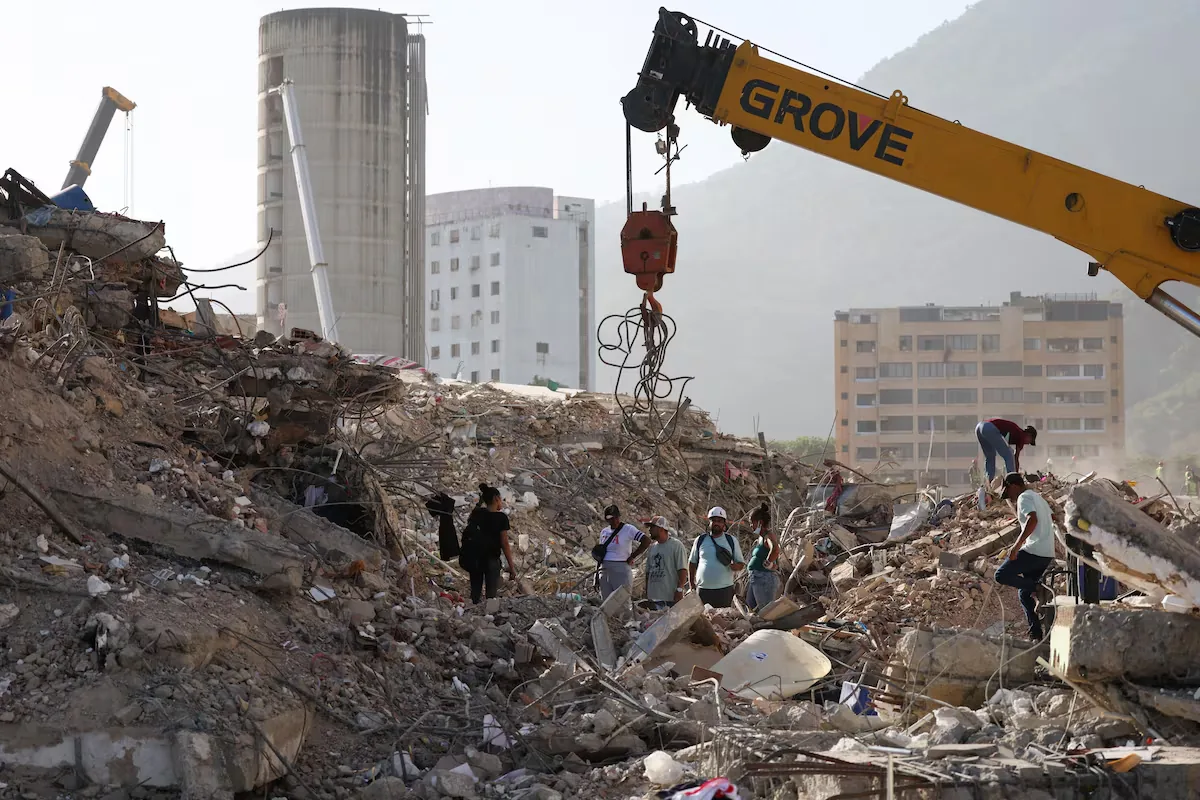
De la Espriella and his vice president, José Manuel Restrepo, have said that relations between Bogotá and Caracas will be channeled through the State Department – which has even caused a timid protest from the interim government in Caracas. Observers agree that Colombia can be by far the main beneficiary of both Venezuela’s incipient economic opening and the necessary reconstruction after the two devastating earthquakes on June 24, which caused more than 6,000 deaths. “There is a great opportunity: let’s walk hand in hand with the United States,” Restrepo said in an interview with this newspaper.
The new president, who arrives with the promise of a tough hand on security, has focused on that porous border of more than 2,200 kilometers. Before being sworn in last Friday, he inaugurated his “territorial handovers” in Cúcuta, the border capital of Norte de Santander, and appointed Jorge Eduardo Mora, a retired general from that region besieged by crime and armed groups operating on both sides, as Minister of Defense. In addition to trade and security, the migration issue also weighs. Almost three million Venezuelans have settled in Colombia in recent years, by far the main host country.