









During much of 2024 and 2025, the Government was able to present the fiscal surplus as the main asset of its economic program. In an economy accustomed to deficit, issuance, and accelerating inflation, the balance of public accounts worked as a clear signal: there was a political decision to break with one of the historical sources of macroeconomic instability. The results followed, as activity showed a sustained rebound and inflation dropped quickly.
Read more Desktop fans to work without melting: four best-selling models
The problem is that this signal began to show increasingly evident tension, since fiscal revenues have been falling for several months (in the first four months of the year they decreased by 7%). Why is revenue falling? Mainly due to a combination of factors associated with the slowdown of the domestic market that impacted the collection of the main taxes: VAT (associated with domestic economic activity), the tax on high incomes, and social security contributions (associated with registered employment). Although there were some tax reductions, they were smaller (the rate of the tax on agricultural exports was reduced by 1 to 2 points depending on the crop), as was their impact on revenue.
And since the government wants to strictly maintain the fiscal target, this requires a public spending adjustment of a similar magnitude, which is what is effectively happening (so far this year spending has been reduced by 4%. The main cuts were in social programs, public works, and transfers to the provinces).
The issue is that the economic context is not the same. Now that cut must be made on public spending that is at historic lows, in a socioeconomic framework that, as we said, has not rebounded for months and with inflation remaining at high levels. Added to this is the outbreak of the corruption case involving the Chief of Staff, Manuel Adorni. The combination of these elements led to a marked decline in the government’s image, something reflected in all polls.
A sign of this frustration was the massive mobilization that took place last week against cuts in university education (accumulating a 35% adjustment since the start of this administration). This scenario signals that society no longer perceives—or at least doubts—that all this adjustment is something temporary and that “the worst is over,” as the president has repeatedly said.
Here lies the crux of the problem. If revenue falls and the Government is not willing to relax the fiscal target, that forces an adjustment of public spending that is not only at historic lows but also risks negatively impacting economic activity, causing a new drop in revenue and feeding back into the process.
Read more These 20 brush heads are compatible with Oral-B brushes and cost just over 10 euros
The Hellenic mirror
Europe knows this mechanism well. The most extreme case was Greece, but Spain, Italy, Portugal, and Ireland also suffered during the debt crisis that plagued the region between 2010 and 2014. Market distrust in the ability to pay the public debt of these countries led to a strong fiscal adjustment to try to balance public accounts and thus bring calm to the markets.
The issue is that this adjustment was applied to economies already hit by the 2008 financial crisis. Thus, the cut in public spending negatively impacted economic activity and revenue, causing the fiscal result not to improve substantially. There the vicious circle became clear: fiscal adjustment, instead of bringing calm to the markets, caused more panic, as the drop in activity and revenue generated more doubts about the ability to pay the debt, which forced countries to adjust even more.
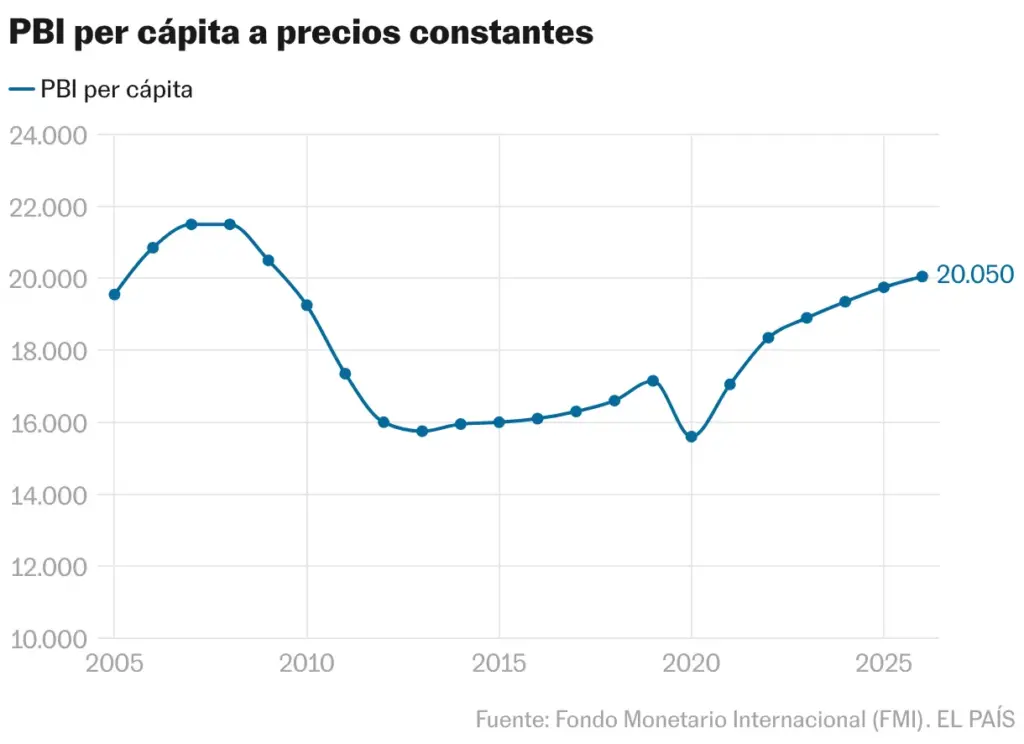
As can be seen in the graph below, GDP per capita fell 25% between 2008 and 2012, but also then remained practically stagnant at those levels for another 4 years. From there, a sustained recovery began, but by 2026 it still had not recovered the 2008 levels.
Of course, there are important differences between the Greek and Argentine economies. The comparison has obvious limits, since Greece is part of the eurozone and, therefore, could not devalue to correct relative prices and faced a sovereign debt crisis in a completely different institutional framework. But the Greek experience serves as a warning on a specific point: a very intense fiscal consolidation, applied to a depressed economy, risks causing a negative effect on fiscal revenues and prolonging the adjustment, eroding not only economic activity but also the social base that supports it.