





The official candidate, Iván Cepeda, would emerge victorious in both the first and second rounds of the presidential elections, according to a survey by the National Consulting Center (CNC) published by the magazine Cambio this Sunday dated April 30. According to the results, the senator from the Historic Pact would win in the first round of the elections, with 37% of the votes. Behind him would be the far-right lawyer Abelardo de la Espriella (20.4%), the Uribista candidate Paloma Valencia (15.6%), and, far behind, the centrist candidates Sergio Fajardo (2.7%) and Claudia López (1.5%). In the second round, Cepeda would win with 46.4% against De la Espriella (37.9%) and with 44.0% against Valencia (40.0%). The same would happen with Fajardo (46.2% against 31.5%) and López (46.5% against 24.9%).
Read more THE COUNTRY of the future starts today
The survey is released two days after the Labor Day speech by President Gustavo Petro in Medellín, in which he defended the policies of his Government and spoke again about his idea of convening a National Constituent Assembly. The head of state criticized the opponents who have challenged several of the flagship reforms of his Administration, and the television media that, according to him, say there is chaos in health care in Colombia. Additionally, he formalized his campaign for a Constituent Assembly, although he assured that he does not wish to reform the current Constitution, but to add a couple of chapters.
Iván Cepeda would triumph in the first round and defeat any candidate in the second, according to the National Consulting Center survey
The official presidential candidate, Iván Cepeda, would win the elections both in the first and second rounds in any scenario, according to the National Consulting Center (CNC) survey for the magazine Cambio, published this Sunday dated April 30. According to the results obtained by the polling firm, the senator from the Historic Pact would win in the first round of the elections on May 31, with 37% of the votes. Behind him would be the far-right lawyer Abelardo de la Espriella with 20.4%. In third place would be the Uribista candidate, Paloma Valencia, with 15.6%. Far behind the leaders would be the centrist candidates Sergio Fajardo (2.7%) and Claudia López (1.5%).
According to the poll, Cepeda would also prevail in any scenario in which he had to face a second round. If he had to face De la Espriella, he would obtain 46.4% of the votes, against 37.9% of the populist lawyer. And if he reached that stage with Paloma Valencia, he would win with 44.0% of the votes, against 40.0% of the Uribista senator. He would defeat Fajardo with 46.2% (31.5%) and Claudia López with 46.5% (24.9%).
The survey results show an increase in voting intention in favor of Cepeda of almost three percentage points compared to the March survey, when he registered 34.5%. However, despite the winning scenarios for the official candidate, the CNC also indicates that he is the candidate who causes the most resistance among respondents: 32.7% of them stated that they would never vote for him for the Presidency. Following him in this item are Abelardo de la Espriella (16.0%), Paloma Valencia (15.1%), Claudia López (4.5%), and Sergio Fajardo (2.7%).
The figures published by the CNC do not show significant variation compared to surveys from other firms, in which Cepeda has maintained solid leadership for several months. However, it does show a change among right-wing candidates: Valencia, who had a surge after her success in the interparty consultation on March 8 and reached 22.2% in voting intention at the end of that month, dropped to 15.6% in April, while De la Espriella, who marked 15.4% in March, gained ground and rose to 20.4% in April.
The CNC results are based on opinions collected in 2,157 surveys conducted in 56 towns across the country. Men and women over 18 years old from all socioeconomic strata participated. Data collection took place between April 23 and 30, and the margin of error for this survey is 3.0%.
Sergio Fajardo: “The Constitution cannot be a weapon of electoral war”
Centrist presidential candidate Sergio Fajardo reacted this Friday to President Gustavo Petro’s announcement in a speech in Medellín, in which he stated that on July 20 he will present the text of his constituent proposal with at least five million signatures. “Serious announcement from the president about a possible Constituent Assembly,” Fajardo wrote on his social networks. He also predicted: “If the opposition wins, this is the initial quota of a social confrontation never seen before.” At the beginning of April, Fajardo had announced his intention to gather signatures, but to defend the current Constitution. According to Petro, he does not intend to change the 1991 Constitution, but to add two chapters.

Petro states he only wants to add two chapters to the Constitution, not reform it
The president calls for a Constituent Assembly but says it is not to change it entirely, but to add two chapters.
“Not changing the 1991 constitution, it is not necessary to change it,” he said. “What we want is to change two chapters: one of the legislative acts that make Colombia’s rights a reality; and another with the reform of the political system, which definitively corners corruption in Colombia.”
Petro bets on five million signatures for July 20
The president says these signatures in favor of the Constituent Assembly will be delivered to the new legislature after the presidential elections, which are held in May and June.
Petro formalizes his campaign for a National Constituent Assembly
The president again asks citizens to vote for those who defend his social reforms, which are currently championed by his friend, senator and presidential candidate Iván Cepeda. “Our campaign also has to raise the idea that not only a leader is elected but that the mandate of the people is put in front,” says the president. “Here I want to start another campaign, mine, that of those who accompany us from the government, from Colombian society,” he added. “There is only one way: it is called National Constituent Assembly.”
Petro: “We have to achieve that the Bank of the Republic again buys all the gold of Colombia at international price”
In the ongoing fight that President Gustavo Petro has with the National Bank, especially because the institution has not lowered interest rates to control inflation, the president mentioned a reform he would promote if a Constituent Assembly were to take place: “We have to achieve that the Bank of the Republic again buys all the gold of Colombia at international price.” This, he says, to discourage illegal mining that seeks to sell gold illicitly to the informal international market.
Petro asks Daniel Quintero to sue those who have stolen health resources
The president makes the request to Daniel Quintero, former mayor of Medellín well known to the audience in front of him. Quintero was appointed this week as the new Health Superintendent, and the president especially asks him to look for the corrupt in Fomag, the fund that manages public health resources.
Petro: “The oligarchs’ television says there is a health chaos in Colombia”
The president downplays the health crisis reported by what he has called the “oligarchs” media. “Even if one looks closely at the accounts, but they don’t see them because sectarianism blinds them, the biggest job creator in the last year is called health,” he assured. “An army of health force. We have a paradox. While private EPS go bankrupt because they have stolen public money from Colombia, 360,000 health sector workers have started working to take care of Colombia’s health that the EPS do not care for,” he added, about the companies that function as entities that manage health.
Petro criticizes Paloma Valencia for suing his pension reform
“That complete pension reform has not been approved,” said the president. “I think Paloma (Valencia) sued it, among others, I won’t get into politics. The congresswoman sued the reform, the bankers applauded, and a judge friend of hers decided to keep it on his desk.”
The pension reform is suspended while it undergoes review by the Constitutional Court.
Petro: “If economic conditions deteriorate, the national government will raise the salary again”
The president lists a long balance of his government, focusing especially on social reforms he promoted: the vital minimum wage, which increased the minimum by 23%; and support for the elderly population. “There are achievements to count, we would spend the whole night,” who also claims achievements in reducing infant mortality. “If economic conditions deteriorate, and there are those who want to make them deteriorate, the national government will raise the salary again, to maintain the purchasing power of the working people,” he promised.
Gustavo Petro: “I hope more progressive mandates follow in Colombia”
The president begins his speech recalling that a year ago he took to Bogotá’s central square, Plaza de Bolívar, the liberator’s flag to defend the labor reform and the popular consultation he then promoted. Without mentioning Senator Iván Cepeda, his friend and presidential candidate who leads the polls, he sent the signal that he expects his election. “I hope more progressive mandates follow in Colombia,” said the president. “That they don’t return us to horror, that they don’t return us to Escombrera,” he added, about a place where disappeared bodies were found in the department where he speaks, Antioquia.
Petro’s delegation defends labor reform and the Constituent Assembly
Before giving his speech, some political leaders said a few words alongside the head of state. Armando Custodio Wouriyú Valbuena, manager of the promoting committee for a Constituent Assembly, gave the president a t-shirt promoting the Constituent Assembly. The Minister of Labor, Antonio Sanguino, who promoted one of the government’s most popular social reforms, the labor reform, also spoke briefly. “The constituent process does not start today, Mr. President; the constituent process started the first day of your government,” said Sanguino, recalling the promoted labor reform and the possible popular consultation that Petro pushed when it sank in the legislature.
Gustavo Petro starts last speech as president on May First
The president arrived on time in the Antioquia capital, Medellín, where the most powerful man since 2002 has been his arch-enemy, former president Álvaro Uribe Vélez. Next to him, on the platform, one of those present waves a flag of the guerrilla group he belonged to, M-19. The audience waves some white flags calling for a Constituent Assembly, and others a banner that says ‘No more 7,837’, referring to the last official figure known about the number of ‘false positives,’ or extrajudicial executions committed by the public force.
Petro shares on his social networks the signature form to demand a Constituent Assembly
Although President Gustavo Petro insists at times that the idea of a Constituent Assembly is of popular origin, no one promotes it as much as he does from the Government. Before traveling to Medellín to deliver his May First speech, he shared on social networks a link for citizens to download the form that allows them to collect signatures in favor of a constituent assembly. “Signatures must be valid, they must not overlap, I left a line in between signatures,” he said in a tweet on X. “I ask you to make copies and give them to your friends and colleagues at work and study,” he added.
At the beginning of the week, the president also shared on his networks the number of a bank account to which transfers can be made “up to ten million” to support the signature collection campaign.
Cepeda: “On August 7 we will give a hug of gratitude to our comrade Gustavo Petro”
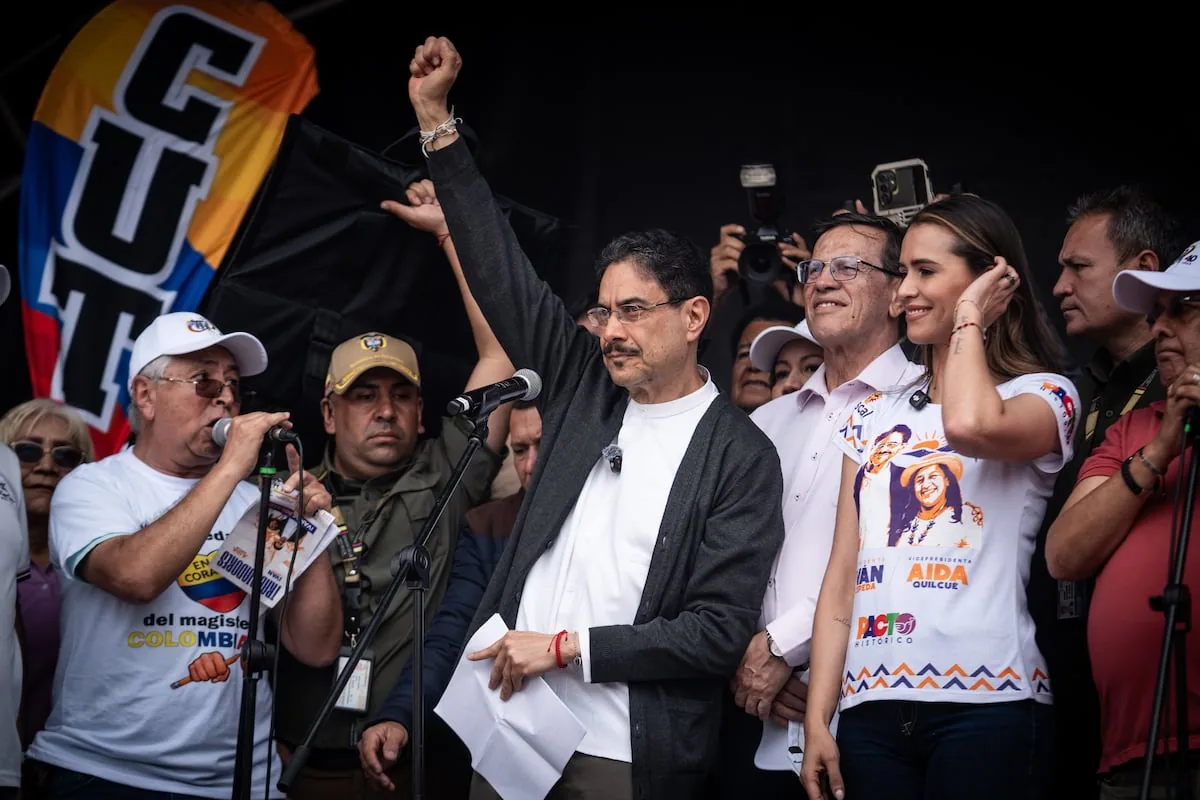
Iván Cepeda’s speech was a tribute to President Gustavo Petro, leader of the left whose popularity catapulted Cepeda to the top spot in voting intention polls. Cepeda praised his labor and pension reform, his increase of the minimum wage. Reforms that especially benefited the unions marching this May First, and all formal workers. He did not dwell on more controversial policies of the president, such as Total Peace, a failed initiative to negotiate with armed groups of which Cepeda was an architect. Optimistically, he repeated that he believes that with the support of citizens they will win in the first round. “Today we are everywhere and we are the great political force of transformation in Colombia.”
Iván Cepeda: “Today we complete 100 mass events around the country”
Cepeda says he has already spoken in public squares before half a million people. “I can proudly say this is my 100th speech, the 100th little paper,” added the one who always addresses the public with a written speech. “With pride and conviction I can tell you that on May 31 we will triumph in the first round of the presidential elections,” he assured optimistically about not having to go to a second round in June against Abelardo de La Espriella or Paloma Valencia.
Read more Álvaro García Ortiz: “With my sentence we have all lost, including the Supreme Court”
Iván Cepeda: “Let Mrs. Valencia hear this: we will defend the pension reform”
The left-wing candidate has not referred by name to the far-right candidate, Abelardo de La Espriella, but he has to the Uribista right-wing candidate, Paloma Valencia, also a senator like him, with whom he has clashed in the legislature over Petro government reforms.
“Let Mrs. Valencia hear this: we will defend the pension reform,” he said about one of Petro’s reforms that the senator sued before the high courts.
Cepeda also said he will continue protecting the ‘vital wage,’ a concept Petro introduced for the first time in January when he decided to increase the minimum wage by 23%, well above what the unions demanded.
Iván Cepeda cites ‘constituent power’ and Bob Marley in his May First speech
“The time has come to be constituent power, which is at the same time transformative and vigilant,” said the official left-wing candidate, Senator Iván Cepeda, before a huge crowd in downtown Bogotá. It is a nod to a controversial banner of President Gustavo Petro, who has been pushing for a Constituent Assembly, but which Cepeda has said in the past is not his priority.
The left-wing candidate also spoke of the election as one between petrismo and uribismo: “On one side is the Uribista far right, and on this side the progressive, popular, and democratic forces.” “The far right, its leader Álvaro Uribe Vélez, its presidential candidate and candidate, represent the continuity of the neoliberal model. The model of opulence for a narrow elite,” he added.
Some words were also for Bob Marley and his song Redemption Song, which the senator quoted for calling to free oneself from “mental slavery.” “Our people have become fully aware that we cannot continue tolerating the levels of inequality and poverty historically imposed on us. We are aware that the historic time for social transformation has arrived, whose foundation we have already laid in these four years of government,” the candidate states.

The CNE opens an investigation against Cepeda for alleged irregularities in his Historic Pact consultation campaign
The National Electoral Council (CNE) has opened a preliminary investigation against the Petro candidate, Iván Cepeda, for alleged irregularities in his campaign for the Historic Pact interparty consultation in October 2025.
According to complaints received by the administrative body, Cepeda would have exceeded the 10% private financing cap he could receive in this campaign due to contributions made by the company Samat Publicidad, worth 609 million pesos, and by the legal representative of the same company, worth 116 million.
Cepeda and seven other candidates have been questioned for not revealing their income and expenses in Cuentas Claras, the official CNE platform. He is the only one among the leaders in the polls who keeps his campaign finances secret.
Petro prepares to give his last May First speech
President Gustavo Petro is preparing to give this Friday his last May First speech as president. This is a special date for the leftist, who for the last three years has used it as a platform to defend his ideas and counterattack his rivals. On this occasion, he will be in Medellín, where he has already announced that he will convene the National Constituent Assembly, the prior step to reform the 1991 Constitution. The idea, which has been widely criticized, seeks to modify, in his words, the Colombian “political system” and approve the social reforms “that were not allowed in Congress.”

Abelardo de la Espriella’s campaign distances itself from former commander Eduardo Zapateiro, charged with sexual harassment
Former commander Eduardo Zapateiro will stop advising Abelardo de la Espriella’s presidential campaign, in which he participated as coordinator of the Army reserve. Through a statement, Defenders for the Homeland, as De la Espriella’s movement is called, assured that the decision was made by mutual agreement: “We consider that the right thing is for General Zapateiro to fully concentrate his efforts on his defense and to prove his innocence before Colombian justice.”
The candidate distances himself from Zapateiro after the Prosecutor’s Office filed a request for a hearing of charges against him for the alleged crime of sexual harassment, for acts that allegedly occurred when he was commander of the National Army. Although he recognizes the trajectory and contributions he made to the campaign, the movement was emphatic in reiterating that it defends women: “Women who serve the homeland, especially those who are part of the Military Forces, deserve safe environments, free from any form of harassment or intimidation. This principle admits no exceptions or nuances.”

The public media system agrees to hold three debates with presidential candidates before the first round
Colombia’s public media system agreed this Thursday to hold a series of three presidential debates with candidates before the first round. The announcement, signed by the manager of RTVC, was made after Claudia López, Sergio Fajardo, Luis Guilberto Murillo, and other presidential hopefuls requested televised meetings. Moderators and methodology are yet to be defined.
Father of murdered Miguel Uribe Turbay criticizes Uribismo for pointing to the Governor of Nariño in the judicial case
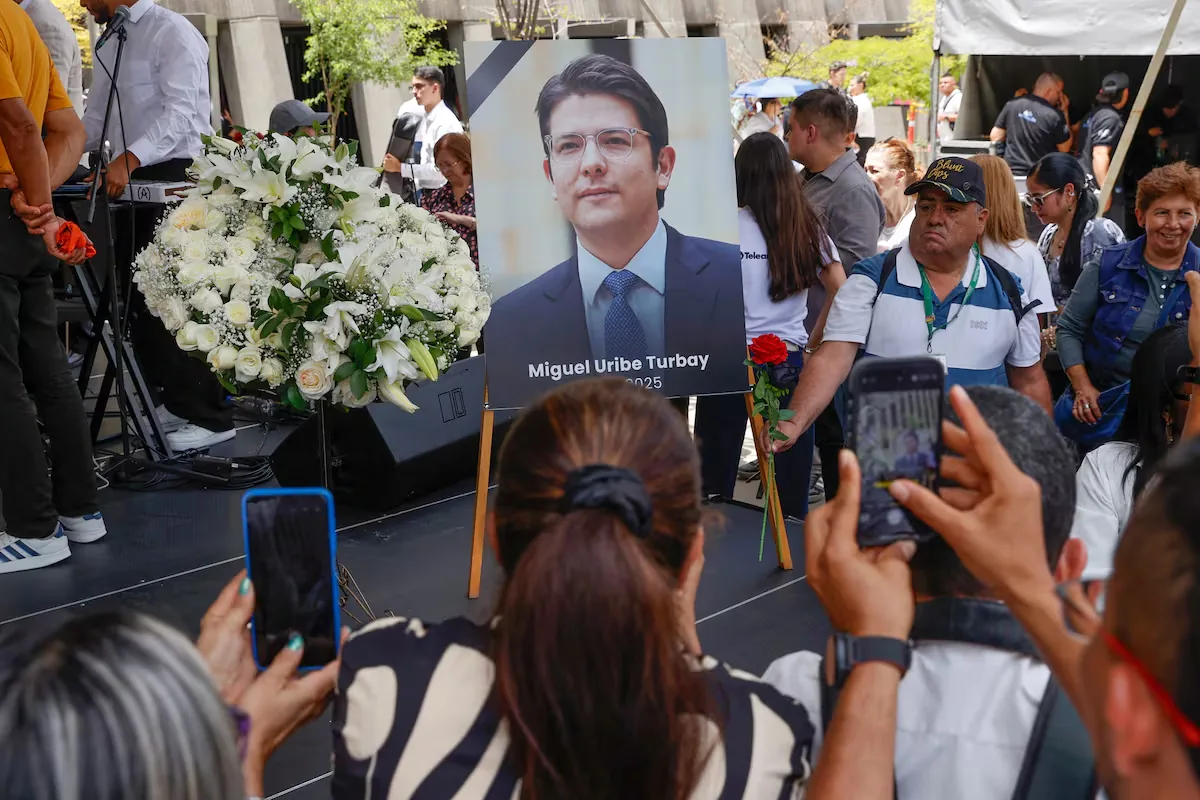
Miguel Uribe Londoño, father of Senator Miguel Uribe Turbay, murdered last year, criticized who was for years an ally of his son: former president Álvaro Uribe. He criticizes because Uribismo has suggested since yesterday, by publishing an anonymous letter on social networks, that the Governor of Nariño, Luis Escobar, is behind the crime. It is an accusation that the Prosecutor’s Office has not made, which has pointed to the Second Marquetalia as the perpetrators of the crime. “What has circulated from Álvaro Uribe Vélez’s environment is irresponsible and deeply disrespectful,” says the father of the former senator. “You cannot play with anyone’s reputation and good name, as was done with mine. The accusations against Governor @LuisAlfonsoEsc based on an anonymous letter are unfounded.” Uribe Londoño also criticized that the founder of the Uribista party and its presidential candidate, Álvaro Uribe and Paloma Valencia, say they represent the flags of the murdered senator. “And one more thing, it is an abuse by the Democratic Center, its leader, and its candidate to use my son Miguel’s name in their campaign. I carry the flags,” he added.
Miguel Uribe Londoño, who is a presidential candidate, divorced from the Democratic Center in December. Álvaro Uribe expelled him from the party considering that the father of his star senator wanted to go support the far-right candidate, Abelardo de La Espriella. He decided to run alone for the presidency, but for now he does not reach 1% in voting intention.

Álvaro Uribe: “The constituent assembly withers the private sector”
Former president Álvaro Uribe referred this Thursday to the petrismo plan to convene a Constituent Assembly to reform the 1991 charter. “The constituent assembly promoted by Petro and Cepeda withers the private sector, as seen in Cepeda’s government program,” he stated in a tweet.
The leader of the Democratic Center has considered that Petro’s proposal demands pure state monopolies, such as health: “They annul the private, use public hospitals for corruption and to finance campaigns, bankrupt the Cancer Institute, and intend that all citizens become slaves of the government’s exclusive, inefficient, and thieving health system.”
On the other hand, Uribe distanced himself from his candidate Paloma Valencia’s idea of becoming Minister of Defense if she wins the Presidency. “I am already very old. Paloma is such a capable woman that she can take the Ministry of Defense to the Presidency and exercise it herself.”
Cepeda wins in the first round but loses in the second against Valencia, according to the new Guarumo survey
The Historic Pact presidential candidate, Iván Cepeda, has the highest voting intention for the first round of the elections on May 31, according to the latest Guarumo survey published this Thursday. However, contrary to the trend in several polls, in the second round he would be defeated by the Uribista candidate, Paloma Valencia, and would be in a technical tie with the far-right lawyer Abelardo de la Espriella.
According to the firm’s figures, in the first round Cepeda would obtain 38% of the votes. He is followed by De la Espriella, with 23%, and, further behind, Valencia, very close, with 22.8%. Sergio Fajardo (2.5%) and Claudia López (2.4%) appear far behind. All other candidates have less than 2%. Blank votes would obtain 7.2%. For the second round, Guarumo indicates that Valencia would obtain 44.6% of the votes, above the 40.1% support for Cepeda. And in a possible scenario facing Cepeda with De la Espriella, the senator would obtain 40.6%, while the lawyer would achieve a very close 40.4%.
The Guarumo survey coincides with all the others in recent months, which give Cepeda as leader and winner in the first round. However, it differs from most of them in the second-round scenarios, in which they also grant victory to the official senator. The most recent were published by Invamer and GAD3 last Sunday and Monday.
The Guarumo survey is based on interviews with 4,680 adults intending to participate in the elections, in 74 cities and municipalities across the country, in rural and urban settings. The regional distribution of the surveys was as follows: Bogotá, 17.7%; Caribbean, 18.6%; Coffee Axis, 17.9%; Pacific, 16.2%; and Southeast, 29.6%.
Hollman Morris invites candidates to specify details for a possible RTVC-moderated debate
The manager of Colombia’s public media system Radio Televisión Nacional de Colombia (RTVC), Hollman Morris, has made public a letter inviting presidential candidates to attend a meeting this Thursday to define the details of a possible debate. The call comes after seven candidates officially requested the media system to organize the debates contemplated in the Electoral Guarantees Law. Sergio Fajardo, Claudia López, Carlos Caicedo, Luis Gilberto Murillo, Mauricio Lizcano, Roy Barreras, and Sondra Macollins requested that the three televised spaces, each up to sixty minutes, required by law be guaranteed.
None of the leaders in the polls are among the applicants. Senator Iván Cepeda has avoided debates and replaced them with public squares, arguing distrust of traditional media, which he has labeled as part of the establishment. Abelardo de la Espriella and Paloma Valencia have shown willingness to discuss but have not attended these spaces, citing Cepeda’s absence. For now, this remains a campaign without debates. RTVC’s proposal opens a door for the main candidates to debate among themselves in front of cameras and present their proposals to the public.
Read more Three dead from a possible hantavirus outbreak on an Atlantic cruise that departed from Argentina