




Spain is rubbing its hands two years before the Los Angeles 2028 Olympic Games. Now, suddenly, without anyone expecting it, our sprinters, in a country of long-distance and middle-distance runners, have managed to stand out in the explosive relay events. Except for some isolated success in a European Championship, the national team had never achieved such a solid foundation. Until now. The women made a splash last year, in Guangzhou (China), with the victory in the 4x400m and the silver in the 4x100m at the World Relays, a qualifying competition for the major championships. In 2026, in Gaborone (Botswana), in a stadium packed with spectators, Spain, with no room left for surprise, reaffirmed its status with a silver medal in the 4x400m, with a new national record (3m 21.25s, ninth best European mark of all time), and another bronze for the 4x100m.
Read more European leaders and Canada support Armenia’s rapprochement with the West in Yerevan
The long relay keeps adding success after success. A couple of months ago, at the World Indoor Championships in Torun (Poland), the women’s 4×400 took the bronze medal and the mixed 4×400 relay, the silver. The Golden Bubbles, as they are known, achieved second place after a sensational race that ended with a new Spanish record that improved the previous best mark by almost three seconds, a world, (3m 24.15s). The four Spanish athletes had to run splits under 51 seconds to achieve this outstanding record: Paula Sevilla (50.60s starting from blocks), Ana Prieto (50.70s), Rocío Arroyo (50.51s) and Blanca Hervás (49.44s).
Paula Sevilla, who overcame doubts after Saturday’s effort, wanted to dedicate it to her mother and all mothers. “We want to honor women with this milestone,” said the athlete from La Solana, Castilla-La Mancha. Ana Prieto was almost scared when Sevilla handed her the baton in first place and it was clear she was pulling ahead. “I saw on the curve that no one was following me and I said, ‘What is happening? I can’t believe the time,’” she said. Rocío Arroyo, a woman of tremendous strength, specializing in 800m since last year, ran the third leg. “I’m taking this experience with me because I had never lived anything like this,” she commented. And Blanca Hervás, the Madrid native who left the Torun World Championships with two relay medals and a sixth place individually, was in charge of finishing the work of all and did not obsess over chasing the other because she knew she had the Norwegian Henriette Jaeger ahead, an athlete with a 49.49s mark and an Olympic 400m finalist. “I’m very excited,” she exclaimed. “I would qualify this as one of the greatest joys. We did a lot of calculations and none showed this time.”
🥈Silver medal and Spanish record 3:21:25🥈
🇪🇸 The “Golden Bubbles” have done it again
BRAVO 👏@paulasevilla7, Ana Prieto, Rocío Arroyo and Blanca Hervás#SpainAthletics #WorldRelays pic.twitter.com/Y2cApf0yBp
Read more EL PAIS Festival, day 3: how to continue for at least 50 more years
— Teledeporte (@teledeporte) May 3, 2026
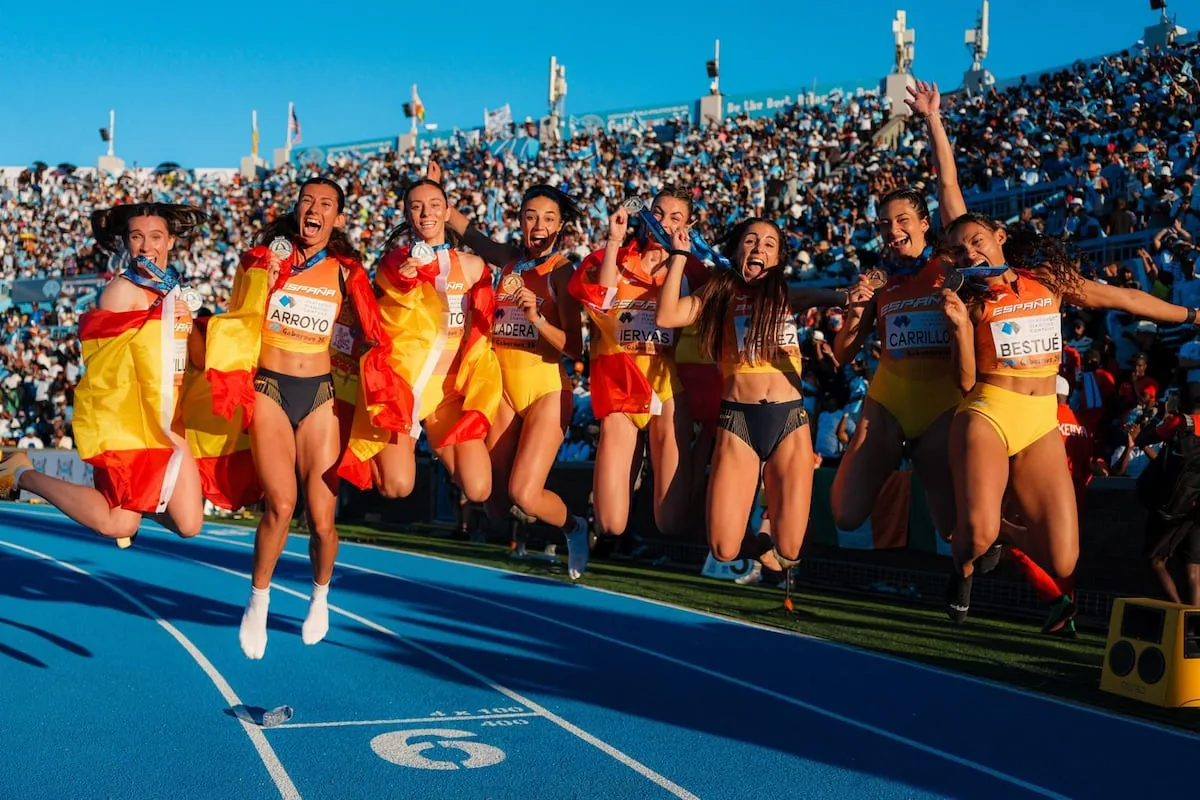
The women’s 4x100m relay finished one step below (42.31s). Lucía Carrillo, Jaël Bestué, Esperança Cladera and Maribel Pérez stayed on the podium a year after winning the silver medal. Another success for a team, with Bestué and Pérez as the base, that had already achieved fifth place at the World Championships in Tokyo (2025) and Eugene (2022).
Spain had a second goal in Botswana: to qualify the highest number of teams for the 2027 World Championships in Beijing. In the end, it almost achieved a full house and qualified five of the six relays. Only Australia managed to qualify all six, and Spain, like Canada and Great Britain, fell short by one. The Spanish team will be at the World Championships next year with the two mixed relays — they also qualified for a new competition, called the Ultimate Championship, which will be held in Budapest next summer — the two 4x400m relays and the women’s 4x100m.
The Spanish team is beginning to reap the fruits of the National Relay Plan (PNR) devised in 2017 by Pepe Peiró, the national coach, when he was still responsible for the sprint sector. The Spanish federation decided to invest time, qualified coaches like Toni Puig, Ricardo Diéguez, Ester Lahoz or Valentín Rocandio, and money, with regular training camps to refine the technique that would allow their sprinters, with less physical potential, to match those from countries like Jamaica, the United States or Great Britain. More important than all that was convincing the athletes that it was possible. The following year, at the European Championships in Berlin, came the first success, who knows if the springboard for everything that followed, the men’s 4x400m bronze medal at the 2018 European Championships in Berlin. Spain hopes to complete its plan at the Los Angeles Olympic Games.
Read more The real Cannibal is Slovenian, beware of imitations