







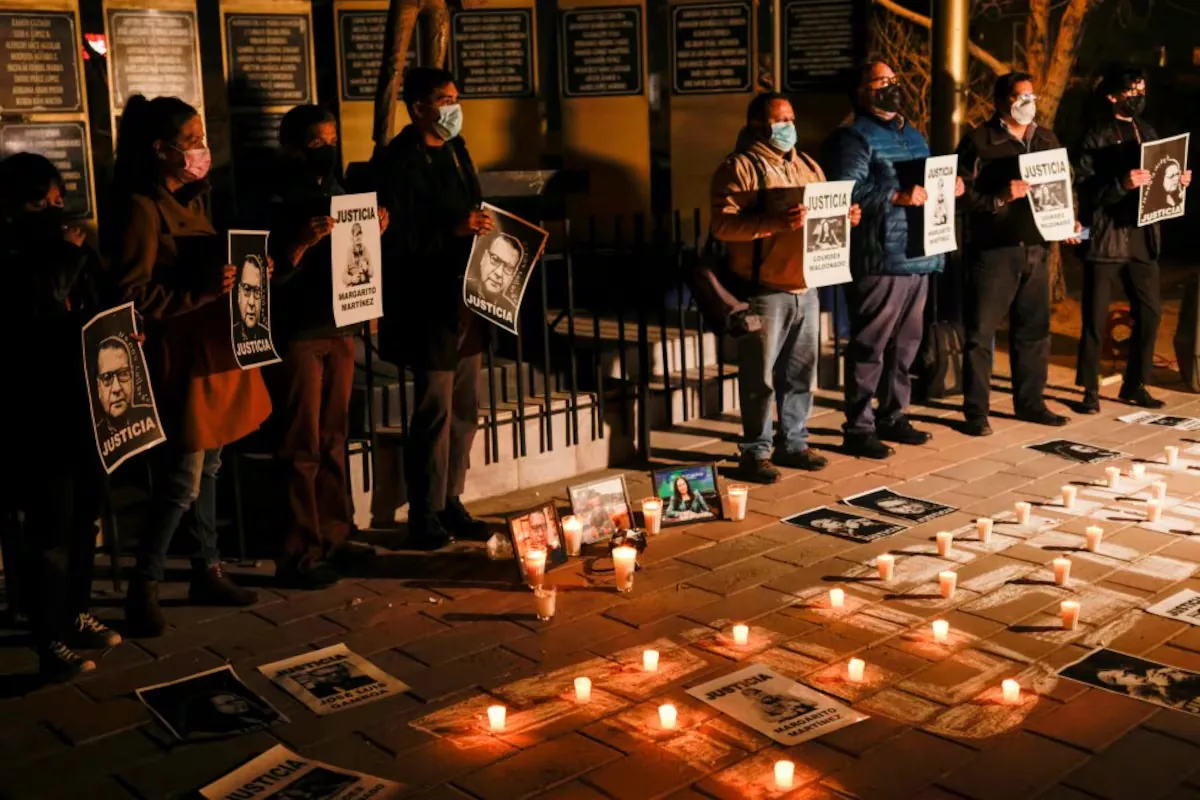
In Mexico, the killer of journalists has a blurred face. Since the crime intertwined with politics at such a deep level, especially at the state and municipal levels, denouncing an act of corruption, for example, has become risky, not to mention denouncing drug trafficking, human trafficking, fuel theft. The one who kills the journalist is not only the one who pulls the trigger, but the web of complicity behind it. And what has made the crime so rampant in this country is its impunity. At least 183 journalists have been killed in Mexico since 2000, according to the count by the freedom of expression defense organization Article 19. In the last 15 years, there have only been nine sentences against those responsible. The Latin American country is considered in international measurements one of the most dangerous, one of the deadliest, to practice the profession.
Read more Trump dismisses the USMCA: “It is important for Mexico and for Canada. Not for us”
The last journalist killed in Mexico was the Oaxacan Alejandro Leyva Aguilar, on July 22, the seventh so far this year. With three decades of experience, Leyva had become a frontal critic of the state government, led by Salomón Jara, from the ruling Morena party. With investigations still ongoing, the governor has tried to distance himself from the matter, claiming that his administration respects the press and guarantees dissent. For Leyva’s colleagues, the washing of hands is not so simple. “Alejandro’s murder comes from here, it comes from the Oaxaca government, it comes from this apparatus,” a reporter told Jara at a meeting organized by the executive with journalists after the crime.
In many cases, the victims had previously reported the risks they were exposed to or directly received threats against them, without the authorities addressing those concerns, as in Leyva’s case. Some even had institutional protection, such as Veracruz native Luis Ángel López Valdez, who was shot 18 times on June 11. The warnings and the government protection show have been of little use, given the increasingly numerous number of deaths of colleagues. While this is the extreme type of violence against the press, there is a spectrum of aggressions that includes the criminalization of the profession in states where laws are passed or sentences issued that have led journalists to jail, as in San Luis Potosí.
It has also become common to stigmatize or discredit journalists from power. This does not happen only in Mexico. On the contrary, it has become a trait of popular leaders who tell their electorate that the press has become the enemy of the people. The President of the United States, Donald Trump, has done this every time he has disqualified uncomfortable reporters, whom he has called “terrible” at their job, “dishonest,” “stupid,” “hateful,” “unpatriotic.” The millionaire president has also resorted to lawfare and has sued several media outlets, from newspapers to TV networks, through civil means.
Although the disqualifications do not kill by themselves, they create an environment of disdain for the work of journalists. In Mexico, former president Andrés Manuel López Obrador used his popular press conferences to confront journalists and media, justifying that he was obliged to deny misinformation (which he considered slanderous). Human rights organizations warned that several of the president’s responses fell into the realm of aggression. Despite this, López Obrador did not stop in his conferences and, in fact, set a precedent. His successor in office, Claudia Sheinbaum, has maintained two spaces, Detector de Mentiras and Derecho de Réplica, dedicated to refuting media publications in the same tone.
Several ruling party governors replicated the model and created similar spaces in their official conferences. This is what the governor of Oaxaca did, launching a program called Trapitos al Sol. One of the journalists exposed in that space was precisely Alejandro Leyva. The journalist reported last year having been the target of attacks and threats on social media, which he directly linked to the accusations made by Jara’s executive in that program. The state prosecutor’s office took four months to acknowledge receipt of his complaint, which also did not lead to any improvement for him.
Some murdered journalists were victims of extreme violence, such as Regina Martínez (2012), correspondent for Proceso in Veracruz, brutally beaten and strangled, or photojournalist Rubén Espinosa (2015), also from Veracruz, tortured for an hour before being killed with a shot to the head. There are indications that their murders are related to their journalistic work, under the mandate of Javier Duarte (PRI). His government has been the deadliest for the press, with 18 journalists killed during his six-year term.
However, violence against journalists seems not to distinguish colors and parties. Veracruz is again the state with the most journalists killed this year (three out of seven). The case of Roxana Martínez, founder of Pulso Informativo del Sureste, shook the country after a video of her kidnapping by men with covered faces and armed, on June 2, was released. After weeks of anguish, at the end of the month, authorities reported finding her body. Without waiting for the results of the investigations, the governor, Rocío Nahle (Morena), had rushed to declare that her tragic fate had nothing to do with her profession. So, what do the crimes against journalists in Mexico have to do with? Why are they killed? Who benefits from their silence?
Read more Malvinas: the strength of a just cause