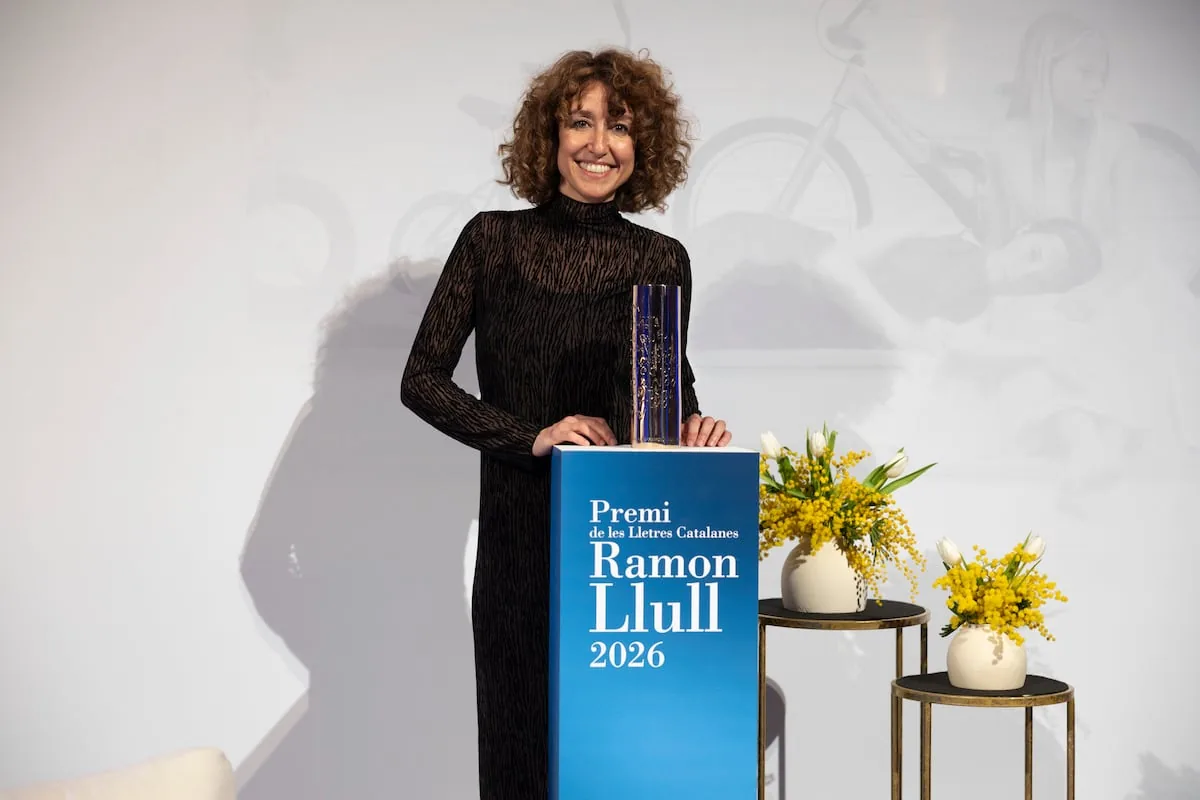
It’s not always easy to escape a photocall. At the Capella dels Àngels, the space where the Ramon Llull award ceremony is held, it is located between the entrance door and the audience chairs, so if you’re not quick-witted, you walk in and are stunned by the flash. Some get scared, one jokes and asks a little hysterically where the canapés are, but in general everyone knows very well how to act. The audience consists of TV3 personalities, editors, flagship writers from Grup 62, and some politicians; surely many coincide at this party every year. It is already known that the winner of this edition is Agnès Marquès, and they are still taking photos of her while someone next to me thanks Ada Parellada for the recipe for ‘fideus a la cassola’ (casserole noodles).
As I said, the award, which comes with a 60,000 euro editorial advance, was announced weeks ago, and naturally, more or less hyperventilated jokes and complaints have started circulating: “another journalist”; “a media personality, with a literary award gaining visibility just before Sant Jordi”; “a commercial operation of questionable literary quality”. I doubt for a second if we’ll see her apologize a little, but the award presentation conversation with Helena Garcia Melero is extremely professional. Marquès masterfully combines maxims (“love is the goal of life, but also the reason why we make controversial decisions,” “with news and rumor, the same thing happens: you get close and the headline drops”) and anecdotes that illustrate them; Garcia Melero warns: “The novel is very cinematic, I’ll just leave it at that!”. Although no one is filming, everything is perfectly televisual, and there’s none of the pedantic discomfort of many writers, with that pose as if the book speaks for itself and any question is offensive.
As we know, the history of media writers is not new and resurfaces every year around April 23rd. Although the term has broadened, we still define as ‘media personalities’ those who have a regular presence in traditional media and publish books. The order of factors is indifferent; there are many renowned writers who collaborate with the media, with Monzó and Pàmies as great examples, but also Llucia Ramis or Màrius Serra. Nevertheless, the term is generally used disparagingly for those who have visibility in traditional media, especially on TV3, and suddenly feel a literary urge. That is, we assume they receive an editorial commission to publish because they are well-known and have access to a good circuit for promotion. The most recent chapter in the history of media personalities was last year, when, just before Sant Jordi, the Catalan Audiovisual Council (CAC) “requested explanations” from TV3 regarding “the presence in its programming of writers related to these media outlets”. If you recall, it was the year of Toni Cruanyes, Xavier Bosch, Sílvia Soler, Manel Vidal, Xavier Sala i Martín. According to the CAC, the previous year (2024), “22% of the authors who were given a voice in TV3 programs during Sant Jordi Day 2024 had a recent professional relationship with CCMA media outlets”. The study concluded that, while this does not constitute a violation of regulations, “a deep reflection on the criteria used for considering a newsworthy event in the dissemination of literary works” is necessary. This year, no one has spoken out, and the pre-Sant Jordi spectacle has followed its natural course.
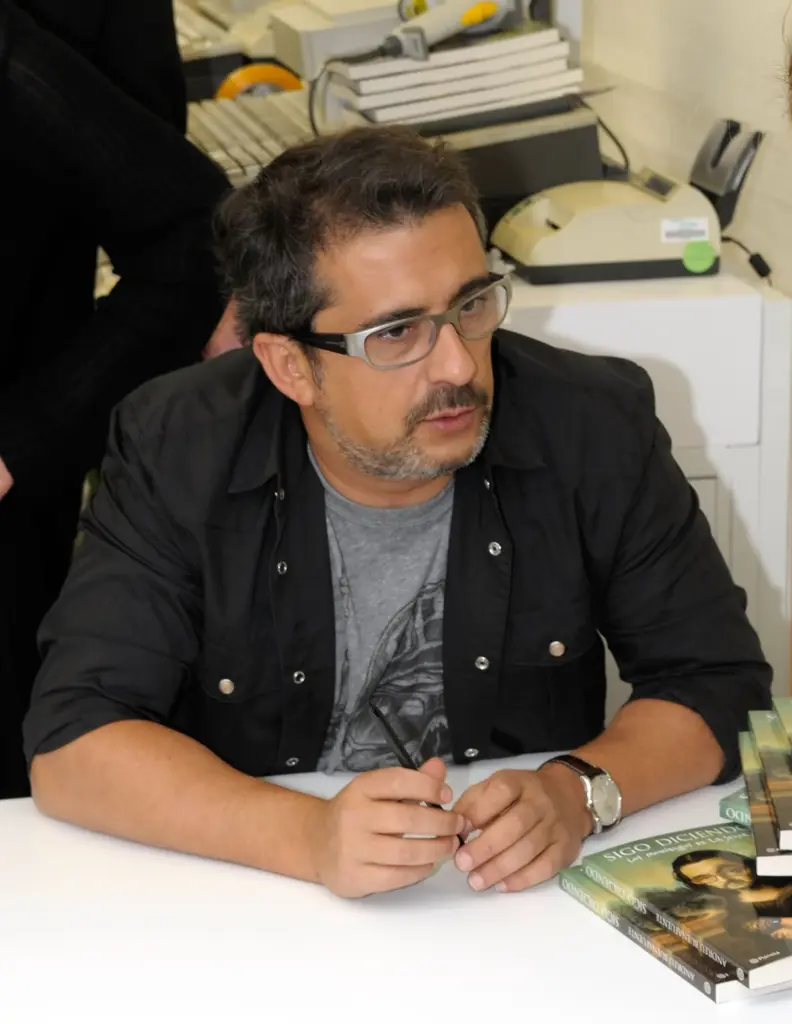
If we go back in the chronology of the concept, there is some consensus on highlighting a couple of episodes. The first could be the origin of its popular use, when in 2000 Andreu Buenafuente published his monologues in book form with Columna and sold them in droves. A television genre (i.e., non-literary) occupied the space of literature. Shortly after, in 2004, Baltasar Porcel promoted a manifesto titled “The Dragon Eats Sant Jordi,” signed by Alfred Bosch, Carme Riera, Emili Teixidor, Ferran Torrent, Gemma Lienas, Isabel-Clara Simó, Robert Saladrigas, and Porcel himself, against the transformation of Sant Jordi Day into a media spectacle. A tantrum from literary writers, who saw that some figures received more attention than them and threatened never to participate again. We all know that hasn’t been the case.
Another important moment was in 2013, starring Pilar Rahola. The Booksellers’ Guild, which every year publishes the list of best-selling books (with all the relevant caveats that they only represent 5% of sales), that year added a specific category for media authors. Rahola, who was included, was annoyed at not being considered literary, which led to the category being removed from the list. ESCI-UPF professor Toni Duró, who dedicated his doctoral thesis to it, considers this episode a turning point in the publishing world, because the label consolidates but at the same time it is assumed that “in the current hypermodern context, we are all media personalities”.
Television in Books
According to Màrius Serra, the eternal nature of the controversy stems from resentment over the loss of centrality of literary writing in public discourse: “My generation still lived in a time when literature was respected, but little by little the balance shifted towards the media”. Paradoxically, the book remains an element of prestige, but Serra reminds us that prestige, etymologically, comes from the verb to feign. The writer was tasked with speaking about the frictions between literature and television both at the seminar and in the book that professors Jordi Marrugat, Víctor Martínez-Gil, and Núria Santamaria have dedicated to the study of literature in the audiovisual era (La literatura del nostre temps, PAMSA).
With the arrival of television, Catalan literature “transforms not only because it is written by those who live from television, but by someone who thinks about what happens to the reader when they watch television,” states Marrugat, following David Foster Wallace’s much-cited text E Unibus pluram, in which he analyzed in 1999 the transformation of postmodern American narrative with the advent of the screen. As Serra writes, Quim Monzó has acknowledged the influence that a document with scriptwriting guidelines, passed to him in 1984 from the then newly launched Catalunya Ràdio, had on his “refined” literary style. Empar Moliner has built a literary work in which she satirizes the world of talk show panelists, television, and now, column writing (in her most recent book, Instruccions per viure sense ella, Columna). It is evident that experiments with the porosity of literary and audiovisual languages are not new; they have been explored from Víctor Català in Un film (300 metres) to Jaume Cabré, who transferred scriptwriting techniques to the structure of the novel, or Albert Sánchez Piñol, according to Marrugat, “the last great creator of best-sellers”. The question, however, is what are their unconscious effects: how is living and thinking in an audiovisual world transforming literature and us as readers? We could divide the answer into two categories.
The first has to do with form. Writer and professor Borja Bagunyà will be responsible for analyzing the impact of television on writing at the next International Congress of Catalan Literature of Postmodernity. He says that the logic dominating current narrative is visuality, as opposed to orality, touch, or any other sense. Screenwriter Gil Pratsobrerroca, author of El joc del silenci (La Campana), another current bestseller, states that he constructed the thriller by imitating the camera shots he would use if it were a series. This intention, common among many current narrators, impacts the linguistic model. Bagunyà detects “a sentence that is increasingly simple, syntax that is simpler, and language that is plainer because the author is not looking for a verbal language experience, but rather the evocation of a clear image,” says Bagunyà, “and with writing, he prunes everything that could hinder it”. According to this logic, the reader of such a novel is not really a reader, but an spectator: “If literature seeks to generate the same effect as Netflix, it will always lose, it will always have fewer resources”. Màrius Serra also sees this exchange of languages in Sant Jordi’s bestseller lists: “They imitate audience calculation, but whoever watches or listens is already an audience, while whoever buys a book is not a reader”.
More than a friction between literary and audiovisual languages, the danger is a confusion between the artistic sovereignty of each language and its commercial uses. If a book’s success is calculated in television terms, the main goal is to sell the rights for an adaptation (that of El joc del silenci is already agreed upon). “A total surrender to capital,” says Bagunyà: “The harm we suffer everywhere, especially in literatures where the world of platforms has entered with more force, is that what we understand by narrative has been homogenized, which is why we are fascinated when we receive stories that follow a different logic, like those of Studio Ghibli; this effect is being lost”. In a globalized world, therefore, translation into other languages becomes a measure of success: “Writers want to access prestigious institutions, which used to be national and are now global, and therefore incorporate clichés and renunciations to facilitate translation”.
The second category has to do with content. According to Serra, the institutionalization of communication sciences, which until the nineties was not a university degree, has been very relevant: “The study of journalism understood as a branch of culture coincides with the revaluation of narrative journalism”. This leads literature, but also theater or cinema, to imitate journalism in their narrative construction and increasingly approach documentalism, which is structured as a search for truth: “The news model converted into a novel,” says Marrugat.
Indeed, on the back cover of Agnès Marquès’s La segona vida de Ginebra Vern (Columna), we are told that it is a “powerful novel about the limits between secrets and truth”. The story starts from a real news item, an advertisement in a local Texas newspaper where a woman congratulates her husband and his lover on the child they are expecting: “It moved me, and I wanted to consider how, from what is presumably journalism, we treat the lives of other people,” says the author. In fact, she explains that it was when she went to Texas that she decided to submit the book for the award: “The immersion I did there gave it veracity and richness; it’s one of the lessons from journalism that serves literature: you have to go to places”. The journalist and writer believes that discussions about the reluctance between the journalistic and literary worlds are sterile, because they necessarily intersect: “A journalist must constantly think about how to tell a story; the difference is that in literature, you can invent it”.
Some Recommendations
Next Thursday, we will see the traditional queues in the streets of Catalonia to get signatures from media writers, television personalities, influencers, and literary authors. We will celebrate literature again, but while we are still trying to discover exactly what we are celebrating, I ask the experts to recommend books with a foot in both camps: apart from Sánchez Piñol, Jaume Cabré, and Empar Moliner, Jordi Marrugat believes that in Allegro con fuoco (Edicions 62), Jaïr Domínguez gracefully uses the most typical metafictional elements of postmodernism, in a book starring someone who wants to create a work of cultural value in the world of cinema, but encounters a sector that prevents him from doing so. Also, Víctor García Tur’s games with cinema: the latest, Els claustres (Comanegra). Màrius Serra says he really liked Garlanda (Blackie Books), by Maria Rovira / Oye Sherman, a monologist and collaborator on various programs. Borja Bagunyà suggests the play with melodrama in Martí Rosselló’s Anna K. (La Segona Perifèria), or Marc Pastor’s work.
Read more Good evening, ‘Homo sapiens’