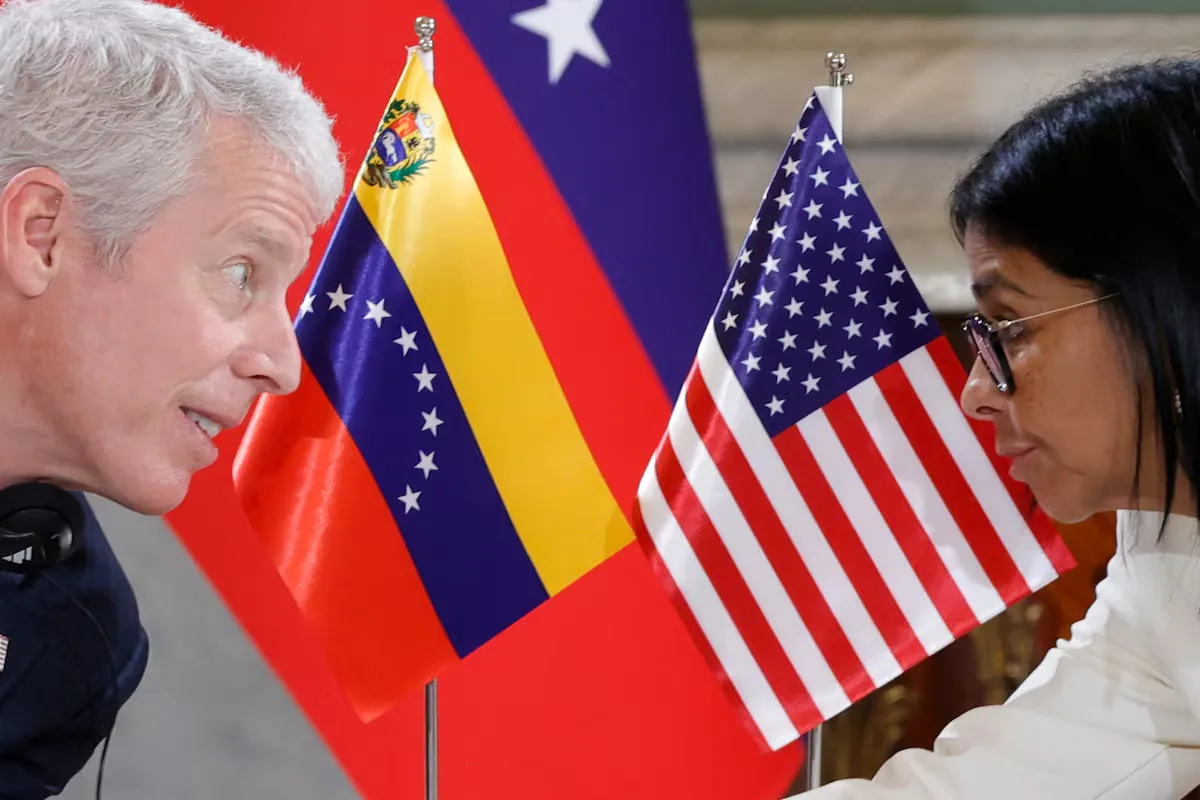
The “greatest oil deal of the century” between Donald Trump and Delcy Rodríguez, through the controversial businessman Alejandro Betancourt, is a crucial milestone in Venezuela’s history. And it is for the worst reasons: the scale of the deal, the opacity of the process, the lack of democratic legitimacy of those who negotiated it, and the extraordinary powers it grants Washington over Venezuela.
Read more The king without a kingdom
Although it will very likely generate a multi-billion dollar investment injection, it is a bad deal. So much so that, for the first time in more than two decades, the opposition and dissident chavismo have agreed in repudiating it. Because, with the little that has already leaked, one can reach a disturbing conclusion: handing over to the United States 35% of 55% of Venezuelan oil and another 20% at great discounts, “at no cost to American taxpayers,” and for a period of a century, is nonsense and a mortgage that will weigh on many generations.
They have sold Venezuela with the Venezuelans inside.
More than an oil deal, it is a Faustian pact. The ruling chavismo obtains what it needs most: political survival. Washington gains what it desires most: privileged access to one of the largest oil reserves in the world and unprecedented supervisory power over the Venezuelan economy. The immediate benefit may be the recovery of a devastated country. The historical cost, however, is much harder to calculate: a cession of sovereignty of extraordinary dimensions.
That seems to be the intimate logic of the deal. Secretary of State Marco Rubio confirmed this week that the United States must control Venezuelan oil revenues to prevent rulers and elites from stealing the income again. The irony speaks for itself: those rulers and elites are the same who have been in power for almost three decades. But Rubio does not seek to break that continuity, but to manage it. Because to control Venezuelan oil wealth, the Trump Administration needs to control political conditions, and that requires stability, not change.
It is a spurious deal from start to finish and must be denounced for what it is: the flip side of the tutelage that the United States exercises over Venezuela and that allows it to control its wealth from Nicolás Maduro’s extraction.
But there is more. It is the beachhead for the entry into the country of a group of companies, oil, financial, and communications linked to Trump, a network of allies and partners who have been part of his administration and have donated to his campaigns. This is the case of the companies Sable and Primavera, as revealed by The Financial Times.
That tutelage has only been possible because the chavista troika has guaranteed its operation on the ground. The hidden face of the oil deal is another agreement, of a political nature, that allows chavismo to remain in power with the approval of the White House. In other words: the Rodrigato hands over the country in exchange for power.
Alejandro Betancourt occupies a unique place in this story. The most prominent of the so-called “bolichicos” is not a mere intermediary: he is the bridge between the corruption of old chavismo, the survival of a post-Maduro order, and Washington’s interests. According to Marc Caputo in Axios, it was Betancourt who connected Delcy Rodríguez with Marco Rubio in the early hours of January 3, while U.S. troops stormed Fuerte Tiuna. Other Venezuelan sources claim that his relationship with Trump’s circle is much older. If the talks in Qatar at the end of 2025 had already revealed that Delcy was listed as Maduro’s substitute in a negotiated exit, we now also know who helped close the circle — and who ensures that this circle does not open with elections.
Trump confirmed it when, asked about presidential elections in Venezuela, he responded that “the country is not ready.” The phrase is cynical and revealing: the vast majority of Venezuelans support elections in the short term, but these would introduce precisely the uncertainty that the new power architecture in Venezuela was designed to avoid.
There lies the paradox of the deal: it can attract the investments that the Venezuelan economy needs to emerge from ruin while consolidating a system that deprives Venezuelans of deciding their own destiny and deepens dependence on Washington under chavismo.
Read more A hundred voices to debate literature, journalism, and democracy at the Hay Festival in Querétaro
Trump has shown disdain for Venezuelan democracy. What matters to him are the businesses and advantages he can extract from them. If Venezuelans are already happy dancing in the street, as he has repeated, why do they need elections and democracy? Faustian pacts always offer something desired — that is why they seduce. Venezuelans could obtain an economic improvement in the short term. But the hidden price is existential because it has been achieved through alliances with anti-democratic forces and will be paid with sovereignty, institutions, and the capacity for self-determination.
The Venezuelan ruling elite has already signed it. It abandoned the defense of national sovereignty and the anti-imperialist struggle that for years served as justification for its political project. In exchange, it received a survival bonus.
After several days of silence, María Corina Machado rejected the opacity of a negotiation carried out in the shadows by a government without democratic legitimacy, but avoided questioning the role of the Trump Administration as the counterpart of the deal. That caution is understandable. It is also a mistake: denouncing only one of its signatories is equivalent to accepting the other.
That is why Machado runs the risk of being trapped within the logic of the Faustian pact. If chavismo has exchanged sovereignty for staying in power, she cannot simply wait for Washington to fix the problem whenever it pleases, since Trump is only interested in the stability of a power architecture that allows him to advance his interests.
It is advisable that Machado understands that there are only two ways to come out unscathed from a relationship with Trump: through absolute submission or by having as much power as he does – and the first attracts favors but offers no guarantees. Machado already tried the diplomacy of obeisance by giving Trump her Nobel Peace Prize diploma after the snub on January 3, when the MAGA leader humiliated her by calling her weak and disrespectful. It did not work because Trump does not want her. And because he does not want her, he does not see her as the protagonist of his Venezuelan project.
There is a third option to deal with Trump: to assert one’s place. The best recent example is Mark Carney, Canadian Prime Minister, who responded to Trump’s tariffs, even knowing that the economic cost for Canada would be high. Canadians understood that certain concessions have too high a price and have rewarded Carney with their support.
Machado does not have the power necessary to measure herself against Trump in any field. But she retains something no one else has: the majority support of Venezuelans. That is why she must disobey him, return to the country immediately, regroup a fragmented opposition, energize politics, and mobilize the population to demand the renewal of the CNE and free presidential elections. She must simultaneously challenge the Rodrigato and the tutelage that supports it.
But first, she must understand her role in what is at stake and realize that this may be her last chance. Only then will Venezuela keep alive the hope of conquering its freedom and renegotiating the oil deal of the century, without going down in history as a de facto colony that does not even become the 51st state of the Union. And only then will she continue to be worthy of the responsibility that Venezuelans entrusted to her by electing her as opposition leader with 93% of the votes. The task ahead is not simply to defeat chavismo: it is to prevent the Faustian pact from becoming Venezuela’s permanent destiny.
Read more Zenyazen Escobar, the second deputy to die violently in Veracruz in the current Legislature