









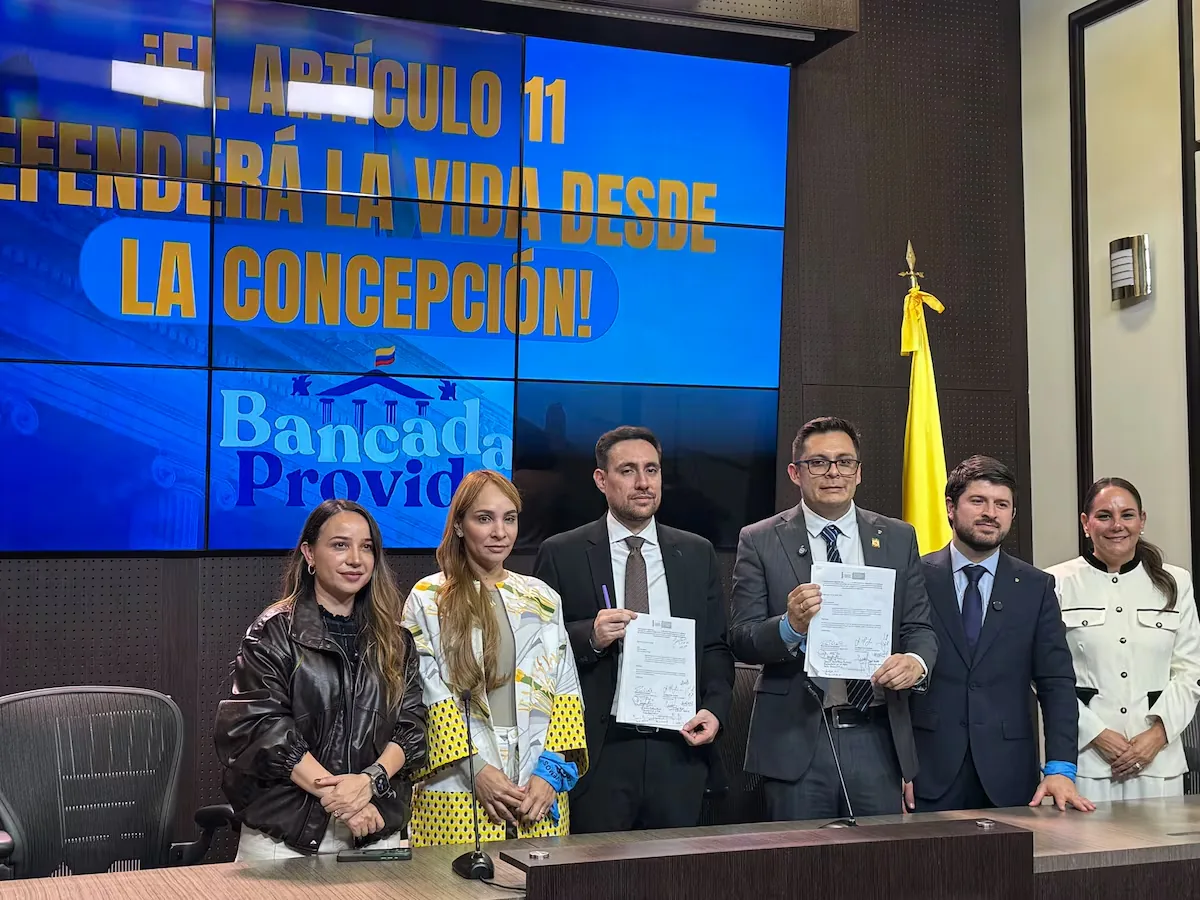
“Pro-life caucus.” This is how a growing group of Colombian congressmen from different political parties call themselves, who in recent days have presented a series of constitutional reforms and bills to restrict acquired rights of women and the LGBTQ population in Colombia. Senators and representatives from Salvación Nacional, the Conservative Party, the Democratic Center, and other groups have filed an initiative seeking to prohibit the right to abortion in Colombia, and another to reverse the right of children and adolescents to gender identity and free development of personality by banning gender-affirming medical treatments. These projects go against multiple rulings of the Constitutional Court that in recent years have advanced in guaranteeing those same rights.
Read more They have sold Venezuela with the Venezuelans inside
The two initiatives are just beginning a long legislative process without guaranteed majorities to advance, but they have ideological closeness to the government of Abelardo de la Espriella and the support of religious and ultra-conservative sectors that backed his presidential campaign. This makes them more likely to become reality than in past legislatures. Conservative Party representative Luis Miguel López, one of the most visible faces of the caucus, explains that their first step is to consolidate that group of parliamentarians. “We are working on forming the caucus. We want to go from the 54 congressmen officially in the last caucus to try to reach 100,” he says in an interview with EL PAÍS. The Colombian Congress has 286 members.
López assures that they have already managed to gather around 60 signatures, especially in the House of Representatives, to support these two projects. “We have members from the major parties, except for the Historic Pact [the left opposition party]. There are congressmen from the Liberal Party, the Conservative Party, Radical Change, the Party of the U, and the Citrep who support us,” he says, referring to caucuses of different ideological positions on paper.
Joining Pel are voices of leaders from Salvación Nacional, the far-right party that endorsed De la Espriella’s candidacy, such as Senator Sara Castellanos or Representative Carol Borda; and from the Democratic Center, the right-wing party led by former president Álvaro Uribe, such as Representative David Cote or Senator Andrés Forero. Senator Jota Pe Hernández, the most voted from the Green Alliance Party, and members of smaller groups like the Christian party Mira, are also part of the pro-life caucus.
Representative Cote leads the project to prohibit abortion. The legislative initiative seeks to amend Article 11 of the Constitution to establish “the protection of human life from fertilization,” a way to fight against the jurisprudence of the Constitutional Court, which in 2022 decriminalized voluntary termination of pregnancy up to the 24th week of gestation. Lawyer Catalina Martínez, vice president of the Center for Reproductive Rights for Latin America, recently explained the risks of the initiative. “We have faced several projects of this type in Congress and none has been successful, but the mere fact that this public conversation is reopened is dangerous. What already exists is a recognized right, with jurisprudence from the last 20 years, and a health service that has been regulated and must be guaranteed,” she said in an interview with this newspaper.
Read more The king without a kingdom
The other project, which seeks to prohibit minors’ right to access gender-affirming medical treatments, has been called the Laura Law. It takes its name from the case of a young woman from Valle del Cauca who began a gender transition at 15 and later regretted it. The article seeks to prohibit three types of intervention: puberty blockers, hormone therapies, and gender-affirming surgeries. Presented with the signature of more than 30 congressmen, it also aims to establish a sanctioning regime for doctors and institutions that perform any of these treatments. “Given the risk of irreversible effects and lack of evidence, the principle of precaution and medical prudence must be applied,” said Senator Forero in defense of the initiative, who was the head of the Democratic Center list.
The Trans Health League, which published a guide for families and caregivers of trans and non-binary children and adolescents, has questioned the law: “If we really want to protect girls, boys, non-binary children, and adolescents, we need more guarantees and better clinical decisions, not a legal prohibition contrary to medical standards and what is established in the Constitution,” it reads. Juli Salamanca, a trans leader linked to the process, emphasizes the dangers of the initiative. “Today they file the so-called Laura Law project, built on a falsehood they have been repeating for months: that in Colombia trans girls, boys, and adolescents undergo sex change surgeries as a routine part of their care. That caricature does not correspond to how health care works and is used to install moral panic, misinform, and justify rights restrictions,” she wrote on her social networks. “The project uses a false premise to turn protection into prohibition and scientific uncertainty into a tool to restrict rights and persecute health professionals.”
Amid the discussion, Representative López acknowledges the closeness of the pro-life caucus with the Executive. “There is an affinity in thought. The government has a pro-family mindset, and that gives us identity. However, within the framework of separation of powers, there is a legislative agenda from the caucus and another agenda from the government. We hope, of course, to have their support.”
Read more A hundred voices to debate literature, journalism, and democracy at the Hay Festival in Querétaro