




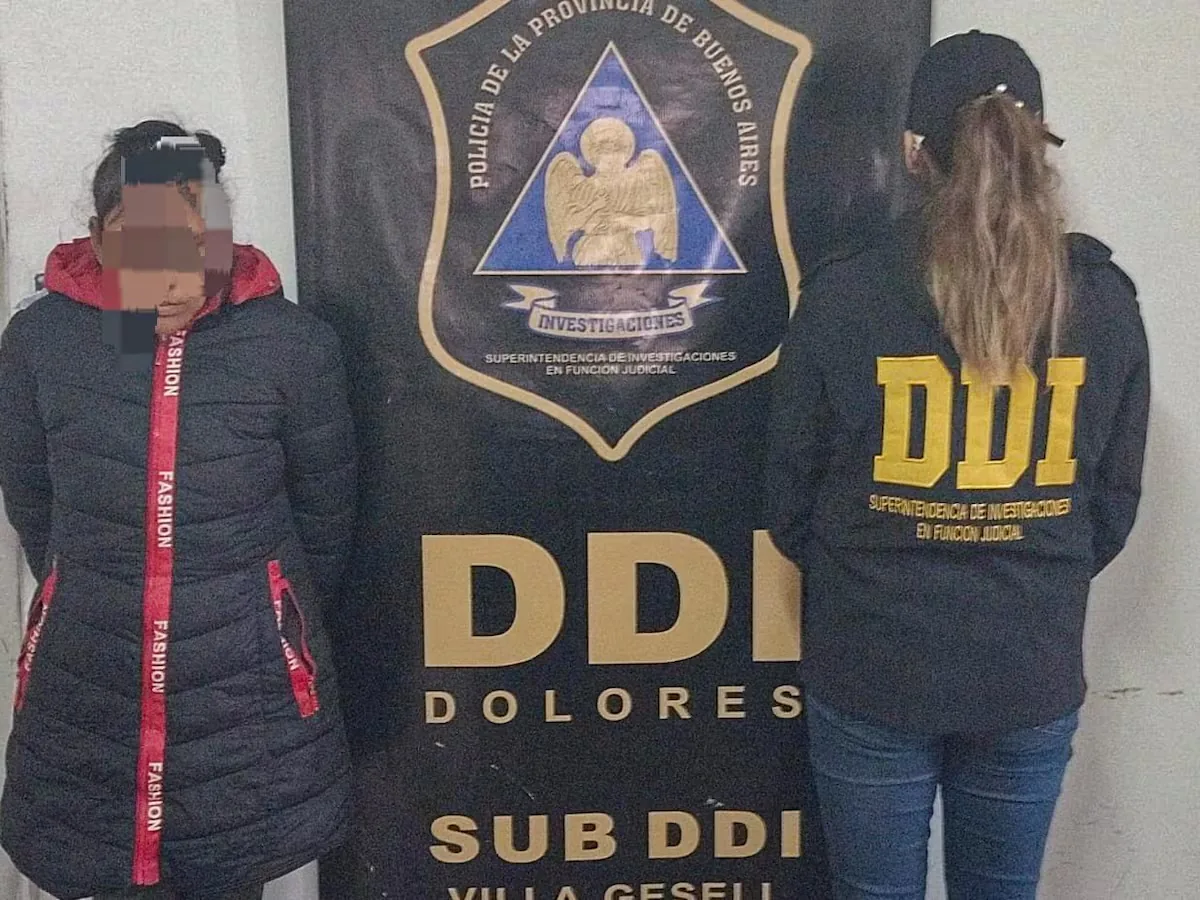
Last Tuesday, two-year-old Isabella Aguirre was admitted to the hospital in the Argentine city of Villa Gesell without a pulse. The subsequent autopsy determined that she had died from asphyxiation due to an obstruction in her respiratory system, and her mother, Lucía Sosa, explained that she had choked on milk. The case gained prominence in the local media when Sosa was arrested and her background became known: the woman had already been investigated before for the deaths of two other daughters under similar circumstances. Doctors at the Maternal and Child Hospital of Mar del Plata, a nearby town where she had previously lived, had repeatedly reported the admission of her children with symptoms of asphyxiation and injuries and had each time recorded in the medical history a context of “high social risk” for the children.
Read more Authoritarian
Rocío A., 19, and Lucas R., 17, are Sosa’s eldest children, or at least that is what they assume; they are not clear on how many children she had, but it could be ten. Both were hospitalized in serious condition as babies, admitted with symptoms of asphyxiation, and were later adopted by other families, where they have felt loved and cared for, but they still suffer when recalling the long period corresponding to “reconnection”: the years in which the justice system insisted on building ties with their biological nucleus before granting permanent custody to their foster families. Following Isabella’s death, they decided to make their testimony public to prevent new tragedies and to demand that Sosa “be in prison or in a psychiatric hospital.”
“I entered the hospital at 21 days old and stayed until I was six or seven years old with the obligation to return to that house of terror,” Lucas tells EL PAÍS from the coastal city of Mar del Plata, accompanied on the video call by his lawyer. “On my third birthday, the court forced me to return for the weekend, and I remember receiving a very severe beating. If I cried or asked to be picked up, they hit me harder. They locked me in a very dark room and were hitting something, I don’t know what, but it made a lot of noise. I was left very afraid of loud noises, of the dark. I remember they grabbed me by the ears to hit my head against the floor, and when I returned to the court on Monday, I was very upset, making gestures to explain what had happened, and my whole face was swollen from crying so much,” he recounts.
During those years, Sosa was in a relationship with Héctor Javier Picart, who is not Rocío’s biological father and it is unclear if he is Lucas’s, since although he is listed as such on his documents, he has not agreed to a DNA test and recently denied paternity in a news interview. Outside of them, the couple had four children, two of whom died under circumstances similar to Isabella’s. Candela, six months old, died in 2013, and Yasmín, eleven months old, in 2016. For this second case, Sosa and Picart were detained for about two years on charges of sexual abuse and homicide. Ultimately, both were acquitted due to lack of evidence.
After that episode, Sosa moved from the city of Mar del Plata to Villa Gesell, 100 kilometers away, where she formed a new relationship and had two more children: Isabella and an older boy, who is currently four years old and, following recent events, is under judicial custody.
“Neither Sosa nor Picart have feelings or a heart. They are people whose only skill is doing harm: hurting people, injuring them, and making them suffer. They have a child, and all they want is to kill him or harm him,” says Lucas, who places both on the same level of danger, although the local media have focused on Sosa and even given Picart space in articles where he presented himself as a victim of the situation and accused his ex-partner of having killed their two daughters.
Rocío says that since she was one year and three months old, she has lived with her aunt, her biological father’s sister, but until she was seven years old, she went through the reconnection process with Sosa against her will. “They were both [Sosa and Picart] very violent. I remember that when I was five or six years old, they forced me to take a nap that I didn’t want to take, and Picart lay down next to me without clothes,” says Rocío, who this Friday testified before prosecutor Juan Pablo Calderón, head of Functional Instruction Unit (UFI) No. 4 of Pinamar, and added this sexual abuse complaint to the case. On Wednesday, it had been Lucas’s turn to testify, along with his adoptive mother and his lawyer, Erika Hooft.
Read more Violeta Shu: “Mexico can host one of the main artificial intelligence parks in Latin America”
“They never listened to us,” Lucas insists about the justice system, which he holds partly responsible for the death of his sisters. The terror during the reconnection process was also that of their foster families, who had to hand over the children to that experience, frightened by the possibility of losing them if they did not comply with judicial procedures. “We are going to do one last trial by fire,” they told Lucas’s adoptive mother when they took him away for the last time before granting her permanent custody.
For the lawyer, judicial failures coexisted with a psychiatric condition of Sosa that, she maintains, was never properly considered. According to Hooft, within Lucas’s case file, Sosa was diagnosed with Munchausen syndrome by proxy, a disorder that leads to inventing symptoms or causing ailments in her children to simulate illnesses. “The hospital admissions were for asphyxiation, in addition to other conditions that came in a chain. For example, she fractured one child’s skull, but the other was like an annex: they all came in for asphyxiation because [Sosa] drowns the children. She drowns them with milk, but she also puts a pillow over their mouth. We warned that she was going to kill the children, and she did,” accuses Hooft, who has been handling cases related to the family since 2008, the year Lucas was born.
“The right of children and adolescents to be heard is one of the guiding principles of the Convention on the Rights of the Child and, as such, has a transversal character in all processes involving them,” points out Sebastián Medina, authority in charge of the National Ombudsman for the Rights of Children and Adolescents. He also emphasizes that this right “is not exhausted in a single procedural act or a single opportunity,” but must be treated as a complex and continuous process.
Asked about forced reconnections, Medina assures that “urgent measures should be adopted for the effective protection of children in cases of suspected violence or abuse” and that it is key to coordinate all judicial and administrative processes involving the victim, considering background, previous interventions, or simultaneous processes carried out by other public agencies. “In this case, there is precisely a lack of coordination between criminal and civil files,” he notes.
Currently, Sosa is accused of the crime of “abandonment of a person followed by death aggravated by kinship” and was summoned for interrogation but, on her lawyer’s advice, chose to remain silent. According to lawyer Hooft, following this latest episode and the new statements taken by the justice system, new charges have been added against Sosa and Picart, including crimes related to sexual abuse, drugs, and baby trafficking. She points out that the investigation could expand to look for traces also in the northern province of Formosa, where Sosa is from and where she traveled frequently. “Besides convictions for them, we want measures for the judiciary,” she adds. “There really has to be a radical change in listening to minors in reconnection processes. This cannot continue like this.”
Read more The audios that corner Verónica Alcocer: frontmen, cash, and luxury in Europe