









“It will be like going back to the seventies,” the taxi driver warned us when we explained that the next day we wanted to go to Transnistria. He spoke Spanish fluently because he had worked in Guadalix de la Sierra, as an extra on the sets of Gran Hermano; the best years of his life, he recalled: he would get drunk and smoke marijuana until dawn, and the next day he would go to work still hungover. However, for a few years, he had returned to his homeland, Chișinău: he told us he was happy because he was finally in control of his schedule and didn’t pay rent, while he drove us to the Romanita tower, an icon of the city’s brutalist architecture. Opened in 1986, today it is a circular block of 23 floors inhabited by working-class people and, according to what I had learned from YouTube, from the rooftop you could enjoy amazing views. We couldn’t verify this because, just as we were about to sneak in, two residents slammed the door in our faces; then, unable to respect any shared limits, we tried the fire escape, jumping over a strategically placed barbed wire to block access. But that was also in vain: a group of neighbors spending the afternoon in the nearby park shouted at us. We didn’t need to know the language to understand that we had been identified as the latest annoying tourists fascinated by the aesthetics of the degraded space.
Read more United States suspends visa application appointments at embassies and consulates worldwide
We didn’t have a car, so we went to Tiraspol, about 80 km from the Moldovan capital, by marshrutkes, minibuses with between ten and twenty seats. Showing the passport at a border control guarded by the giant hammer and sickle symbol, and having the visitor visa stamped, was the first performative gesture of the many required by the self-proclaimed Pridnestrovian Moldavian Soviet Socialist Republic (PMSSR). And yes, the country as such exists. But de facto and partially: although it declared independence from Moldova in 1991, with which it signed a ceasefire agreement in 1992, Transnistria is not internationally recognized. Not even by its admired Russia, which maintains its military bases there while being revered by 367 thousand inhabitants who only speak their language when selling you magnets with Vladimir Putin’s face.
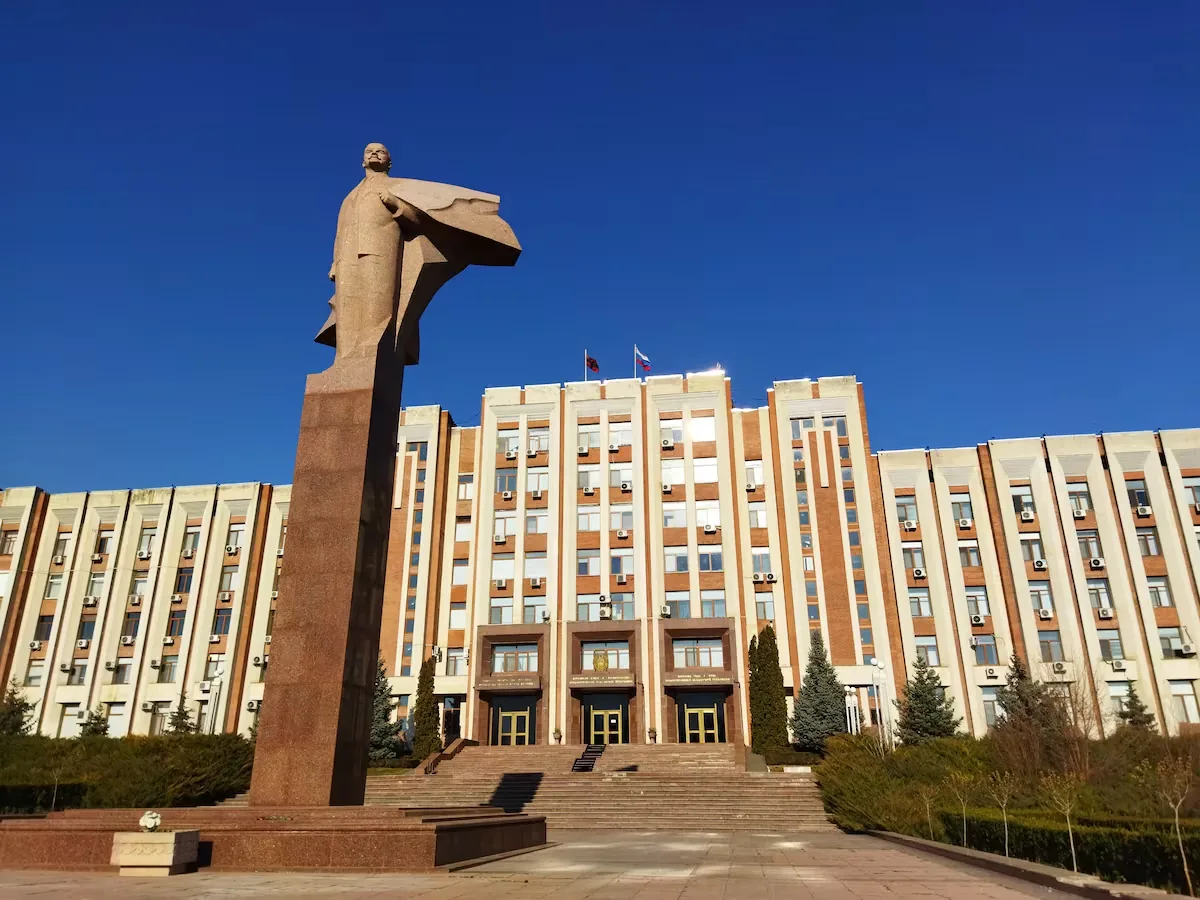
How is it explained, then, that in a destination considered a risk zone by the Ministry of Foreign Affairs I dedicated myself to taking hundreds of photos of soldiers guarding grand institutional buildings without my hand trembling? Because of an obscene ambivalence. On one hand, we walked the streets of Gorky, Lenin, and Marx under Cyrillic signs and blatant displays of communist adoration; also the Twenty-fifth of October Avenue, which crosses the town from end to end offering you in a straight line the most representative icons of the metropolis, such as Suvorov Square or the House of Soviets; that is, absolutely figurative architectures and sculptures, leaving no room for any postmodern interpretation. We were excited, therefore, to witness a region that was shielding itself from Moldova’s new democratic phase and its desire to be part of the European promise; the fortification was palpable at street level: there was no wi-fi network to connect to check the map or an online dictionary, although we could buy a Pepsi or a Coca-Cola in a supermarket where Roxette was playing.
Read more The trial
On the other hand, we were overwhelmed by an inevitable and disappointing sense of artificiality, as if we were hungry Westerners looking at a restaurant window with the dishes on the menu recreated in ceramic. Upon arrival, we had to exchange currency, since cards linked to foreign banks do not work; they only gave us bills: they had decided to withdraw from circulation their well-known colorful plastic coins after they became a prized souvenir to speculate on. Then, at lunchtime, we discovered that in a developable area of about 24 km² we only had two canteens available: Back in the URSS and URSS, separated by two hundred meters. From the first, tired of waiting for a table, we decided to leave; we were not overwhelmed by a great sense of loss: the diners were swallowing gyozas and chicken thighs. With the second option, however, the opposite happened: there was no one, so we immediately pointed with our finger at what we wanted to fill our stomachs with. Before paying, we realized we were still actors in that show, with the arrival of a whole group led by an Italian guide. We took our trays and sat in the dining room of that place: in one corner there was a television projecting the soap opera of the moment with no local enjoying it, and in the other stood a stand full of informational leaflets with TOURIST VISITOR written on the cover. The rest of the day no longer surprised us: towards evening, resting in a shady corner under a 16-meter-high Lenin statue, a guy with Silicon Valley worker airs asked us to get out of his wide panoramic view to photograph his girlfriend with a latest-generation iPhone, who posed stylized in an image she would instantly post on social networks.
When do you stop being a curious traveler and become a collector consumer of rarity? What grants you the category of one personality or another, the geographical infrastructure or the configuration of your gaze and your steps? Before setting foot in Transnistrian territory, I read countless articles describing this place located between the Dniester River and the Ukrainian border as the country that does not exist. Leaving it behind us, not without having visited each and every one of its emblems, I was certain that it was us — morbid outsiders, depoliticized and attracted by the aesthetics of an ideology that had never addressed us — who made the mirage of that place possible.