








“I wrote to five CEOs and four replied,” says Ben Horwitz, a student at Harvard Business School. CEOs usually don’t respond to emails from strangers. I was also asking them to have coffee or attend a meeting with students, nothing very important. But Horwitz had a trick: he had created a small app that mimicked the style of these executives when writing, with typos, no greetings, barely a line with six or eight words. And it worked.
Read more Between protests and corsets, the Bezos assault hints at the end of an era at the Met Gala
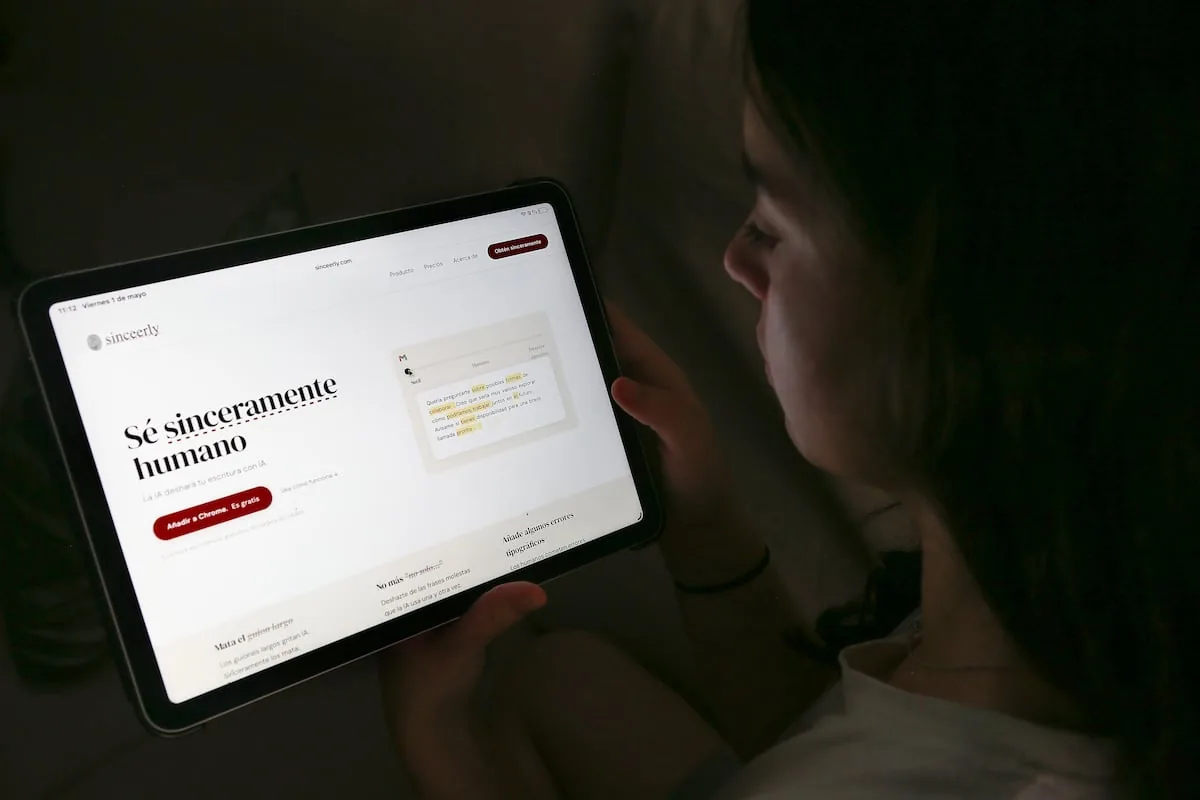
Horwitz has turned that trick into a business idea: the app Sinceerly (the name adds a typo to a typical word used to sign off emails, as if it were called “cordially”), which turns formal and profusely well-written texts, like those made by AI, into something more shabby. Sinceerly offers three levels of conversion: “subtle,” “human,” or “CEO,” which is the god mode of sloppy writing.
I made the anti-Grammarly. Mess up your emails with AI. https://t.co/R6kdTpoc0W pic.twitter.com/1AF5qrCFwT
— Ben Horwitz (@horwitzben) April 23, 2026
“I myself make a lot of typos and my inbox is full of AI junk,” Horwitz explains to EL PAÍS via message. “I realize that I now unconsciously write like Sinceerly’s ‘subtle’ mode. I’m ‘human’ mode in my good mornings (brief, but with typos), and I aspire to the CEO style: clear, to the point, and very very brief,” he explains. Beyond the idea, which is half a joke and unlikely to become a big business, Horwitz wants us to notice something that is already happening: we see so many texts written with AI that we spend part of our effort figuring out if the author cheated. One way to make it clear that something is human is to write with typos, the new pinnacle of human prestige in the AI era. “Unconsciously, I have become a worse writer,” says Horwitz. “I realize that I now purposely write with grammatical errors. So people know I’m human. It makes me a little sad.”
He is not the only one who is sad about this decline due to the fierce perfection of AI. “Now we doubt everything, whether a video or a text is written with AI. It makes me very sad the direction this is taking, and abusing AI makes us not reflect as much,” says Nerea Satrústegui, writer and professional editor.
Typos as a reward
Typos and a certain laxity in grammar is something people have accepted faster than it seems. Julio Alonso, professor of AI at UNED, noticed something like this back in 2023, but in his mind it is inevitable to give it some value: “A few months ago I confessed to another professor that now, when I find spelling mistakes in a student’s work, I have to control an impulse to value it better, because my subconscious interprets those kinds of errors as a sign of effort, that they haven’t delegated that work to an AI. He replied laconicly: ‘and do you think the students don’t know that?’,” he explains.
The vicious circle that could be created if we all continue down this slope will be funny: “This poses a circular problem: people add errors to signal that they are human, and then we need AI to do the same. I hope we don’t get to that point, although I have no idea,” says Jenna Russell, researcher at the University of Maryland.
Read more From Mass Tourism to Drug Trafficking: the Costa del Sol Two Decades After Malaya
All this is happening because there are humans who want to make it clear that they don’t use AI to write. It is a valuable signal today, at least for now. A journalist from the NYTimes revealed on X that a publicist told him that email open rates went up when they put a typo in the subject because it was a human signal. The same happens with texts: “We put a lot of value on the proof of effort. So it makes sense that those who write by hand start to worry if their style might make them be mistaken for AI,” says Alonso.
It’s becoming clearer how we’re going to tell that something wasn’t written by AI.
— Marc Andreessen 🇺🇸 (@pmarca) May 1, 2026
Typos are the easiest way not to seem like AI. But for those who want to write correctly, it is not easy to stand out. There are resources that AI uses more and that humans, when seeing them, intuitively detect as automatic writing: dashes, the formula “it’s not this, nor that, but this over there,” or ellipses and a moral closure at the end. But it is a dubious method. Dashes no longer appear as much because OpenAI made its ChatGPT use them less. Also, knowing too well how AI writes can imply unpleasant things: “Linguistic markers can change, but as things stand right now, the more you read AI-generated text, the more obvious those signals become, and more and more people talk about them and keep track of which ones are current,” says Russell, who has found that those who best detect AI-written text are those who use it the most.
For Russell, there are some tools like Pangram and GPTZero that are acceptable for detecting text, at least in English: “They are generally reliable,” she says.
However, there is no reliable solution beyond achieving a voice and having something to say, which also doesn’t seem like a panacea. “To not sound like AI you need to know who you are when you write. Know your voice, your tone, your crutches, your way of building an idea. No tool can give you that. It can help you in the process, yes, but you must make an effort. Your voice, your tone, is the first thing lost when you delegate writing without that prior work,” says Satrústegui. It’s a path, but it doesn’t really solve the problem.
The best option is to go more towards the root of the problem: not writing, but ideas. Russell tries to see if the specific ideas of a text were thought by a human or an AI. They discovered that by extracting features from fiction stories from more than 10,000 human stories and 50,000 written by AI, they could train a simple model to detect if a story is AI or human: “And without using any stylistic traits!” says Russell. “But there is a long way to go to understand how to detect structural differences between human thought and AI. And as AI improves, who knows how much distance there will be in 10 or 20 years,” she adds.
Read more Isabel Díaz Ayuso’s tribute to Hernán Cortés shakes Mexico City’s politics