

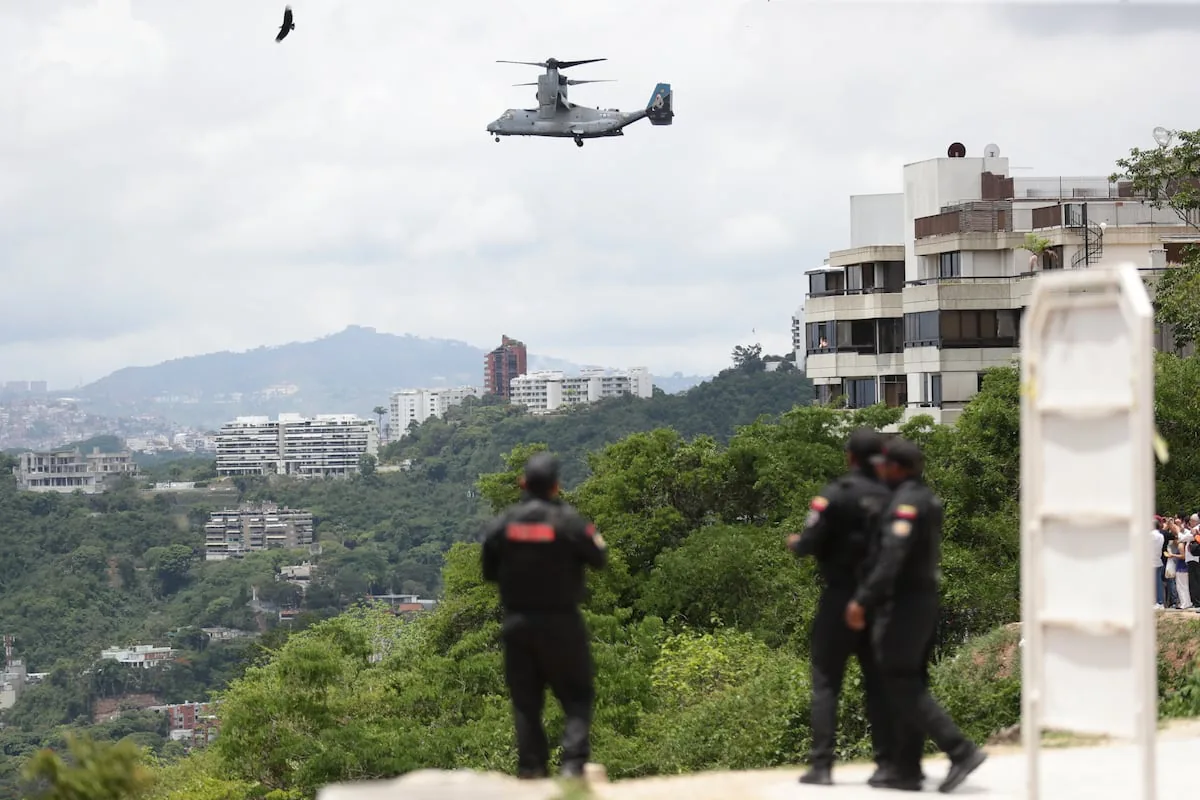
Two military aircraft landed in the parking lot of the United States embassy in Caracas, turned into an airstrip. They entered and exited twice through the Caracas valley up to the hill, where the American flag remains raised since a special forces intervention captured Nicolás Maduro and his wife Cilia Flores and the Governments restored relations.
Read more The Iran national football team will be based in Tijuana during the World Cup
The gusts of wind that lifted the huge aircraft with their propellers knocked down the branches of the surrounding trees. About twenty American soldiers disembarked from the aircraft. On the ground, fire trucks, ambulances, and police patrols mobilized. Without further ado, on a cloudy morning, the evacuation drill requested by the United States and announced in advance by the Venezuelan Foreign Ministry was carried out.
The maneuvers for “possible medical situations or catastrophic contingency” had been announced on Thursday by the Venezuelan foreign minister, Yván Gil, who said they were authorized by the Government. The announcement, however, generated criticism among left-wing sectors that reject Donald Trump’s tutelage in the country. In particular, the Communist Party of Venezuela, opposed to Chavismo, held a small demonstration in Caracas with banners saying “Yankee go home.”
During the operation, as was later learned thanks to a message on the social networks of the U.S. embassy, the second official visit of General Francis Donovan, head of the U.S. Southern Command, was also carried out. The official got off one of the planes that were part of the drill and was received by the chargé d’affaires of the embassy, John Barrett. He also met with representatives of the Venezuelan Government and the force that Washington has deployed in the country in recent months, as part of the direct tutelage over the Chavista Government that took charge after Maduro’s capture.
At this moment a U.S. military response exercise is taking place at the United States Embassy in Caracas. Ensuring the rapid response capability of the army is a key component of mission preparedness, both here in Venezuela and… pic.twitter.com/PpEwghap8r
Read more Cristian Mungiu, Palme d’Or winner with ‘Fjord’: “Let’s make the audience nervous”
— U.S. Embassy in Caracas (@usembassyve) May 23, 2026
“We remain committed to ensuring the implementation of the three-phase plan of the President of the United States, particularly the stabilization of Venezuela, and to the importance of shared security throughout the Western Hemisphere. The United States is committed to a free, secure, and prosperous Venezuela for the Venezuelan people, the United States, and the Western Hemisphere,” they added in an official message from the embassy. The official had already been there in February, the month after the attacks.
The event attracted few more than the curious and usual neighbors of the Valle Arriba viewpoint, the southeast neighborhood of the city where the U.S. diplomatic headquarters and those of other countries are located. The media and news agencies, on the other hand, set up their longest lenses early to capture the two MV-22B Ospreys of the Marines over Caracas. “I thought I would only see a plane like that in movies,” commented a young man who stopped with his friends to watch the maneuver. People’s conversation went back to the early hours of January 3, when dozens of aircraft, armed that time, entered a city that for the first time experienced a foreign military attack. Saturday’s drill had nothing to do with what was experienced that night and, given how inexplicable Venezuela has become since then, humor saved the day once again amid uncertainty. “These are transport planes,” said one. “Maybe the ambassador ordered a grill delivery to the aircraft carrier,” fantasized another and burst out laughing.
Alongside the operation, the Iwo Jima ship was again deployed along with the missile cruiser Lake Erie in Venezuelan waters, about 11 kilometers from the coast. Between last August and January of this year, the United States mobilized its war fleet to the Caribbean as part of an operation against drug cartels in which more than 30 boats were destroyed with over a hundred deaths. Maduro and his wife landed on the Iwo Jima after being extracted and arrested at their residence in Fuerte Tiuna. That ship was their first place of detention before arriving at the Brooklyn jail, where they are currently. The teams have remained in the area and others have joined, while Donald Trump has directed his intervention threats towards Cuba.
Read more Scenarios in post-Maduro Venezuela: “It is a great growth opportunity for Colombian entrepreneurs”