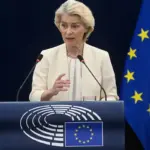





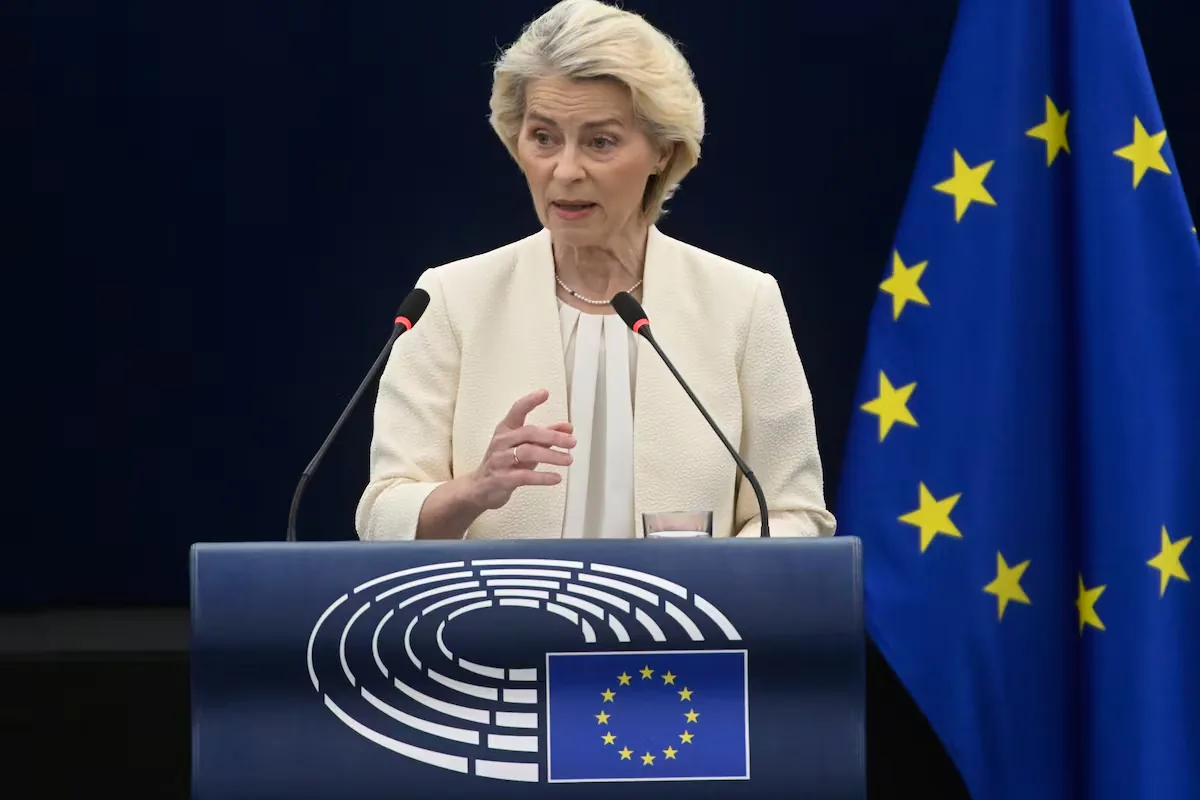
The Ceuta migration crisis marks the start of the academic year in the European Union. The irregular entry this summer of tens of thousands of people into the Spanish autonomous city from Morocco has also led to breaking another taboo in the European asylum system. The President of the European Commission, Ursula von der Leyen, proposed this Wednesday before the European Parliament a new regulation that would allow Member States to suspend —“flexibilize,” as she called it— migration rules in cases of crisis. The proposal from the German conservative during her State of the Union speech confirms a new hardening of the EU’s asylum stance, which is fortifying itself and already seeking to launch deportation centers outside its borders.
The images of tens of thousands of migrants crossing from Morocco to Ceuta shook the EU this summer. They barely occupied a few lines of Von der Leyen’s 22-page speech, a speech full of announcements and nods to the European spirit. But the German conservative spoke about that and other migration crises (such as those in the Baltics) and blamed human trafficking mafias and the EU’s “adversaries” for using “vulnerable people” against the community club. “The Ceuta border is a European border because Ceuta is Spain, Ceuta is Europe,” she declared solemnly.
Von der Leyen stated that the response to migration is the migration and asylum pact, which came into force in July and tightens conditions for asylum seekers arriving in Europe. But she also made it clear that this set of rules could be suspended with this “new European emergency response framework” with which, in similar situations, it will be possible to “temporarily” provide “flexibility in the standard procedures” of European migration rules.
She did not provide further details, but it seems clear that what she will propose in this new framework is the suspension “for a limited time and in a strictly defined manner” of migration rules in order to speed up and facilitate returns. “The events of this summer show that our tools must evolve, especially in emergency situations. Europe needs the necessary means to protect its borders at all times. Especially in situations where mass movements are organized and used as a weapon,” Von der Leyen justified, after emphasizing that “the Ceuta border is a European border, because Ceuta is Spain, Ceuta is Europe and Europe is there for you.”
The arguments used to follow this path also rest on external security: “From our eastern borders to the coasts of Crete and throughout the Mediterranean. And, of course, with the Ceuta crisis. These events are of a different nature. But they have two things in common. The first is that vulnerable people are being exploited by unscrupulous traffickers and smugglers, and by our adversaries,” she stressed in a clear reference to episodes like what happened several years ago at the Poland and Lithuania border, when Russia and Belarus used migrants in a kind of hybrid attack on their borders.
Read more Ayuso stands up the rectors at the start of the academic year and thus avoids a university protest
“Emergency protocol”
Moscow has been very present in her speech. The invasion of Ukraine more than four years ago triggered all security and defense alarms in the EU, and these are sounding louder and louder. The failed drone attacks on Leipzig airport in Germany this summer have raised this alert even more. And for this reason, and due to justified distrust in the historic US ally, Von der Leyen has put on the table the creation of a “security protocol for emergencies” when one of the States feels there is an external threat to its security: drone incursions, cyberattacks, sabotage. “Threats that are growing every day.”
“We are facing an openly hostile world,” she warned. And this has led her to go further on this point than on migration. She did so by giving an example of how that mechanism would work: like NATO’s Article 4, which contemplates that allies will consult each other when one of them feels in danger. The Commission President avoided giving the idea that her proposal is separate from the Atlantic Alliance. “We are strengthening our work with NATO,” she proclaimed.
In the trade chapter, China also had a considerable place. Von der Leyen highlighted that the trade deficit (difference between imports and exports) for the EU is around 1,000 million euros. To correct it, she recalled that negotiations are underway with the Asian giant, but that this is not enough: “Words are good, but actions are better,” she said. “We will use all the tools at our disposal to rebalance the relationship,” she added, without giving further details.