








The story goes more or less like this. The coordinator of the cultural supplement (from now on, C) comes up with the idea to commission a piece explaining why Quim Monzó (Q) likes Etgar Keret’s (K) stories so much. The curiosity is justified: every time the publisher La Segona Perifèria of Miquel Adam (A), a Keret enthusiast tasked with translating the Israeli writer’s work into Catalan, publishes a collection of stories or an anthology by K, Q showers K with praise on the old social network Twitter (X).
It has happened again. Not long ago, we have on the market El blues de la fi del món, a somewhat debatable title which is the Catalan version of אוטוקורקט or Autocorrect, K’s latest book published in 2024. It was translated from Hebrew by Paul Sánchez Keighley (SK), just as he had done with Les edats de l’home. Q, once he received the new stuff, did not miss the appointment and wrote on X: “So far, Keret never disappoints. If you accept a piece of advice, don’t miss this book,” sparking C’s curiosity with which this story begins.
The authority of Q, a supposedly living legend of native letters, is such that all reviews or interviews with K in Catalan feel compelled to mention his fondness for the Israeli’s work. And not only that. C also knows, from previous experience, that any text featuring Q will have many visits. That is why he turns to the columnist Bonet (B), who for some unknown reason has somewhat specialized in writing journalistic articles about Q. Here we pause the sequence of events and introduce a reflection. Although for years there were dozens of imitators and followers of Q’s style in Catalonia, the truth is that none have consolidated and the path has been cut off. On the other hand, anyone would say that his legacy has flourished, delocalized, just at the other end of the Mediterranean in K’s work. B picks up the pencil and notes this thought, which he judges brilliant, in a margin of El blues de la fi del món.
Although it is hard to compare, B finds it obvious that there are points of contact between the two storytellers. Especially between Q’s latest stories, those from El millor dels mons and Mil cretins, full of muted microviolences and “private hells.” In K’s new book, tinged by the presence of war in the Middle East, the stories, besides making you laugh as always, also make you cry. But B does not stop at his own opinion. He wants more, and asks the editor A, who tells him: “I might say that Keret condenses in two or three pages situations similar to those Monzó unfolds in stories of fifteen or twenty. This makes Keret’s stories very eventful and electric, having to sacrifice, that is, the irony that Monzó imprints in the details. The irony yes, but not the monumental black humor, which seems to me the clearest point of connection between the two writers.”
B knows that Q reads K. But does K read Q? Through A, he passes the question to K’s literary agent, Gal (G), who, awaiting the answer, is completely sure of K’s Monzó-ism. In fact, G knows that K uses a Q story in his creative writing classes in New York and Be’er Sheva, “the story of a woman who puts a dirty fork on her husband in a restaurant,” says G. Since B can’t recall which story it is, he asks his go-to Monzó expert, Edgar Illas from Indiana University (I). He identifies it instantly. It is ‘La forquilla’ from Mil cretins. Professor I also takes the opportunity to give his opinion: “I would say they both share style and stance insofar as they write the tension between postmodern perplexity and the context of Catalan or Israeli conflict.”
Read more Leire Martínez wins ‘Mask Singer’ upon being revealed under Clavel: “You did incredible”
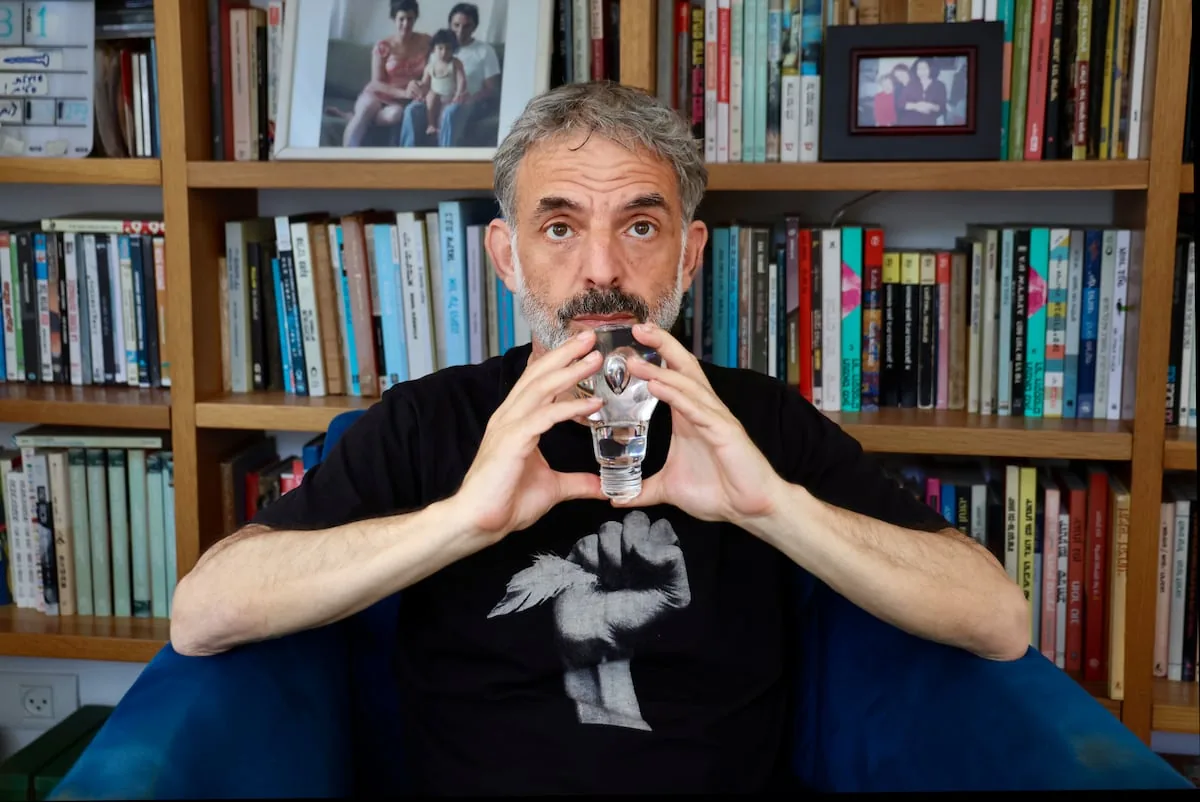
Still perplexed by I’s academic position, B receives K’s response. Naturally, he knows Q, and confesses that the compliments on X make him blush. Besides, he explains why he works with ‘La forquilla’ in class: “It is a story that draws its strength not from the characters or the plot, but from the narrative point of view. It tells the story of a marriage from the perspective of a diner sitting next to them, capable of perceiving something the husband will never know simply because he is seated at a different angle. It is this profound understanding of the mechanisms of a story and of humanity (which so often are the same) that makes Monzó an indispensable master for any narrator.”
We approach the denouement. B thinks, sharpened, that he needs one last angle to illuminate the story. Q’s. So he goes straight ahead and shares K’s message with him. He replies: “I really like Keret. He is precise and efficient, and does not use frills. I don’t like comparing books. I didn’t know Illas’s theory and I don’t quite see it clearly. I’m pleased that Keret uses ‘La forquilla’ in university classes. I had no idea. The story of ‘La forquilla’ comes from the observation of an event that literally happened in a restaurant in Maçanet de Cabrenys. I was at the table next to the couple dining there and I was surprised by what discreetly happened. I didn’t add anything. I tried to transcribe it as simply as possible.”
B believes he can affirm that all —A, G, I, K, and Q— have precise and efficient answers to C’s question. In any case, he tells himself, satisfied, he has tried to transcribe it as simply as possible.
Read more A worker dies after being hit by a backhoe in a Cercanías tunnel in Madrid

El blues de la fi del món
Translation by Paul Sánchez Keighley
La Segona Perifèria
192 pages. 18.95 euros