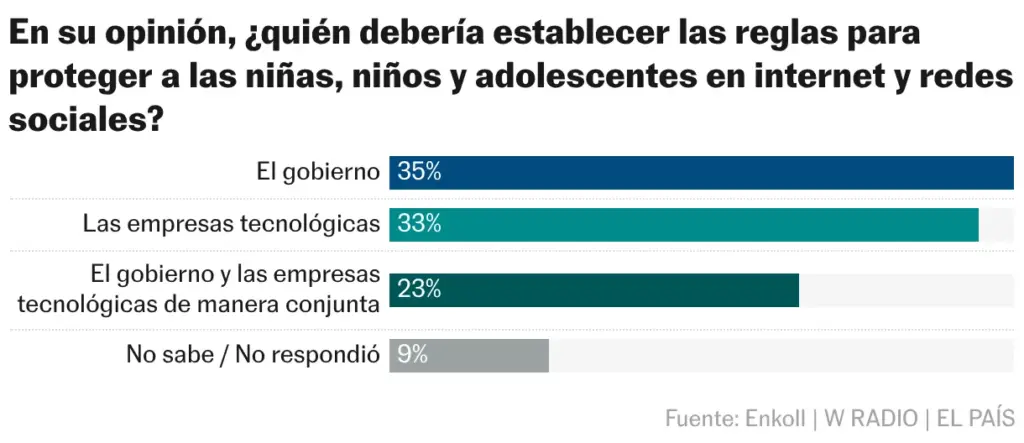
Eight out of 10 Mexicans consider that social networks and internet use are little or not at all safe for minors, mainly due to possible contact with strangers, the risk of cyberbullying and abuse, exposure to violent content, or addiction problems. When asked who should regulate the protection of “girls, boys, and adolescents,” public opinion is almost evenly split between the Government and technology companies, with 35% and 33%, respectively, while 23% believe it should be done jointly. The rest do not know or do not answer. These are part of the results from a survey by Enkoll, conducted for EL PAÍS and W Radio, carried out within the framework of Claudia Sheinbaum’s second government report as president of Mexico. Throughout July and August, the president has focused public attention on the debate about the use of cell phones in schools and how to regulate minors’ access to social networks.
Read more September does not belong to those who seek to rewrite it
The polling firm Enkoll, via telephone and with a human operator, asked 1,205 people during the last week of August about various topics, including for the first time a section titled “Internet and social network use among minors.” The initial question, “How safe or unsafe do you consider the use of internet and social networks for girls, boys, and adolescents currently in our country?” shows that 84% of Mexicans consider it an unsafe environment for minors. This aligns with what President Sheinbaum said in early August, when she cited in her daily press conference the National Public Opinion Study, Audience Protection, and Regulation of Networks for Minors, which details that 86% of respondents consider it “very important” or “somewhat important” to have a proposal to regulate minors’ access to social networks.
Enkoll asks respondents if, before the interview, they had heard that the Government is analyzing a proposal to regulate the use of social networks by girls, boys, and adolescents. Here, only 50% knew about the official initiative. The survey proposes a series of measures such as “requiring digital platforms to protect girls, boys, and adolescents from content inappropriate for their age,” “limiting the use of cell phones during the school day in primary and secondary schools,” “limiting the time minors spend on social networks,” and “requiring parental authorization for minors to open social network accounts.” In all cases, the general opinion was favorable.
It was expected that by the end of August rules on cell phone and social network use in schools would be presented, but this has not happened. The school year began this Monday, August 31, the same day that the Secretary of Education, Mario Delgado, attended the presidential press conference, where he only spoke about the results of a survey of half a million teachers. The vast majority believe that there should be a set of guidelines to regulate the use of digital devices during classes.
It is not clear what the Mexican Government’s plan is to regulate social networks and internet use in classrooms, although the president has repeatedly insisted that there is no hidden intention to censor or eliminate these technologies in education. In the Enkoll survey, respondents are asked whether it is more important to regulate access and use or to let families decide. Thirty-five percent believe it is the prerogative of parents, while the rest think that “girls, boys, and adolescents must be protected through stricter rules for internet and social network use.”
Methodology
1,205 effective interviews with women and men aged 18 or older, with a valid voter ID from the Mexican Republic.
From August 25 to 29, 2026.
Face-to-face interviews in homes, conducted with electronic devices applying a data collection instrument (questionnaire) suitable for the study’s purposes.
Read more Sheinbaum’s approval remains at 69% on the way to her second year in office
Sample selection
The sample is representative of the Mexican Republic.
A probabilistic and multi-stage sample was conducted:
– Stage I. Electoral sections were selected with probability proportional to size (PPS) sampling of the nominal list.
– Stage II. Blocks were selected in each primary unit in the sample using probability proportional to size (PPS) sampling of the nominal list.
– Stage III. Homes were selected in each block with systematic sampling with random start.
For better population representation, quotas by gender crossed by age range are managed.
Precision and confidence
The results have a margin of error around +/- 2.83% with a 95% confidence level on the main indicators.
Read more The Shield of the Americas, a great opportunity if built well