







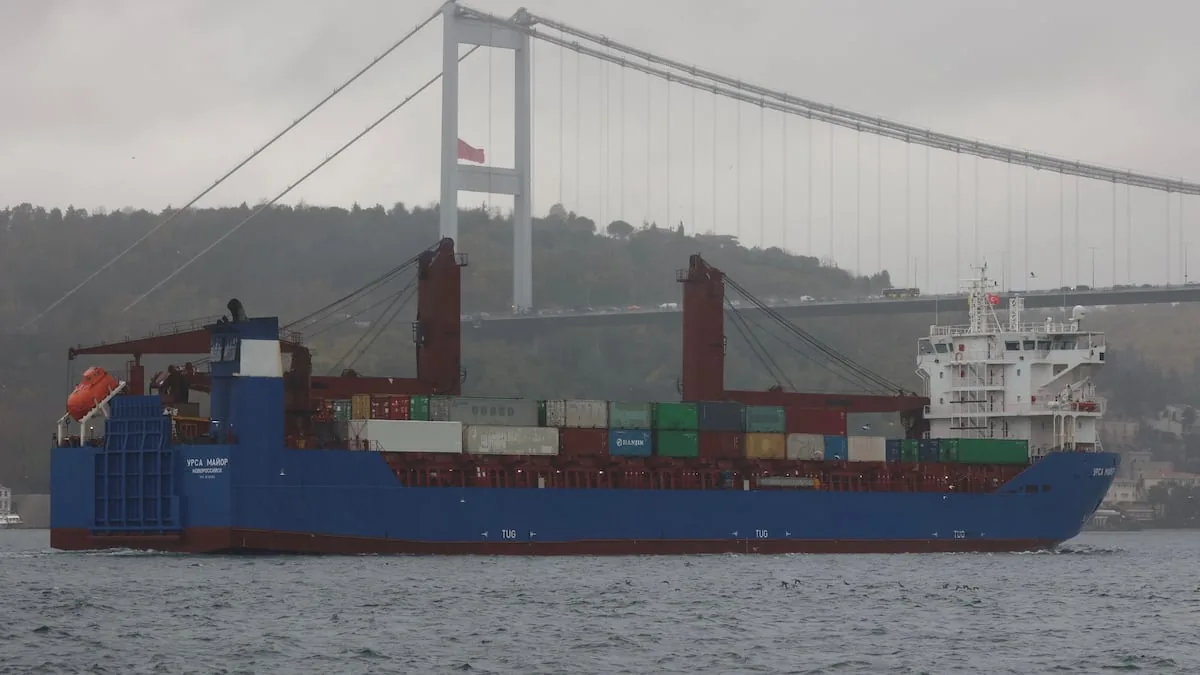
“To date, no authority has attributed the sinking [of the Ursa Major] to sabotage or deliberate attack,” concluded Defense Minister Margarita Robles this Monday in Congress, where she reported on the salvage operation of a merchant ship from the Russian military fleet about 60 nautical miles off the coast of Cartagena on December 23, 2024, which resulted in the rescue of 14 of its 16 crew members. A CNN report recently revived interest in this shipwreck by claiming that the Ursa Major (Osa Mayor, in Russian) was carrying nuclear reactor parts for submarines destined for North Korea. Robles did not support this theory but did reveal that, according to the declared cargo, the ship was carrying “components intended for the construction of a Russian nuclear icebreaker,” as well as empty containers, spare parts, and two large Liebherr cranes.”
Read more Vehicle found in Cúcuta in which Yulitza Tolosa was last seen
The minister read in the Defense Commission a report prepared following the latest news by the General Staff of the Maritime Action Force of the Navy which, in general terms, reproduces the written response the Government sent on February 23 to the Popular Group, with some minor exceptions, such as the time the Cartagena Coordination and Rescue Center (CCS) received the distress signal from the Ursa Major (13:15, according to the report; 12:55, according to the parliamentary response) and other major ones, such as the presence in the cargo of components for a nuclear icebreaker. Both versions agree that “the captain reported explosions in the engine room,” which were confirmed by statements from several crew members to the rescue teams, and that these explosions caused water to enter through the stern of the ship and a progressive list that eventually caused its sinking.
The Navy report reveals that the merchant ship, which had departed on December 11 from Saint Petersburg and had “as its declared final destination” the port of Vladivostok, at the eastern end of Siberia, “had previously been identified and monitored as part of NATO’s activities tracking Russian logistical convoys in the Mediterranean.” Although operated by the company Oboronlogistika, it worked for the Ministry of Defense of the Russian Federation.
After receiving the alert, the CCS of Cartagena mobilized the salvage ship Clara Campoamor, the rapid intervention boat Draco, and a helicopter, and ordered a merchant ship sailing in the area, the Oslo Carrier III, to head to the site to support the salvage operation. The patrol boat Serviola, which was monitoring three Russian Navy ships, also did so.
On the afternoon of the 23rd, the Maritime Rescue helicopter inspected the merchant ship, “noting the progression of the flooding and the severity of the structural damage. Late in the afternoon, the ship had a 30-degree list to starboard and the flooding had already reached the main deck,” the report states. An inspection carried out by the Serviola detected a strong smell of fuel and that the two cranes “had a strong degree of tilt, which could cause their detachment.” A total of 14 crew members, who had managed to abandon the Ursa Major in lifeboats, were picked up by the Draco, which was en route to Cartagena.
Read more The author of the Modena hit-and-run has no links to radical groups, according to the Government
The situation changed when, in the late afternoon-evening of the 23rd, the amphibious assault ship Ivan Green arrived in the area, which was precisely one of the three Russian warships being monitored by the Serviola. It positioned itself alongside the Ursa Major and formally requested to assume control of the rescue, explains the Navy report, invoking the principle of jurisdiction of the flag state of the distressed ship as provided in the United Nations Convention on the Law of the Sea. As requested by the Russian military ship, the Spanish vessels moved away to a distance of two miles from the distressed merchant ship, although they continued to collaborate in rescue tasks and monitoring possible marine pollution.
Impossible rescue
“At 23:20, the list of the Ursa Major rapidly increased until it sank, leaving debris on the surface that were investigated by the Ivan Gren,” the report concludes. After the shipwreck, the Clara Campoamor remained in the area until the next day to assess the situation, while the Serviola stayed monitoring the activity of the Ivan Gren. Despite two crew members missing, the Russian warship began transit towards the Levant at dawn on the 24th and moved away.
The report does not provide any hypothesis about the cause of the explosions in the engine room and only states that no authority has attributed them to sabotage or attack. It only notes that “the wreck finally sank at an approximate depth of 2,500 meters.” Robles emphasized that these are international waters and that, at that depth, it is impossible to rescue it.
Military sources indicate that the wreck may have been dragged by ocean currents and may no longer be at the place where it sank. This point was, in any case, closer to the Algerian coast (30 nautical miles) than to the Spanish coast (60 miles). Without being able to analyze the condition of the compartment where the explosions occurred, the consulted sources acknowledge, it is impossible to determine their cause. All hypotheses will thus remain open.
Read more Final Liga MX: schedule, tickets, and where to watch Pumas — Cruz Azul