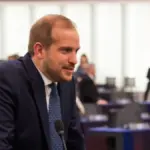

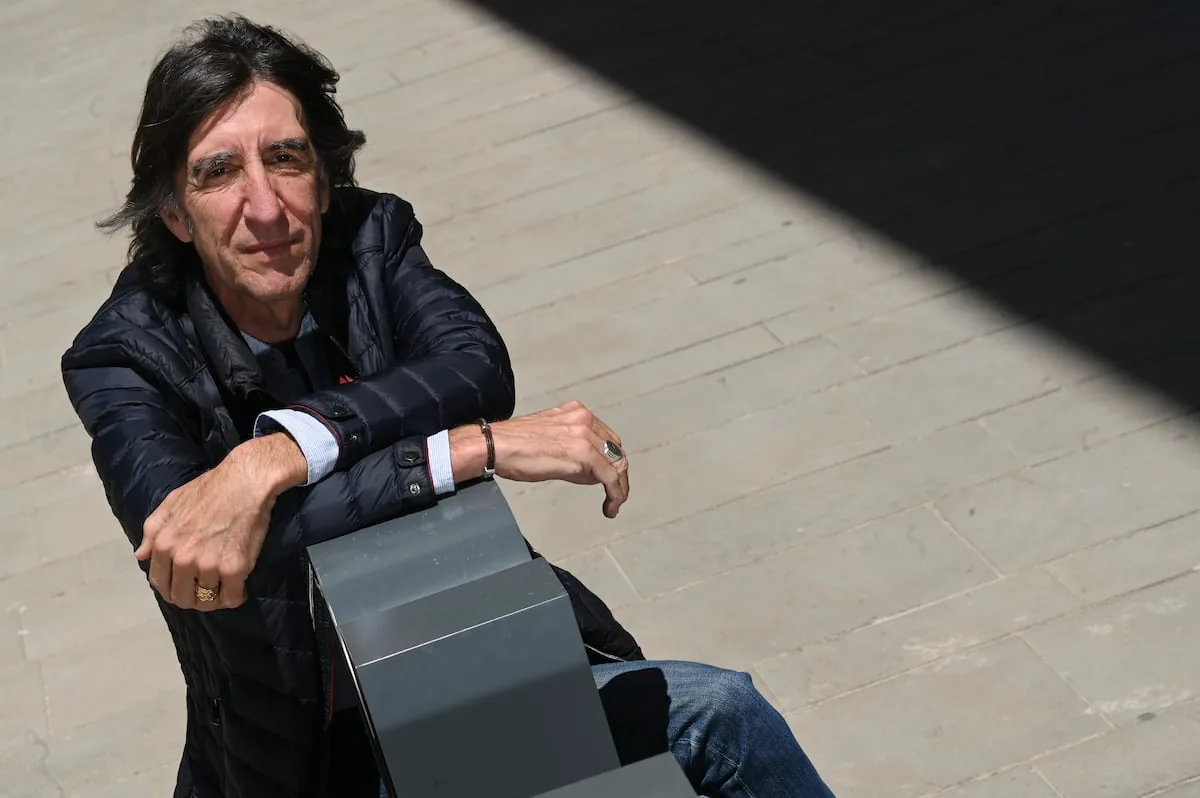
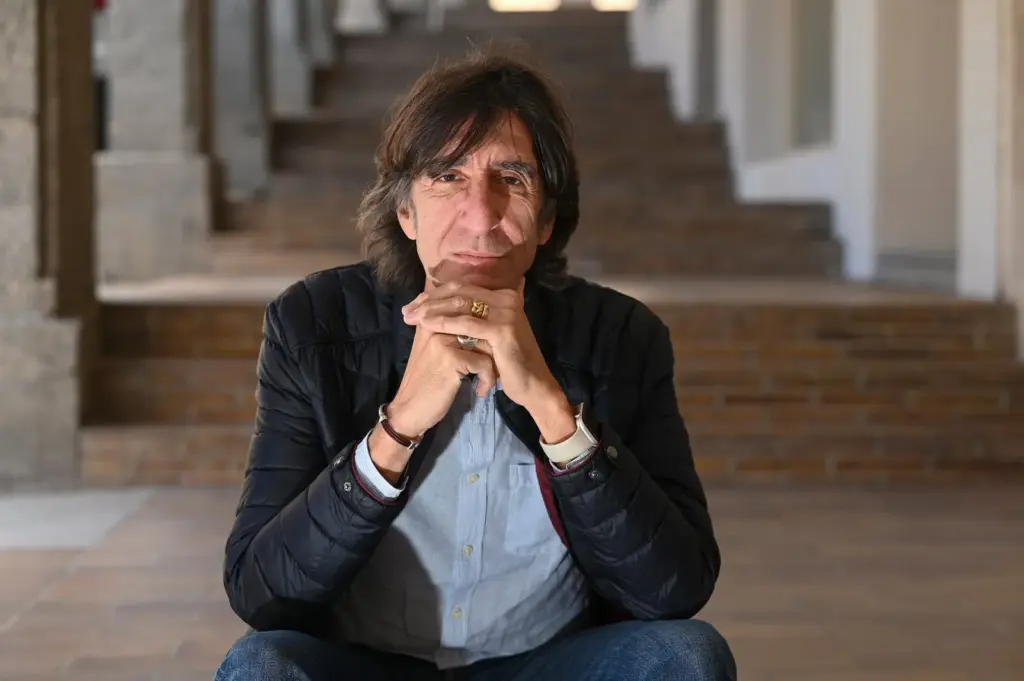
Benjamín Prado is such a cheerful, talkative, and fun-loving man that it is hard to read him confess that he is scared, that he is already on a “countdown.” But that is what he reveals in his memoirs, What Am I Doing Here, which Alfaguara will publish next week, in which he goes through his life and confesses that he suffers from “a neurological disease that is currently incurable” which he prefers not to detail. The 64-year-old Madrid-born writer, also a poet, lyricist, playwright, and even an accidental actor, reviews a life of great friendships, readings, and a compass always activated to try and move forward. We talked at the Barbitania festival in Barbastro.
Read more Two dead and four seriously injured in a shooting in El Ejido (Almería)
Question. You say that one day Sorogoyen called you, proposed you act, and you said yes. What did that mean?
Answer. The confirmation that I am a guy who is always trying on shirts that are eleven yards long and that they fit me well. I thought he was joking or wanted a script. And when he told me it was to act, I said no, but then I thought: “Why not? Something different, new, a test and that’s it.” What I always do, stick my spoon in other people’s dishes, which is my job.
Q. Did you become a poet by order of a teacher, as you say?
A. It was like that, that teacher saw something in me and said: “You are going to write poetry. Go buy About the Angels by Alberti and Poet in New York by Lorca.” And so it was. What did he see in me? No idea. What did Alberti see when he became my friend? No idea.
Q. You met the poet by chance and became close.
A. My father sent me to the corner bar and there I saw him. Alberti hated his book About the Angels because it was his masterpiece, and when I met him and told him I had read it, he got defensive: Did you like it? he asked. And I, with the arrogance of 17 years, said: “It’s not bad, but I liked Sermons and Dwellings more.” And he said: “How old are you?” “17.” “Come on, I’ll buy you a gin and tonic.” And that’s how a 15-year friendship started.
Q. Is everything you put in your memoirs true?
A. “Everything” is too big a word, but this is true (laughs).
Q. Your father was a motorized escort for Franco.
A. Yes, yes, he was the most handsome man in the world, a kind of Clark Gable with green eyes, a fascist mustache of the time, a rider’s uniform, and a Harley. One day when his motorcycle broke down, my mother looked out, saw him, and here I am. Later he set up a mechanical workshop and that’s what we always lived on.
Q. Poet, writer, journalist, lyricist with Joaquín Sabina… What are you?
A. Basically a fraud who gets involved in other people’s lives (laughs) and does things that seem more theirs than yours. The most fun thing in life is costumes, not what we are but what we appear to be; no one in costume is having a bad time if it’s by choice. I have learned many things, I have been lucky to be born in a generation in which the ’27, ’36, ’50 generations were alive… One read Alberti fascinated and went to eat with him. Read Gerardo Diego or Luis Rosales fascinated and went to interview them. Jaime Gil de Biedma, Ángel González, and others have been like family while also literary myths. Beautiful friendships start in bars, that’s how I met Rafael, Sabina, Luis García Montero… Forty years have passed since all that and my friends, except those who have died, are still Luis, Joaquín, Chus Visor… the same ones.
Q. You have wanted to turn rock and roll into poetry and poetry into rock and roll.
A. Yes. I was fascinated to see Allen Ginsberg doing a poetry reading; it was the closest I had been to Bob Dylan, my hero, who is the namesake of my daughter, and I said: I want to do this, take poetry to other places. That’s how I started doing tours of 50 or 60 concerts with Coque Malla, Leiva, Pereza… A poem gains a lot of power having a band or a musician behind it. People don’t really know what they are going to or what they have seen; it’s a very good ground for surprise, but they keep an idea, a verse.
Q. Wars between poets are fierce. Have you felt at war?
A. I have always defined myself as a deserter from both armies. I don’t care about the style or trend in which a poem is written but what it tells me, what moves me. I will die with a blank blacklist; I don’t have a blacklist. I have followed a line similar to realism, but I have not abandoned the irrationalist part, the part of Poet in New York, About the Angels. Those first two books are like my first two girlfriends and they are always in my head, along with Neruda’s Elementary Odes, like satellites orbiting around me.
Q. Does public exposure benefit or harm an author?
A. Nothing harms a poem or a novel. The author is the least important. Public exposure neither improves nor worsens you as a writer. There have been cases of greats like Terenci Moix who wrote The Day Marilyn Died, a marvel, a novel like any book by Marsé, and decided to write another kind of novels to have great success and follow Manuel Lombardero’s theory that “selling books to those who read is a ruin, you have to sell to those who don’t read.” I prefer to sell them to those who read and if there are new ones, great.
Q. Why so many superstitions? You only write in green, for example, and with a gifted pen.
A. No idea, my father used to tell me I was an idiot and he was probably right. Everything has to be odd, like the TV volume, straight shoelaces, I can’t carry money facing backward, I can’t step on iron, I jump over manholes, I don’t pass under scaffolding, and one day a bus is going to kill me on Gran Vía. And I’m also accumulating OCDs. It’s horrible. I haven’t treated it because I don’t hurt anyone either.
Q. You reveal that the countdown has started because of your neurological disease. What does this mean?
A. For a coward like me, it means a lot of fear, a lot of melancholy because I have almost more dead than alive in my contacts. I miss a lot of people. Why would I go to Barcelona, for example, if Gil de Biedma, Juan Marsé, or Joan Margarit have died and Vila Matas no longer drinks. And so in many places. I am very cowardly, I am very afraid of death, of disappearing, of not seeing my children anymore. I am very afraid. I am 64 years old and my health is so-so, so I don’t know.
Q. And how are you?
A. Pretending that I am better than I am. For now, I am in the state where you can still pretend, do a little theater.
Q. Has this changed your priorities? Is that why you wrote your memoirs?
A. Partly yes. I was starting to forget many things, names, situations. I had the project of doing my ten Juan Urbano novels, I have seven, and I have put this in the middle so I don’t forget everything along the way. Long projects are reckless after 50 because you never know what can happen to you.
Q. Like your friend Almudena Grandes.
A. I always told Almudena: “Almudena, the day the world ends, there will be Will Smith left, who is the one who remains in all the movies, and you, who are a force of nature.” And look.
Q. At the end of the book, you say your romantic relationships have not gone well.
A. They have gone terribly.
Q. Have you failed, or was it luck?
A. It’s always a tie, 5-5 or 0-0, but a tie. When things don’t work, it’s because neither of the two has done it well, but maybe I am excessively demanding and my idea of love is like that Sabina song that says: “I don’t want a civilized love.” I don’t know. It hasn’t worked. Living together is complicated, they say friction creates affection, but I think friction creates chafing, like shoes, and it’s hard for two people full of quirks and immovable principles to end up understanding each other.
Q. Do you give up?
A. I don’t know, children also take up a lot of space when thinking about romantic love, but one of the mistakes we make is thinking we can choose things. As I think my entire autobiography says, things have been choosing me. Maybe I was smart enough to take them, but life is the same: things happen, people appear, others disappear, some disappoint you, betray you, others are always loyal, others surprise you, you thought there was nothing there and there is everything. But it is very difficult to find someone who understands you and whom you understand. A flamenco singer said: “I loved my wife so many years that I ended up in love with her.”
Q. You declare yourself a survivor of an extinct world that also doesn’t interest you.
A. We belonged to the world of “us” and now we are in the world of “I,” everyone is on their own, the news is starting to be a bit on demand, people don’t want to see unpleasant things. There is a terrible war in Iran and what worries us is gasoline. The dead, women’s freedom, or restoring democracy don’t matter to us, how lucky Americans are that every time they want to restore democracy they find oil. Solidarity is disappearing. And in the literary world, I have the feeling that we are the last ones who believe that literature was a journey from the past to us. Now we are in the culture around, everyone wants to look like the one who is successful at the moment. Literature is the only thing that has survived digital and yet we waste it by turning it into an appendix of social networks where we don’t know if we are the fish or the fishermen (laughs). It’s unknown.
Read more Zapatero, investigated for money laundering in the ‘Plus Ultra case’ at the National Court