






The land caravan of activists called Global Sumud Land, which aims to bring humanitarian aid to the Gaza Strip, reported this Sunday that the authorities in eastern Libya have detained ten of its members, including the Spanish Alicia Armesto Núñez, while negotiating the convoy’s passage at a security checkpoint near the city of Sirte. This is the second time the group has been prevented from passing, having already been intercepted on May 18 near Sirte.
Read more The negotiation of a pact between Iran and the United States unsettles Netanyahu’s Government
In the main group, of about 200 people, there are four Spanish citizens. One of them, Armesto, went ahead with the other nine to negotiate passage. “The volunteers of the Global Sumud Land Caravan approached the Sirte checkpoint to negotiate passage. It has been almost two hours. We have heard nothing from them since then,” the group had previously reported in a message shared on social media on Sunday afternoon.
“If you are a citizen of one of these countries, call your Ministry of Foreign Affairs. Ask what they are doing to protect their citizens who are part of a humanitarian convoy in Libya,” concludes the Global Sumud statement.
The other nine detained are Polish citizen Laura Kwoczala, American Jenelle Jones, Argentinians María Paula Giménez and Lucas Ezequiel Aguilera, Uruguayan Matías Álvarez Rodríguez, Portuguese Ana Margarida França Santana Baptista, Tunisian Ashraf Joya, and Italians Domenico Centrone and Leonarda Alberizia.
The United States Department of State considers eastern Libya an extreme risk area and warns that the region is characterized by deep instability, the presence of armed groups, high crime rates, risk of terrorism, kidnappings, and the constant threat of unexploded explosive devices.
The region has been ruled with an iron fist by Marshal Khalifa Haftar since the fall of dictator Muammar Gaddafi in 2011, an event that triggered such instability that it turned the North African country into a failed state. In the west, with Tripoli as the capital, there is a government recognized by the international community. Haftar controls the eastern territories of the country, where he has imposed himself by force against various factions with the support of Egypt, the United Arab Emirates, and Russian mercenaries.
The activists were able to pass without problems through western Libya, but were prevented from passing at a point west of Sirte, controlled by the so-called Libyan National Army under Haftar’s command. A Turkish source from the convoy explained that the soldiers assured them they would not allow any foreign activist to pass.
Read more Two dead and four injured in a traffic accident on the A-2 in Jorba
Days later, the convoy reported that negotiations with the authorities had stalled. “Repeated requests for meetings to finalize the details of the reception and delivery of humanitarian aid, along with the specialists traveling on board, have received no concrete response,” the group explained. They consider that “the genocide and blockade of Gaza continue and the Palestinian people cannot wait for this absurd bureaucracy to be resolved to receive relief and aid.”
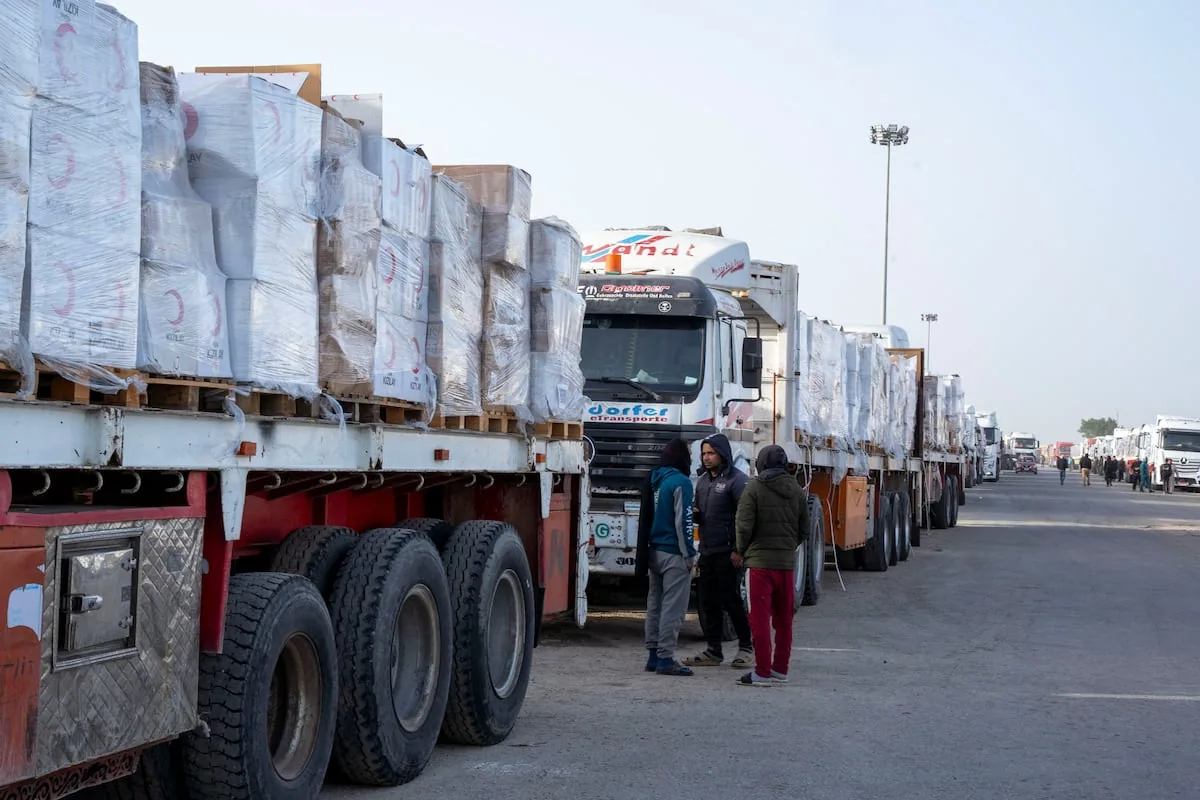
The convoy includes 30 vehicles, including 10 trucks and two ambulances loaded with medicines, and carries 270 people of 26 different nationalities, including experts in medicine, engineering, logistics, and humanitarian law. The initiative started from Mauritania, Tunisia, and Algeria, among other countries, about a month ago.
“Every item on board is meticulously documented. All participants are committed to civil and non-violent action. Every step is taken in accordance with international law,” the organization explained.
The group also recalls the recent interception of 50 ships of the Global Sumud Flotilla and the “brutal and illegal detention” of 328 participants in international waters while heading to Gaza. “The right of the Palestinian people to receive aid and control their own borders is not a request: it is a legal and moral obligation of all states and institutions that claim to defend human rights,” the statement emphasizes.
In fact, this land convoy set out in parallel with the maritime flotilla in early April. In June 2025, a first caravan already tried, unsuccessfully, to reach Rafah from Cairo. Unlike the previous one, this one is not only focused on aid and logistical support to the flotilla from land but also transports medicines, construction materials, and mobile homes that they want to bring through the Rafah crossing. The activists have passed through Mauritania, Algeria, Tunisia, and Libya, where they are now, and intend to enter from Egypt.
Read more The money from Alex Saab that reached Abelardo de la Espriella’s accounts