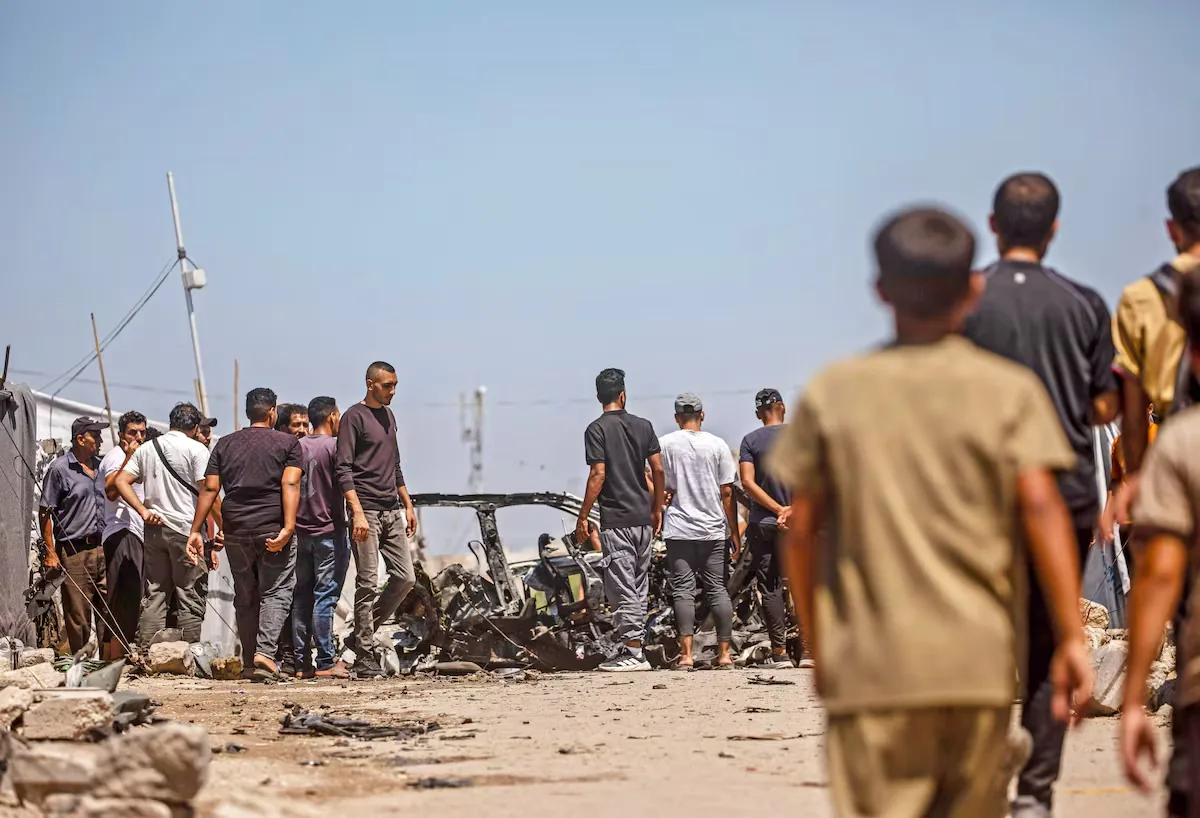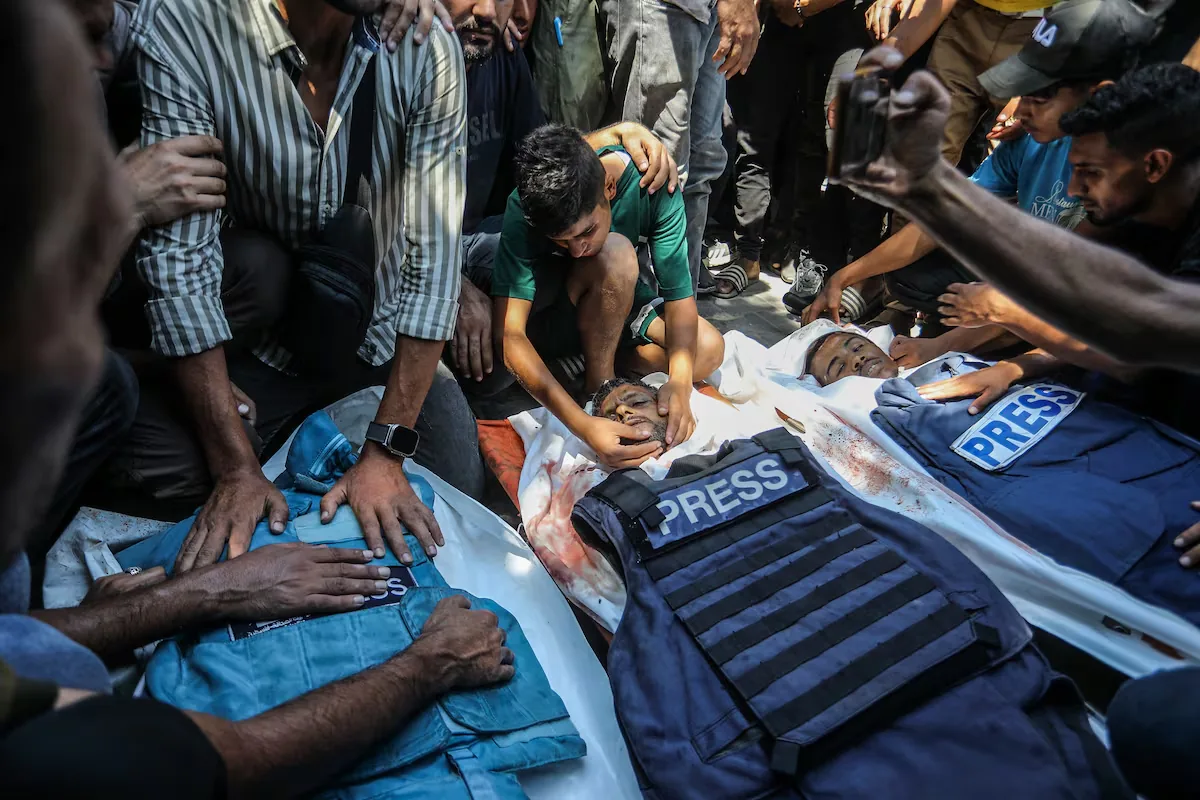
On the morning of August 25, 2025, the Israeli army fired two tank shells without warning at the Nasser hospital, the only operational one in southern Gaza. The target was the top of an external staircase that journalists from the Strip regularly used, with the knowledge of the Armed Forces, to capture images and broadcast live. Almost ten minutes later, when medical personnel had come to attend to the wounded and more journalists were approaching to cover the news, the troops launched another two simultaneous shells, in a tactic known as double-tap that usually targets civilians.
Read more Eroticism and complicity: Dree Hemingway stars with her partner in the new JW Anderson campaign
The quadruple attack claimed 22 lives, including rescuers, relatives of hospital patients, and five journalists: Hussam al Masri and Moaz Abu Taha, cameramen for Reuters and Al Jazeera, respectively; Mariam Dagga, contributor to the Associated Press news agency; Moaz Abu Taha; freelance photographer for Reuters, and Ahmed Abu Aziz, correspondent for Middle East Eye and Quds media.
The Israeli army claimed it had identified Al Masri’s camera as “a Hamas camera,” without clarifying why it opened fire again a few minutes later and used such explosive ammunition. It also linked the Islamist movement to several of the journalists, in a process that consists of presenting them once dead as legitimate targets, spreading intelligence information—often without evidence or circumstantial—that links them to Hamas. Faced with a succession of international criticisms, Israeli Prime Minister Benjamin Netanyahu ended up “deeply” regretting the “tragic accident.”
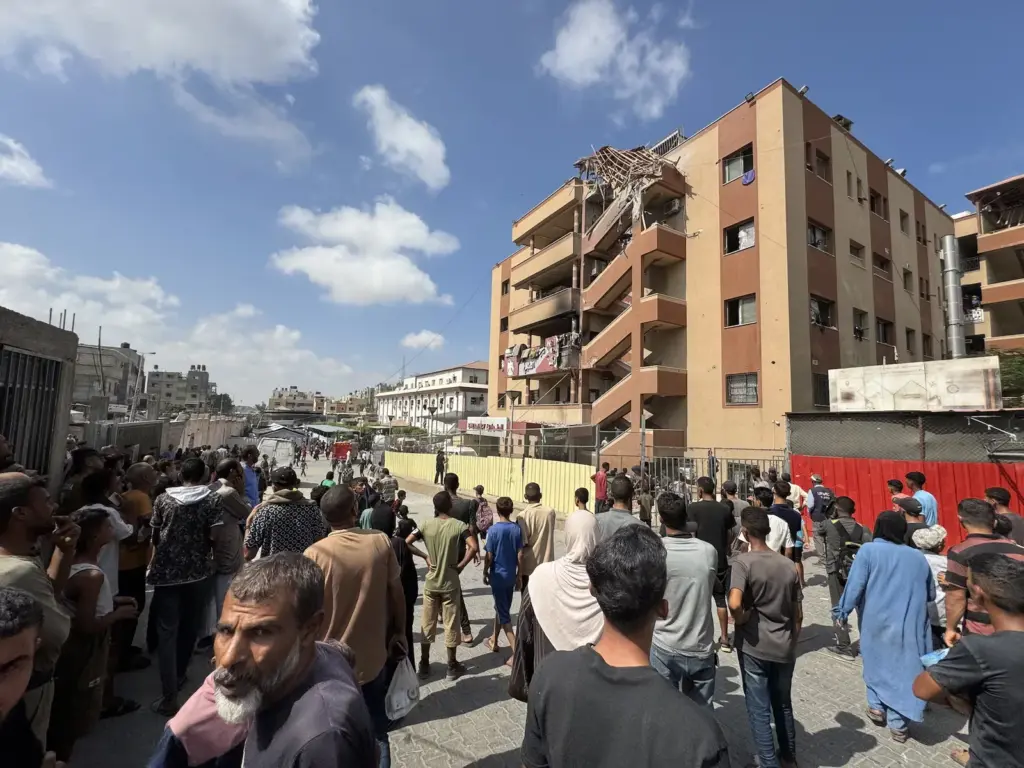
One year later, an Israeli soldier with direct knowledge of that massacre explains that his army “identifies cameras as an immediate tactical threat” because a live broadcast can reveal “how many soldiers there are, where they are located, and with what weaponry,” information he never specifies because Palestinian militants can use it to attack them. “I’m not sure if soldiers on the ground distinguish between a journalist’s camera and a camera that helps Hamas. For them, all cameras help Hamas,” he notes.
The soldier speaks with a small group of media, including EL PAÍS, under strict anonymity, in testimony provided by Shovrim Shtiká, the Israeli NGO of former soldiers—better known internationally by its English name Breaking the Silence—that gives voice to those who decide to denounce abuses they committed or witnessed in uniform in the occupied territories. He faces a real danger. Not only because his action is punishable by imprisonment, but because of the stigma of betrayal it carries in a society that, since Hamas’s attack in October 2023, closes ranks even more tightly over what happens on the battlefield.
In the case of Nasser hospital, located in Jan Yunis, the famous infantry brigade that carried out the bombing, Golani, identified the camera as a threat, citing suspicious behavior, which consisted of covering it with a piece of white cloth. Al Masri usually did this to protect it from dust and the strong summer sun. “To justify the mission to disable it, Golani elevated it in the chain of command as a tactical threat. That’s what they called it: ‘Hamas camera.’ From their perspective, it’s Hamas’s camera because Hamas can see anything there,” adds the soldier.
“My interpretation of how soldiers perceive cameras and the media in general is that they are accomplices of Hamas. They collaborate with Hamas because, essentially, when they transmit information or criticize Israel, they strengthen Hamas. So, when they see a journalist, they see a hostile agent. It doesn’t matter if the camera says ‘Hamas’ or ‘Press.’ For them, it’s a camera that supports Hamas,” he adds.
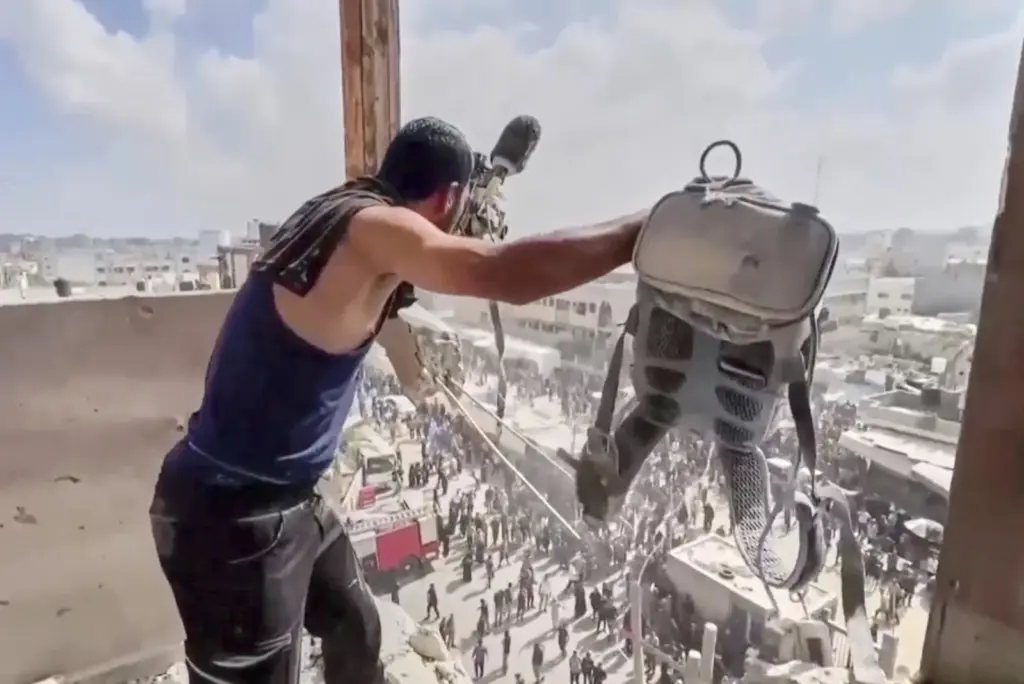
The initial plan in the bombing of the hospital was to use more precise ammunition, through drones, but a problem prevented it. Instead of waiting, artillery fire was chosen, from tanks located less than three kilometers from the target, according to calculations made by military experts.
The next day, the army issued the results of its preliminary investigation. It spoke of “holes” it would investigate, but emphasized the “extensive and covert visual intelligence gathering carried out by the enemy” and again presented the hospital (like others that no longer exist today) as a position from which Hamas “carries out terrorist activities against the troops,” something that no UN agency or international NGO present on the ground has confirmed. It also labeled six of the dead as “terrorists.”
It is the same brigade, Golani, that participated a few months earlier in the massacre of 15 emergency service members in southern Gaza. Some showed signs of execution. The soldiers buried several of the vehicles they attacked to try to hide the evidence. It is one of the two cases in which the Israeli army will open internal criminal investigations, along with that of the Palestinian girl Hind Rajab, riddled with bullets while begging for help next to the bodies of her relatives, in January 2024, as announced last week.
The deadliest country for the press
In these almost three years of war, Israel has killed more than 200 Palestinian journalists, according to the most conservative estimate, that of the Committee to Protect Journalists. In some cases, admitting they were the target. Israel has been responsible for two-thirds of journalist deaths worldwide for two years (2024 and 2025), according to the Committee, based in New York. From 86 last year, far above the second country, Sudan, with nine.
Meanwhile, it prevents free access to Gaza for journalists outside, in a ban with few precedents on which its Supreme Court has yet to rule. It has been granting extensions to the State for two years to present its position in the case initiated by the Foreign Press Association.
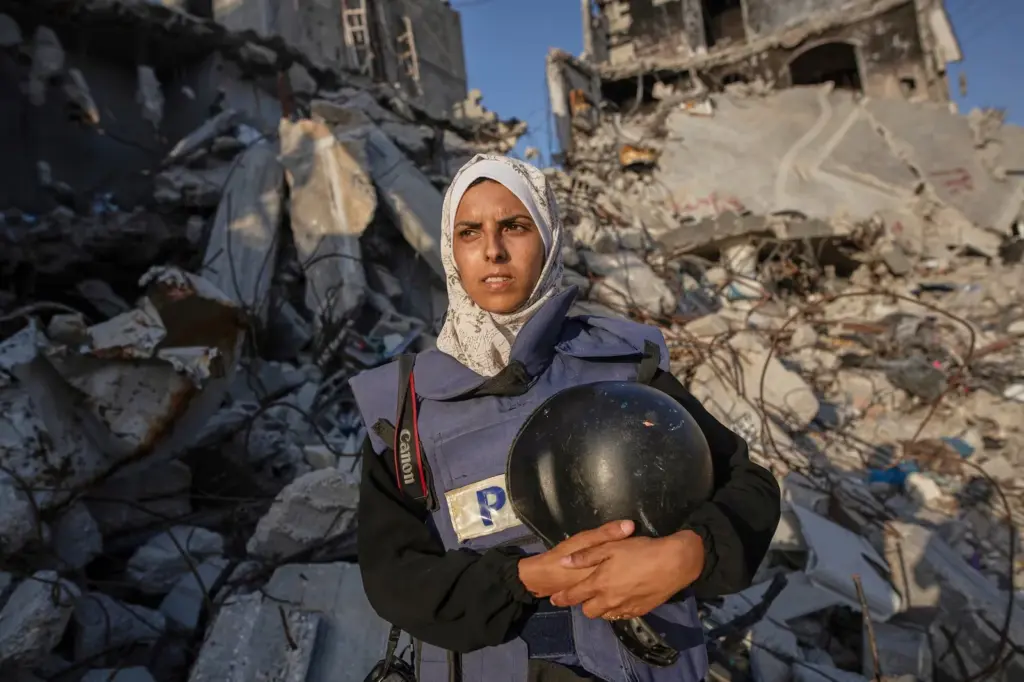
In 2025, the Israeli media Sijá Mekomit and its English version +972 revealed that the Israeli army created a “Legitimization Cell,” following the Hamas attack, which is responsible for gathering intelligence information in Gaza to improve Israel’s image in international media. Among its tasks is identifying which Palestinian journalists could be presented as undercover Hamas agents, especially when criticism of Israel for its brutal invasion intensified, which has left more than 73,000 dead, 174,000 injured, and a lunar landscape of ruins whose sight makes one feel “good” and is “the result of a deliberate policy,” as Defense Minister Israel Katz declared last week, when visiting the part (more than half) of the Strip controlled by the troops.
The effort to track justifications has led to forced and erroneous attributions, according to that information. The army presented a document found on a Hamas computer to point to Al Jazeera journalist Ismail al Ghul (killed in an Israeli bombing along with his cameraman Rami al Rifi) as a member of Hamas’s armed wing. But, according to the document released, he would have received his military graduation in 2007, when he was ten years old.
These alleged links to Hamas are sometimes established retroactively, once the controversy has started. This is implicitly acknowledged by an Israeli army source, noting that they are carried out “mostly” before the bombing. “We don’t attack journalists for being journalists,” but when there is “evidence linking them to terrorist activities,” the source emphasizes, who did not respond to questions about the existence of the “Legitimization Cell.”
Shovrim Shtiká’s executive director, Nadav Weiman, says the army combines its “reckless rules of engagement” and its “de facto retroactive incrimination procedures” as “an almost automatic justification for every bullet, shell, or missile fired, and as a tool to avoid conducting genuine investigations.” The attack on Nasser hospital “derives from these policies,” which are “the basis of how it chooses to fight in Gaza,” despite “attempts to present them as an isolated incident or as conduct that does not conform to protocol.”
Read more Coven Academy: The Spell of the Witches