
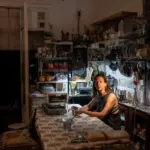




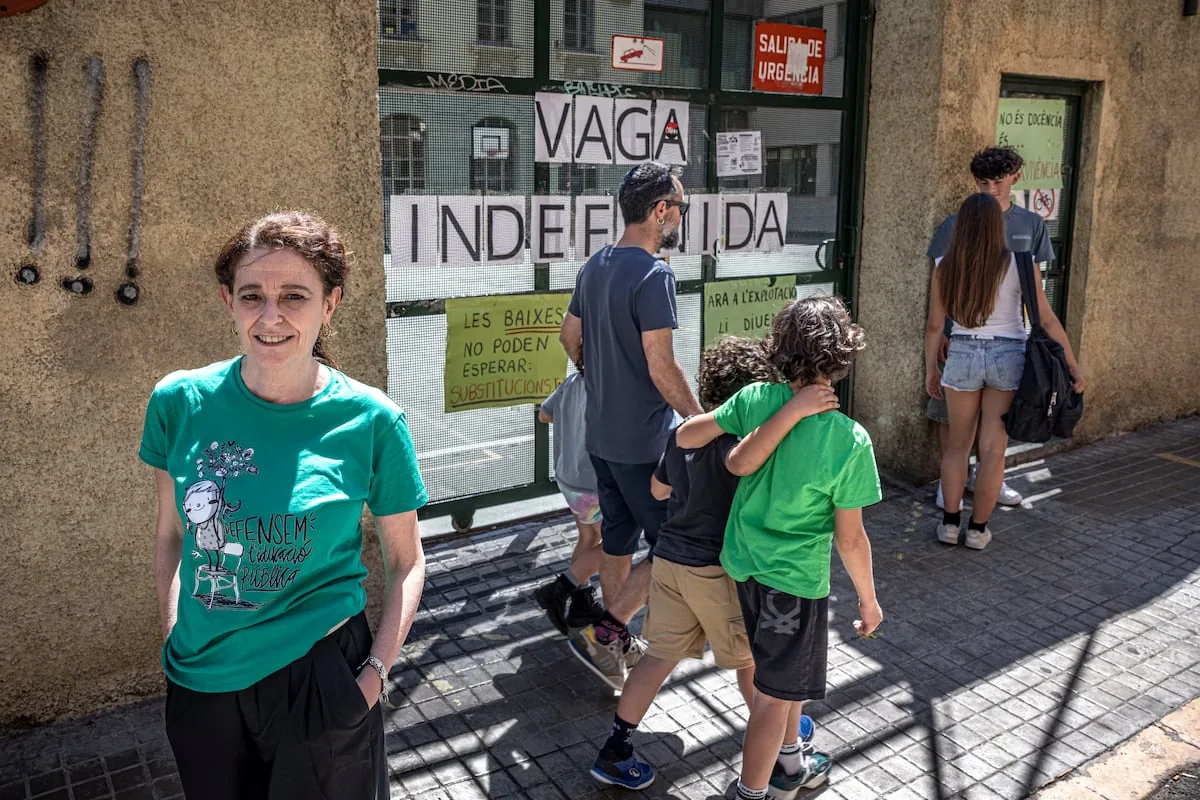
Empar Penadés has been teaching for 37 years and is about to retire. She is a teacher of the second cycle of Early Childhood Education at a public school in Valencia. Her students are between three and six years old, a key stage for learning skills that will serve them throughout their educational journey. Penadés has often seen the same thing. Kids who, because of the environment they live in, she could almost guarantee at that age will take the university entrance exam and go to university. And others who, for the same reason, are likely to drop out of school, although during the years they spend in her hands ―and in some cases, for quite some time after― she does her best to prevent it. “They are boys and girls who, if they do not receive support from someone behind them, inside or outside the school, have a very hard time. And the gap between some students and others has widened in recent years with students coming from abroad,” says Penadés, whose impression is supported by the data.
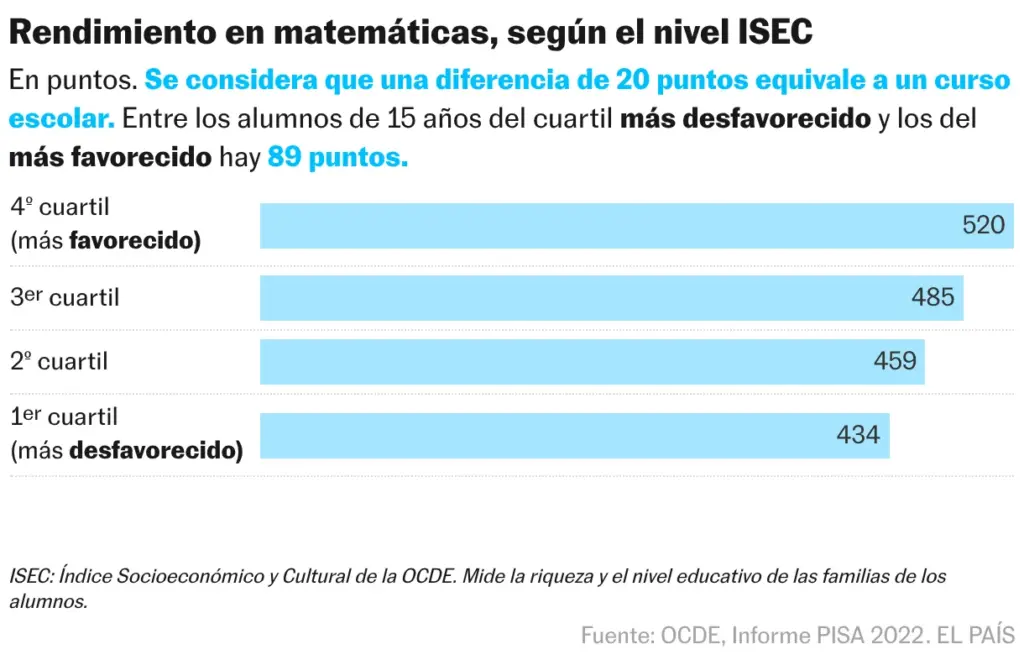
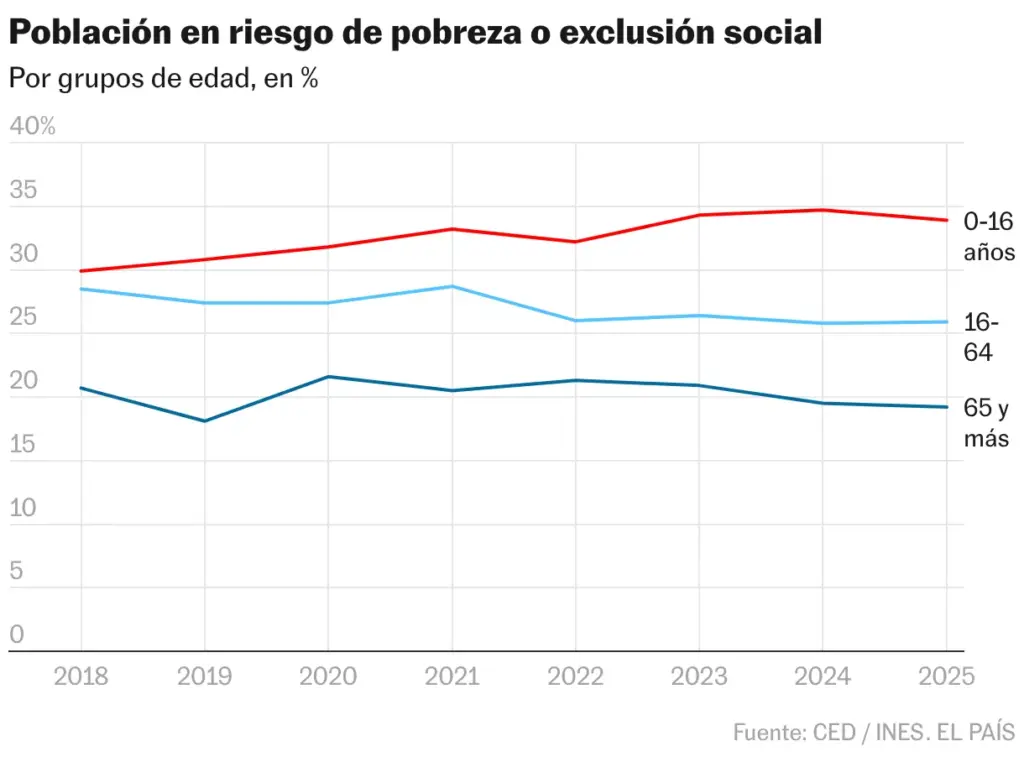
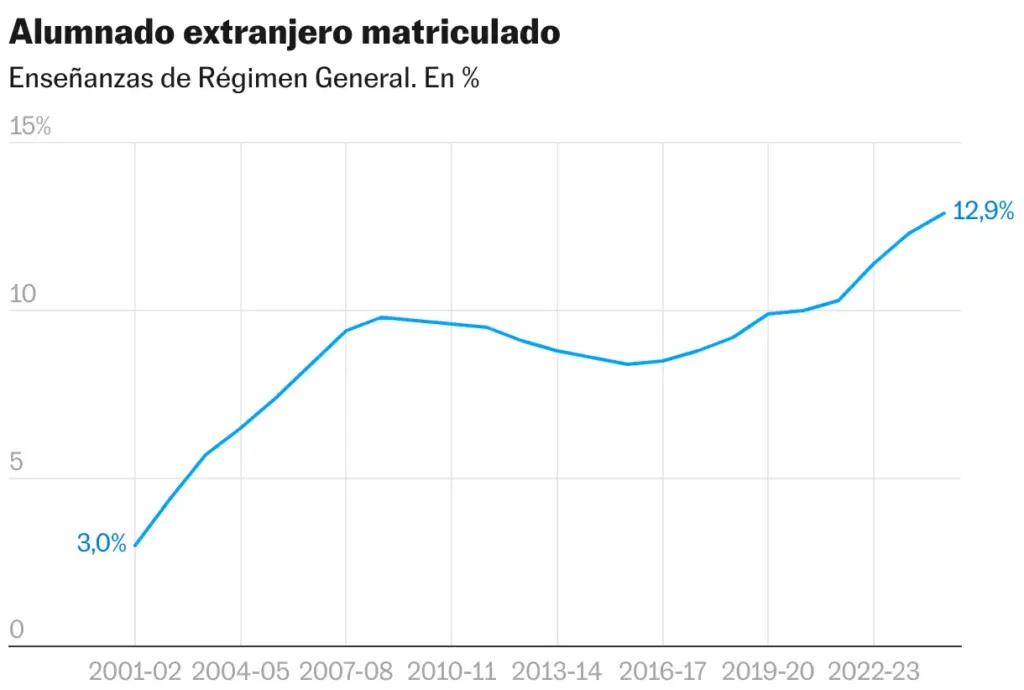
The 120,000 fifteen-year-old adolescents living in the most affluent Spanish households (according to a socioeconomic and cultural index developed by the OECD) have the equivalent of four years’ advantage in mathematics over the 120,000 kids of the same age from the most disadvantaged families, according to the latest PISA Report, the largest international assessment. Unlike what happens with other age groups, between 2018 and 2025, the percentage of minors at risk of poverty or social exclusion has not only not decreased in Spain but has increased by four points and reaches 34% of the total. And the early school dropout rate of foreigners, which ten years ago was double that of natives, now triples it.
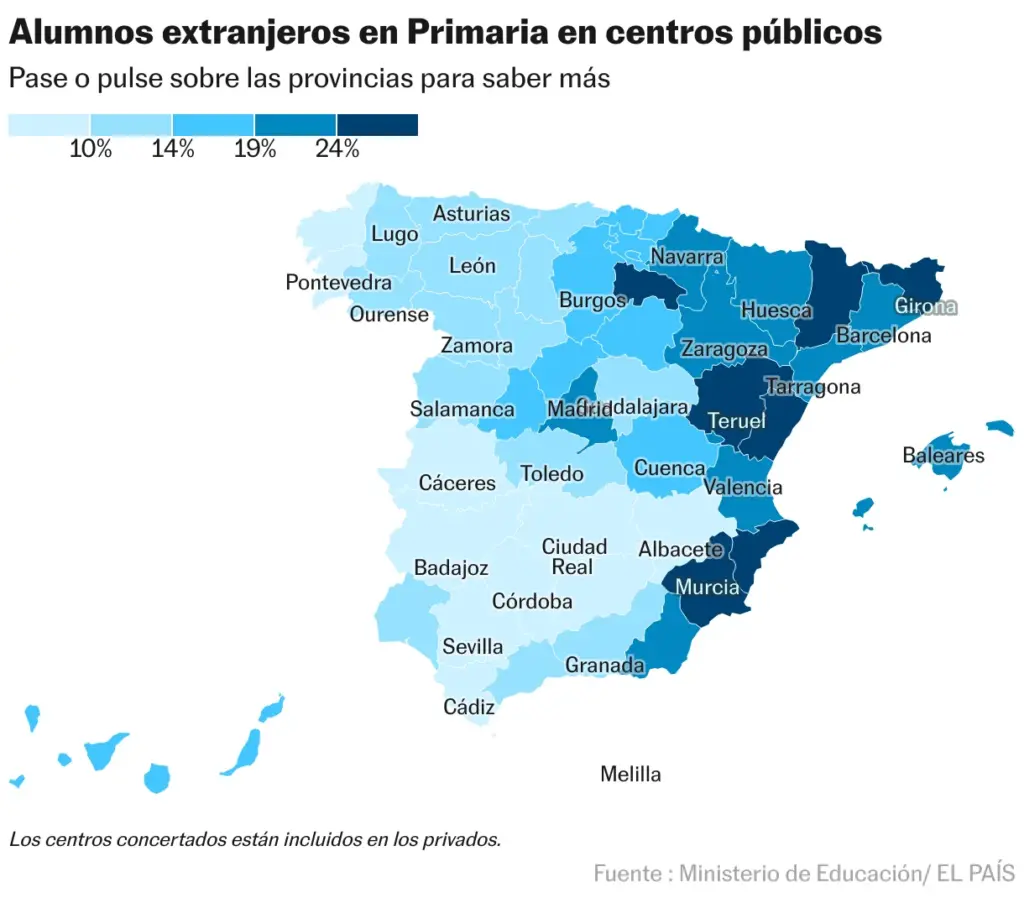
A decade ago, there was a foreign girl in Penadés’s class. Now, however, the teacher has several kids from Georgia, Russia, Brazil, Venezuela, or Argentina. Ten years ago, as has always happened, she had poor students in class, but they were very rare, and now they are no longer so, the kids who were forced to live with their entire family, four or five people, in the rented room of a shared apartment. The increase in child poverty and foreign students (some of whom arrive with no knowledge of the language or with curricular delays) mainly affects public schools (they represent 18% of primary enrollment, eight points more than in semi-private schools). And this increase in classroom complexity, which has not been accompanied by more resources, underlies the strikes and protests of teachers in the Valencian Community, Catalonia, Aragon, and Madrid, four autonomous communities notable for the concentration of foreign kids in the public school network. In all these places, the same can be heard: teachers do not want to get rid of the new vulnerable kids, but they need more resources to attend to them.
The fact that the socioeconomic and cultural level of the parents is what most influences students’ chances of educational success is well established. “But what we have much less information about is what processes generate that inequality,” says Sheila González, a researcher at the University of Barcelona specializing in social and educational inequality. What follows attempts to answer that question. A problem that affects not only Spain but the entire developed world, and that highlights the limits of the educational system to compensate for starting differences.
A school for one social class
One of the factors experts mention is origin. “We have a school that was designed for middle-class people, who had cognitive professions, to send their children to learn to have cognitive-type professions. And when the system was universalized and working classes, who had more manual jobs, entered, it did not fully adjust,” says sociologist José Saturnino Martínez from the University of La Laguna. “The consequence is that the school privileges very intellectual types of knowledge. No one questions teaching reading, writing, or mathematics. But there are mandatory knowledges that as adults almost no one uses, such as syntactic-grammatical analysis, more typical of Philology studies. On the other hand, knowledge that can be very useful in life, like having some idea of plumbing, carpentry, etc., typical of working-class trades, the school leaves in second place. Many school contents do not engage a part of the kids, who see them as something alien to their daily life, cultural experiences, and interests.”
The working classes, adds Manuel Fernández Navas, a professor of Education at the University of Málaga, “usually value the immediate usefulness of things more: this is useful for this, here and now.” While in school knowledge has, to a large extent, an “exchange value”; it is assumed it serves to be exchanged for a grade. “And who adapts better to spending six hours in class doing something that has no use for their daily life? Kids from higher social classes, who have internalized at home the expectation that having a degree will serve them in the future to have a career and a better social position.”
The language of the school
Social class also brings children and adolescents closer to or further from the type of language used in classrooms. “In the materials, in the way teachers communicate with students, in how they justify the activities they develop and evaluate them, the linguistic code of the school is much more similar to that used in families with more education,” says Miquel Àngel Alegre, project manager at Equitat.org (formerly Fundació Bofill). The difference, the sociologist indicates, is noticeable in how children from those homes speak from an early age. “With more complex grammatical structures, subordinate clauses, use of the passive voice, and a more conceptual repertoire.” Conversely, kids from families that use a more restricted code “feel more disoriented and have more difficulties reaching the minimum initially expected in school.”
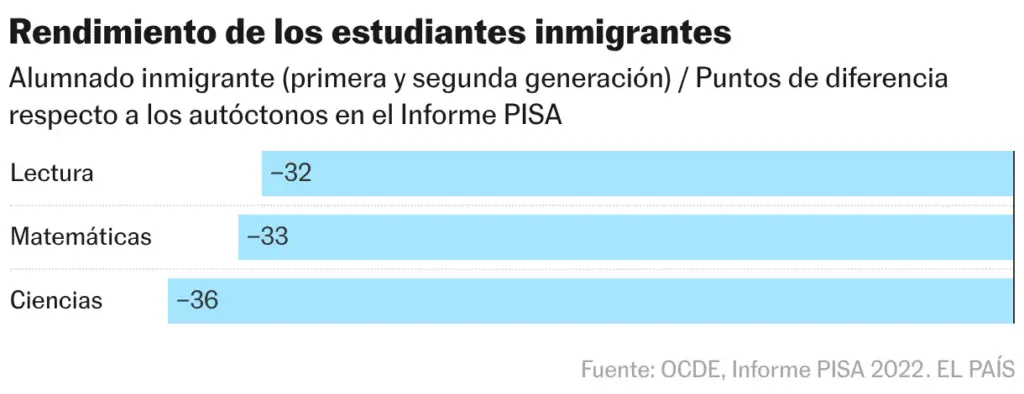
That gap, which has existed since education was universalized, has been widened with the incorporation of kids from other countries. “With some of them, and their families, teachers can hardly communicate at first because they speak very distant languages, like Urdu or Tagalog, and do not know any Romance language,” says Sheila González. One of the teachers’ demands in the protests of recent weeks is to increase reception classrooms that provide students with a base to be able to manage in class.
Read more The Oresund Strait, the new frontier in Russia’s hybrid war against NATO
Less learning time
Wealth level also conditions the learning time students are exposed to, says José Saturnino Martínez. The most vulnerable population is the one that attends preschool the least, which delays their contact with formal learning. Their families take them to fewer extracurricular activities, have fewer possibilities to resort to private lessons to keep up with the school curriculum, and less capacity to afford the costs of post-compulsory education. They can also help less with studying and doing homework personally, especially as its complexity increases in secondary school. Carla, 18 years old, a student at a high school in Albacete, is an example of such disadvantage. Since she was 11, when her parents’ drug addiction became evident, she stopped being able to count on them, not only to help with homework but to have dinner guaranteed. “At some point, they didn’t even ask me about my grades. And I got used to locking myself in my room and focusing on my studies,” she says. Carla is what the PISA Report describes as a resilient student, and she will take the university entrance exam in June. Her brother, however, did not fare as well, has repeated two years, and seems about to drop out of school.
Things taken for granted
Carla and her brother’s case highlights another factor of educational inequality: “The educational system assumes that all students come to class having had breakfast, with the necessary clothes not to be cold, or having slept all night in a comfortable bed, because learning requires minimum conditions. But we know that this does not always happen.” The Spanish educational system is underdeveloped to alleviate these types of problems. It does have, for example, school meal scholarships, but usually limited to Early Childhood and Primary stages. And even that type of aid is not always available because scholarships fall short or because the school lacks a cafeteria (a problem affecting one in six public schools and more than 80% of high schools, according to the NGO Educo).
The new poverty
Traditionally, poor people were usually unemployed, González points out. Their situations were very complicated, “but they were at home and could at least provide present parenting. Now, however, there are many people who are poor despite having very long working hours. And that means we have children who are not only poor but whose parents are absent all day, which prevents them from accompanying them and makes it difficult to establish rules and limits.” A consequence of such neglect, continues the specialist in educational inequality, “is that schools are detecting the arrival of children without habits; kids who still wear diapers or who do not have communication habits because no one talks to them.” Job insecurity, economic stress, substandard housing conditions, and fear of eviction sometimes lead, adds the Catalan political scientist, to mental health problems. “Which, combined with other things, like migratory grief, form a cocktail that ends up in school and the school is also not managing well.”
Access to silence
María, her husband, and their three children, who arrived from Venezuela in 2024, live in a room in the Valencian neighborhood of Orriols measuring “10 steps long by six wide,” in an apartment where three other rooms are rented out. The furniture in their room is limited to a couple of dressers, a mirror, a double bed, and three mattresses that during the day rest standing against the wall. The space becomes smaller as the children grow, says María, and less suitable for studying and living. To be able to concentrate, experts point out, it is necessary to have spaces of silence and tranquility that are uncommon in the homes of the most vulnerable kids.
The consequences of the ghetto
School segregation, that is, the very unequal distribution of students with difficulties among schools and school networks, also impacts students’ learning, says Alegre. When a teacher does not have one or two students with educational needs to whom to direct more intense attention, but a classroom where most students have them, they cannot fulfill their role well. In such schools, research shows something like the opposite of the Pygmalion effect occurs, González points out: teachers lower their expectations for their students. And that lack of faith makes some kids who, despite difficulties, could have excellent performance, try less.
Knowing how to demand rights
Families’ knowledge of how the educational system works is also linked to cultural capital, says sociologist Miquel Àngel Alegre. This translates, for example, into a greater tendency to contact their children’s tutors if they observe academic performance problems. And a greater tendency to demand the necessary resources to be well attended to if learning difficulties, such as dyslexia, are detected. They also have greater capacity to guide their children through different educational options (something the Spanish public system barely offers), or to contact people who can provide such information. Knowledge that is especially important in the case of Vocational Training, which, after being seen for decades as second-class education, is beginning to seem more attractive to the middle classes.
Unlike the Baccalaureate, which has only five branches, there are more than 180 training cycles, which are not in all centers or municipalities, and often have cut-off grades. Choosing well usually requires, therefore, support to design a strategy. And it is another area where kids from less affluent families start at a disadvantage.
Read more Gibraltar, European and without a fence: “An uncertainty that was very harmful ends”