








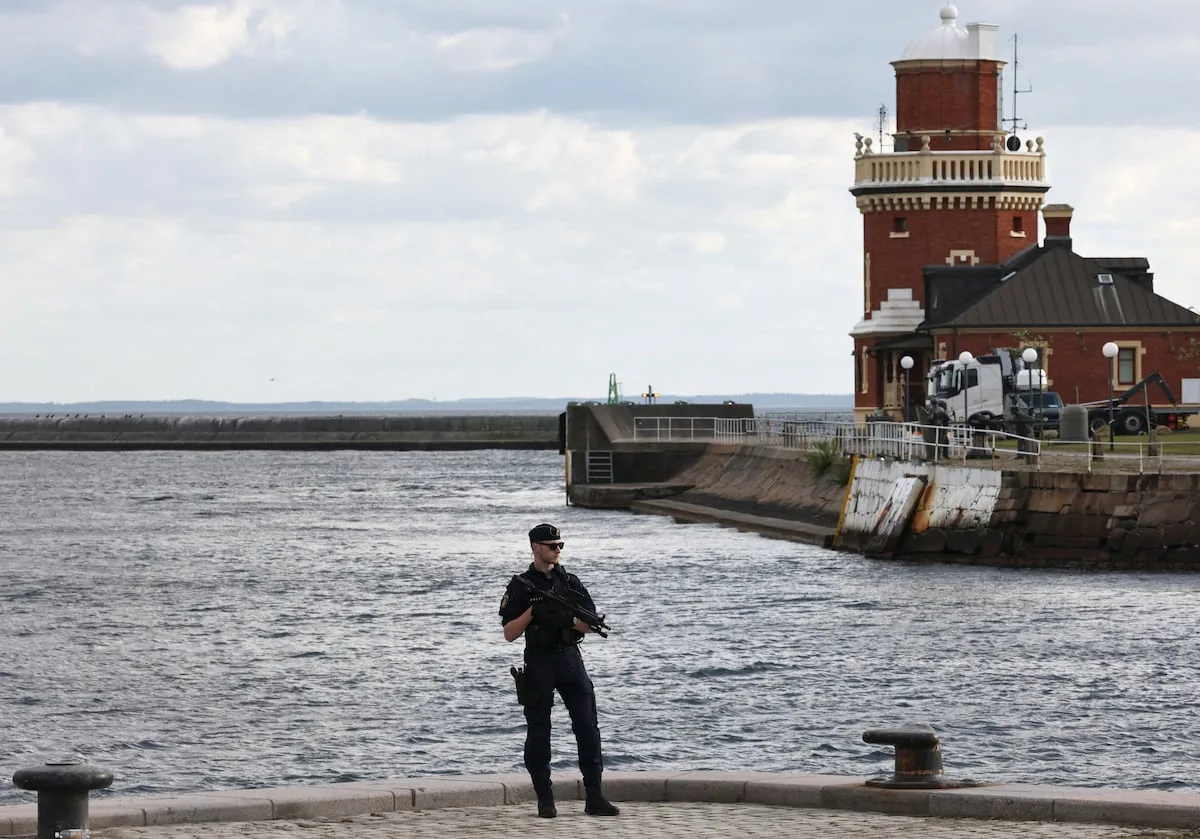
The port and ferry terminal of Helsingborg are bustling with activity. Everything operates with an almost choreographed efficiency. Ferries maneuver slowly; refrigerated trucks wait their turn to board alongside cars, cyclists, and workers crossing the Oresund Strait as if taking a commuter train. After all, only four kilometers separate Swedish Helsingborg from Danish Helsingor. From the waterfront promenade, under the oblique light of Northern Europe, which lengthens the evenings over the water, the strait is so narrow that it is hard to see it as a strategic border. But that maritime boundary, which seems ordinary on cartographic maps, is today one of the high-tension points between Russia and NATO. The setting of a hybrid, gray war, of maritime sabotage and ghost ships.
The Oresund Strait is one of the three gateways from the Baltic Sea to the Atlantic Ocean, along with the Danish straits of the Great Belt and the Little Belt. This means that every vessel entering or leaving the Baltic — goods, energy, oil, data cables, military traffic — passes through this corridor.
For centuries, controlling Oresund meant controlling access to the Baltic, explains Per Svensson, 62 years old. Tanned by the sun from his morning walks, he finishes a black coffee in a café near the Helsingborg terminal (114,000 inhabitants) while recounting that he worked two decades on the port’s ships. Now he likes to sit and watch the comings and goings of ferries and cargo ships. And read about the region’s history. “These waters have always been something ordinary for us, not a border. Now everything seems to have changed,” he says thoughtfully.
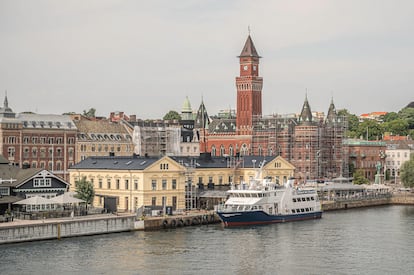
Historically, these straits were a source of power and wealth for Denmark, which for four centuries collected maritime tolls. In post-Cold War Europe, that geostrategic importance faded somewhat under decades of Nordic integration, commuter ferries, and weekend tourism. Today there are no tolls. But the old geostrategic power of the strait has returned strongly amid Russia’s attempts to extract hydrocarbons fueling its war against Ukraine.
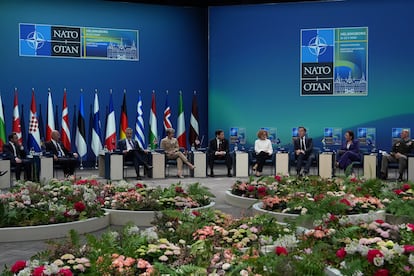
In 2025, Nordic authorities verified the passage of at least 292 ships linked to Russia in the region. Ships that left Russian ports to the Baltic crossed through Oresund or Great Belt towards the North Sea and from there to the Atlantic. From the terrace of the luxurious Clarion hotel in central Helsingborg, where NATO foreign ministers met last week, those vessels can be seen almost every day, says Swedish foreign minister Maria Malmer Stenergard.
They are apparently normal ships, but under a dense layer of bureaucracy they are part of the so-called ghost fleet or shadow fleet, Malmer Stenergard points out. These are old vessels, with opaque ownership structures to make them hard to trace, flying flags of distant countries that change very frequently, which the Kremlin and its orbit use to export hydrocarbons. It is their way of circumventing Western sanctions for the large-scale invasion.
Recently, intelligence reports have also documented that many of these ghost ships carry armed contractors on board who protect the cargo and also cloak these vessels in a military aura. “It cannot be proven that they are Russian military, but there is evidence that they are linked to paramilitary companies with ties to the Kremlin,” says a Swedish officer.
Russia’s war against Ukraine, which shook Europe more than four years ago and changed its landscape and mindset forever, brought about a structural change in the Nordic region that today, under the Kremlin’s threat, has been strengthened. The invasion dictated by Vladimir Putin also pushed Finland and Sweden into NATO. Both Nordic countries provide the Atlantic Alliance with invaluable strategic and geographic capabilities. Their accession and the already existing membership of Estonia and Denmark transformed the perception of the Baltic Sea. With the exception of the Russian enclaves of Kaliningrad and Saint Petersburg, it became an allied sea. Almost a “NATO lake,” as experts called it. That raised the value of strategic points like Helsingborg.
Conflict in the shadows
However, far from being characterized by calm waters, the Baltic is today one of the main laboratories of Russian hybrid warfare, says Elisabeth Braw, researcher at the Atlantic Council’s Transatlantic Security Strategy Center.
There are no battles between fleets nor classic naval confrontations. The Kremlin uses more ambiguous tactics, such as sabotage or damage to marine infrastructure, interference with navigation systems, manipulation of AIS signals, covert operations difficult to attribute, and espionage activities.
And at the heart of that hybrid war is the ghost fleet. “Russia has discovered that these ships serve them for more than just moving oil, such as causing damage in the Baltic, so they are exploiting it,” warns Braw, who has researched the Kremlin’s hybrid war extensively.
Russia has found that it can cause a lot of damage without using military means. There is also the environmental risk, due to the constant threat of those decrepit oil tankers transporting Russian hydrocarbons. Since October 2023, authorities in the region’s countries have recorded at least 11 significant incidents of damage to submarine cables. Mainly telecommunications and energy; also some damage to gas pipelines and other critical infrastructure, according to an Estonian intelligence report. Although most investigations have not officially attributed the incidents to the Kremlin, several of the most serious cases have involved vessels linked to Russian ports or the ghost fleet.
Ships like the Fitburg, detained by Finnish authorities in December 2025 after being accused of damaging telecommunications cables between Finland and Estonia. The cargo ship sailed under the flag of Saint Vincent and the Grenadines, had departed from Saint Petersburg, and was found with its anchor down in Finnish waters. A pattern that smells from afar like a Russian shadow fleet.
Thus, Helsingborg, the Baltic bottleneck, has gone from being a peripheral and quiet place to a surveillance space. The small port city on Sweden’s southern coast and the Oresund Strait are now part of the Atlantic defensive architecture.
Maritime international law states that those ships that appear linked to the Russian ghost fleet have the right to navigate. And unless there is evidence of environmental risk, fishing offenses, or crimes against maritime traffic, Swedish, Danish, Estonian, or Finnish authorities have limited room for maneuver. That is why it is difficult to close the hinge of the Oresund Strait to them.
However, a few months ago, the Swedish government implemented a legal change that expands the powers of its Coast Guard to request insurance information and also monitor ships simply transiting Swedish territorial waters and even the Swedish exclusive economic zone of the Baltic. “We are not at war, but we are not at peace either,” said Swedish Prime Minister Ulf Kristersson.
Back at the port of Helsingborg, whose terminal practically overlaps with the terraces of restaurants and cafés by the water, crowded under the May sun, Karin Akerman says she is “a little worried.” This 55-year-old teacher has two teenage grandchildren and fears that war might one day reach her waters. “We always thought we would never live through a conflict, but nothing is certain anymore,” she says. On the opposite shore, in Danish territory, noise has also returned over a hypothetical annexation of Greenland by Trump. The peaceful North of Europe is once again looking at its maps with concern.
In a small nearby square, two teenagers are recording a TikTok video. For a couple of days, the attraction of the small city has been the tide of police and military deployed during the NATO meeting. “Nothing ever happens here. And I don’t think anything will happen,” says one of them, shrugging.
Not far away, at various points along the coast of Scania, old concrete bunkers built during World War II and expanded during the Cold War still face Oresund. For years they were historical, anachronistic remains of a Sweden on alert. When the Baltic was seen as a possible line of confrontation with the Soviet Union. Now, in a country that is militarizing even more, that talks about submarine cables, maritime surveillance, espionage, and hybrid war, for many they make sense again.