
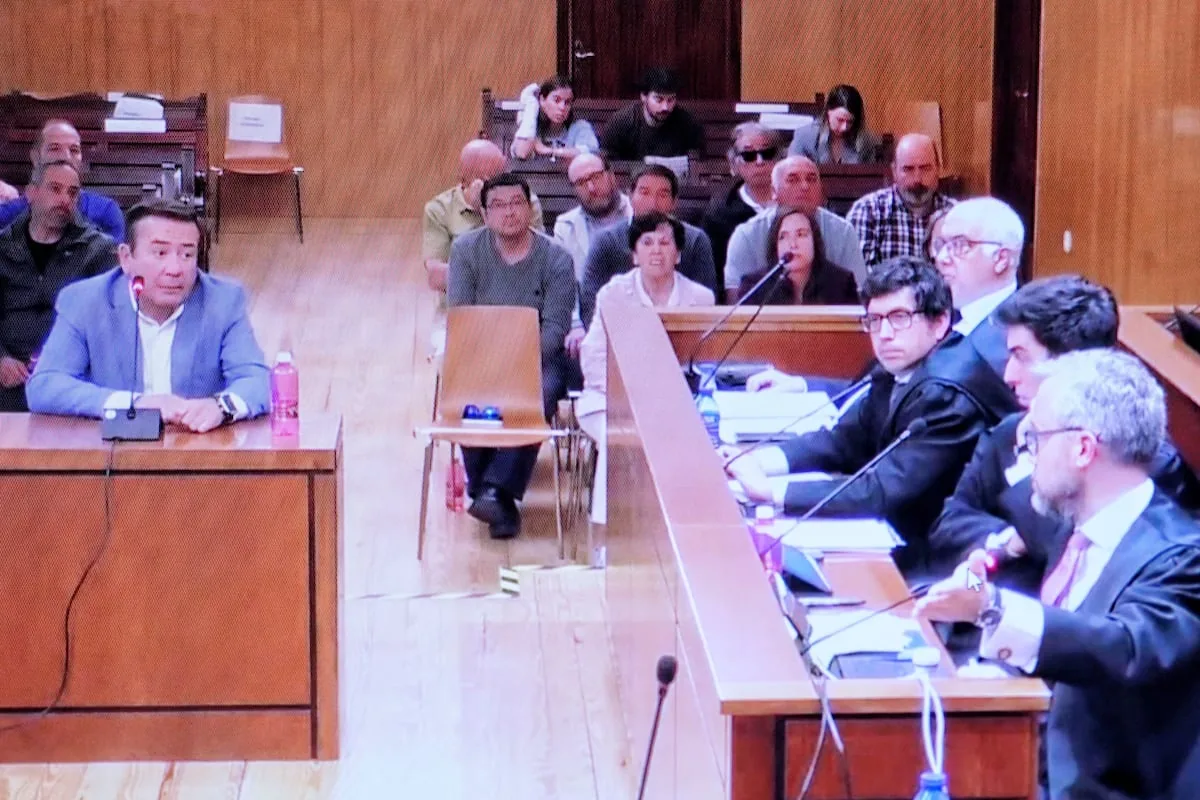
The so-called Funeraria case is one of the most macabre in recent Spanish history. It is being investigated whether the company Grupo El Salvador, from Valladolid, removed the dead from their coffins before cremation to resell the caskets. The trial, which has been held since last March at the Provincial Court of the capital of Valladolid and will last until June, besides showing the devastation of the thousands of affected, has become for attendees a masterclass in mortuary matters and its industry.
Read more The Oresund Strait, the new frontier in Russia’s hybrid war against NATO
After finishing with more than 200 statements from those affected and the experts, last week the accused began to testify. First, the relatives of the owner of the prosperous funeral business, Ignacio Morchón Alonso, who died in 2022. His son, Ignacio Morchón Vaquero, testified, limiting himself to saying that he was just “the boss’s son” and did what his father ordered. The deceased patriarch’s wife, Rosario Vaquero, who was listed as the administrator of the family empire, exercised her right not to testify and stated that she had never been to the funeral home. The same was done by the brother, Andrés Morchón. The two daughters of the deceased businessman, Rosario and Laura, who carried out management tasks in the company, as well as about twenty employees very close to the family, were left for the next hearings.
However, as the trial sessions progress, old and new questions remain open. These are some of the loose ends of the Funeraria case.
Moving a dead person. All the witnesses agreed on the difficulty involved in moving the body of a deceased person. In fact, there are courses in thanatopraxy and thanatoesthetics that teach how to handle a corpse. Likewise, all agree that to take a dead person out of one box and place them in another or on a rigid surface (necessary to put them in the oven) more than one person is needed. However, the accused claim that removing the deceased from their expensive coffins to put them in cheaper ones or in box lids for incineration was “Justo’s [Martín Garrido] business,” the person in charge—along with two other workers—of the crematory oven in Santovenia del Pisuerga, where Parque El Salvador is located, which includes a cemetery. The accused say that Justo, who was the one who reported (with photos, videos, and documents) these alleged practices to the police in 2017, did it “all on his own risk,” without anyone giving him any instructions. According to them, he did it out of revenge because he believed he had not received a proper pension. Justo, who never denied being upset about the financial issue, testified before the judge—before hanging himself from a tree in his garden in August 2024—that of course he moved the bodies with help, including from the boss and his own son, but also from the other employees. And that everyone knew what was done there.
A million euros in plastic bags. During the searches carried out by the National Police agents in the so-called Operation Ignis, launched in 2019, nearly a million euros were found in plastic bags and envelopes hidden in the home of the patriarch, Ignacio Morchón Alonso. In his statement before the judge, made before he died, he said he kept that money for his children because he did not trust banks. However, he deposited into accounts everything his company produced. Where did that capital come from? He claimed it was the savings of his entire life. His son, on the other hand, explained during the trial that his father “was very smart and had business vision, and if he had a penny he invested it.” He gave the example of recent times in the funeral home, when they were already engaged in the construction of all kinds of buildings.
Read more Gibraltar, European and without a fence: “An uncertainty that was very harmful ends”
“Family” employees without qualifications. Just as Justo started working at the company in 1995 to return a favor to the mayor of Santovenia de Pisuerga, according to the businessman’s son in the trial, the rest of the employees of Grupo El Salvador are mostly family members and unqualified people. “Justo had no studies at all,” Ignacio Morchón (son) told the judge last Wednesday. His uncle, who was the company’s accountant for years, was a school teacher. His mother, the administrator, was first a butcher and fishmonger with her father and later, over the years, followed him in the coffin sales business and in creating funeral homes. Many of the employees are children of other employees, “placed” by their father out of familiarity, but not for specific qualifications for the position. These almost affectionate relationships make the employees and the owners of the investigated funeral home form today an almost completely compact block.
Compromising conversations. The conversations from the wiretaps carried out by the police during their investigation revealed in the last day of the trial the complicities between employees and between workers and owners. “It was Justo, who is extorting them because he says they continue doing downstairs [in the new Valladolid Funeral Home] what they did upstairs [in Santovenia],” two women, partners of employees, talk on the phone. “This is a catch,” one worker tells another, “they were after him from the Interior Ministry,” he asserts. “No one would have found out with me, but with this clown…,” another employee comments, referring to the detained owner’s brother, who, already retired, continued working at the Santovenia cemetery. “The others won’t say anything, but this fool…,” the women emphasize in another conversation.
Gas consumption. Although supposedly the incinerations began to be done in the latest funeral home the group created in the capital, Valladolid, with a more modern crematory oven, the gas consumption of the Santovenia oven remained stable throughout the investigated years: 2015-2025. This would support Justo’s version, the whistleblower and main author of the desecrations, that they took most of the deceased to be cremated at the old facilities in Santovenia de Pisuerga, where he was. This was to carry out the switches more securely. It would also coincide with the version of many of the affected, who said they transferred their deceased there but were not allowed to see how the cremation was carried out. And it might explain the alleged urn and ashes swapping reported by the affected, who concluded during the trial that they were given remains that were not those of their deceased relative.
The key is called Victorio. Victorio Senovilla, friend and partner of the founder of the funeral empire, is today one of the investigated. For decades he ran a workshop next to the Santovenia cemetery, where he made coffins. He is the main supplier to Ignacio Morchón Alonso’s company and also helped him defraud the Treasury with false invoices or inflating invoices on other occasions, according to the patriarch’s son during his testimony at the trial. The police suspect him, and the Customs investigation points to him as a presumed money launderer of the money obtained from reselling coffins rescued from the crematory oven, which he could then resell to his partner and friend. The investigation confirms an accounting discrepancy corresponding to at least 4,500 coffins. The Prosecutor’s Office estimates the total amount of the fraud at four million euros and calculates that 5,973 switches were made, which is why it requests 20 years in prison for each of the main defendants, three decades of disqualification from providing funeral services, fines of 12 million, and million-euro compensations to the families of the deceased affected by these alleged practices.