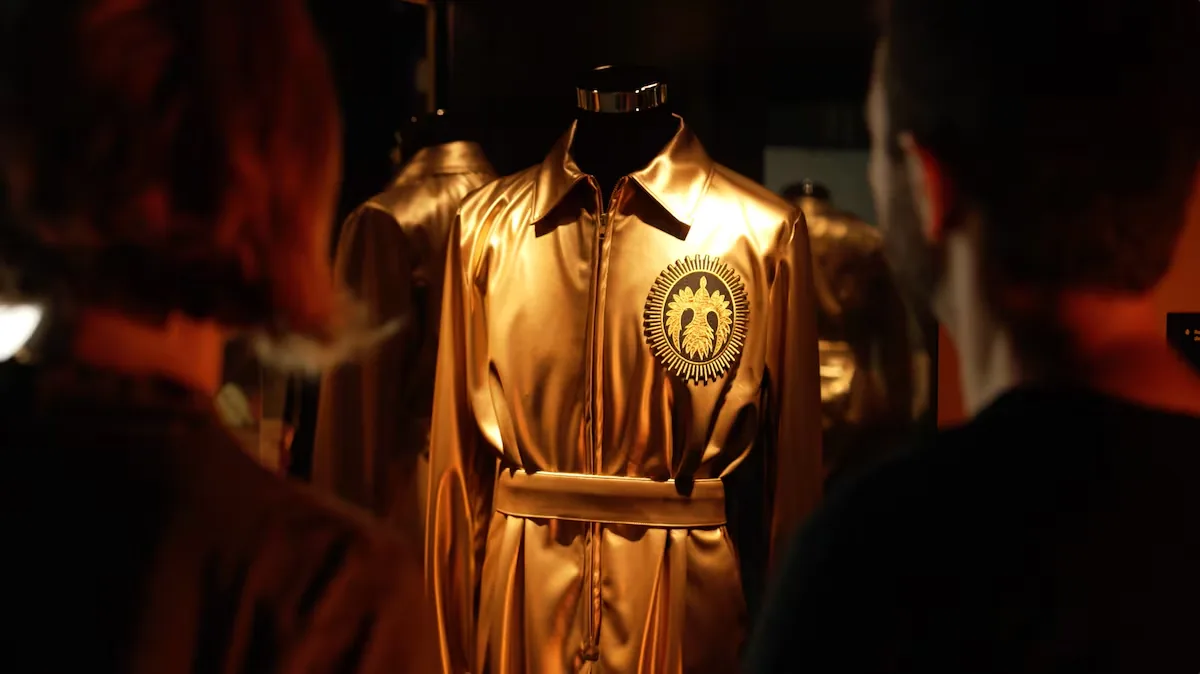








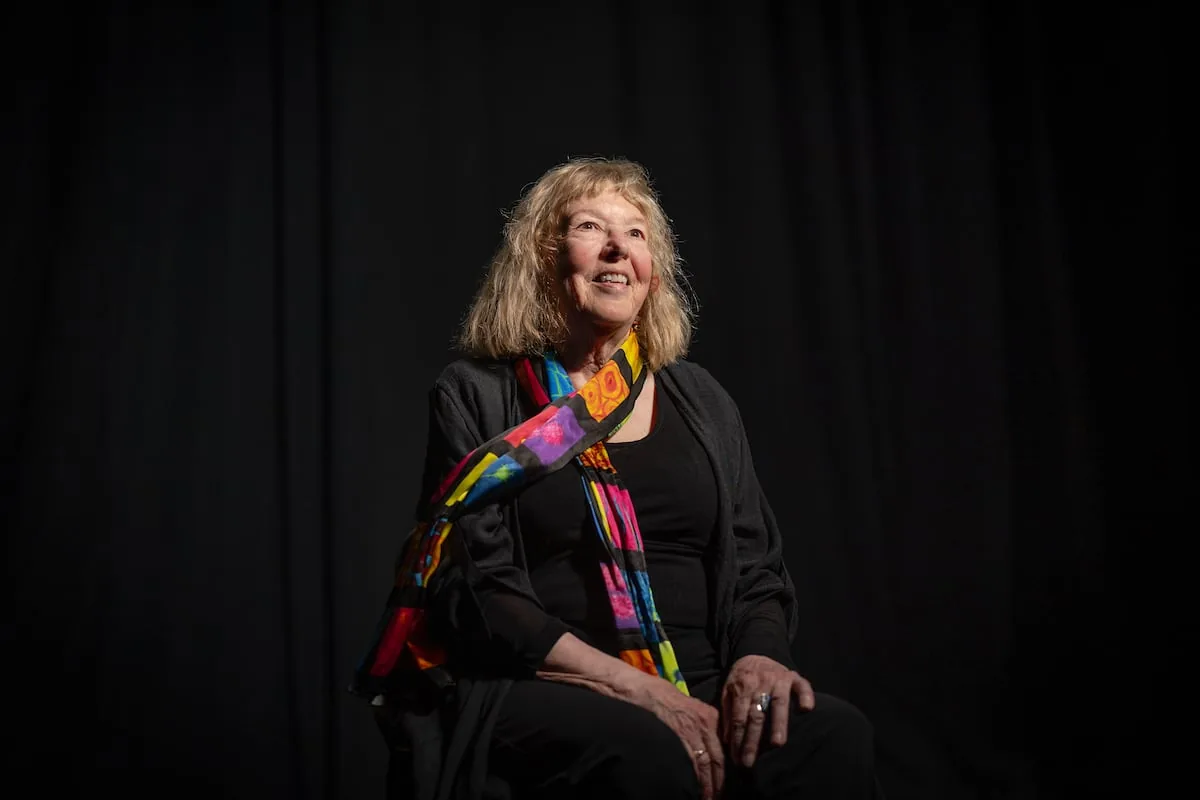
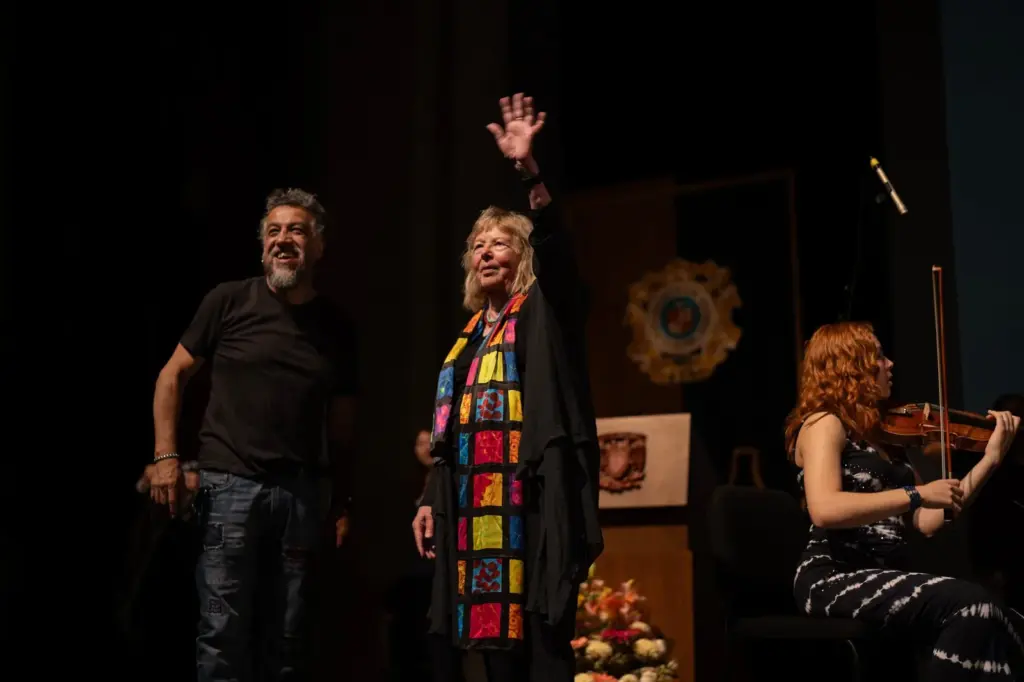
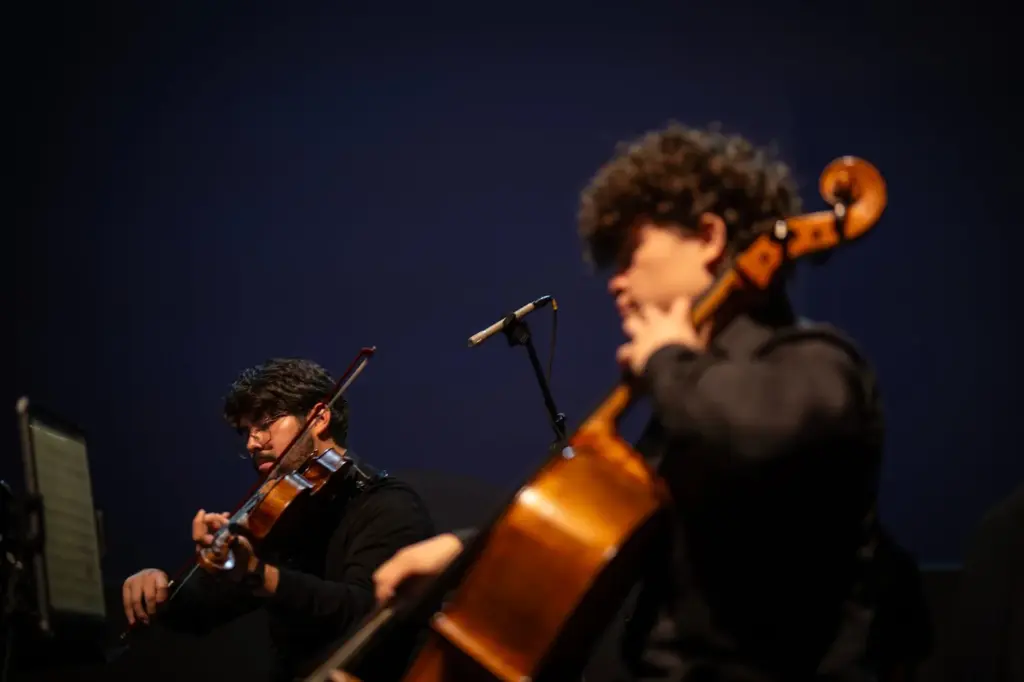
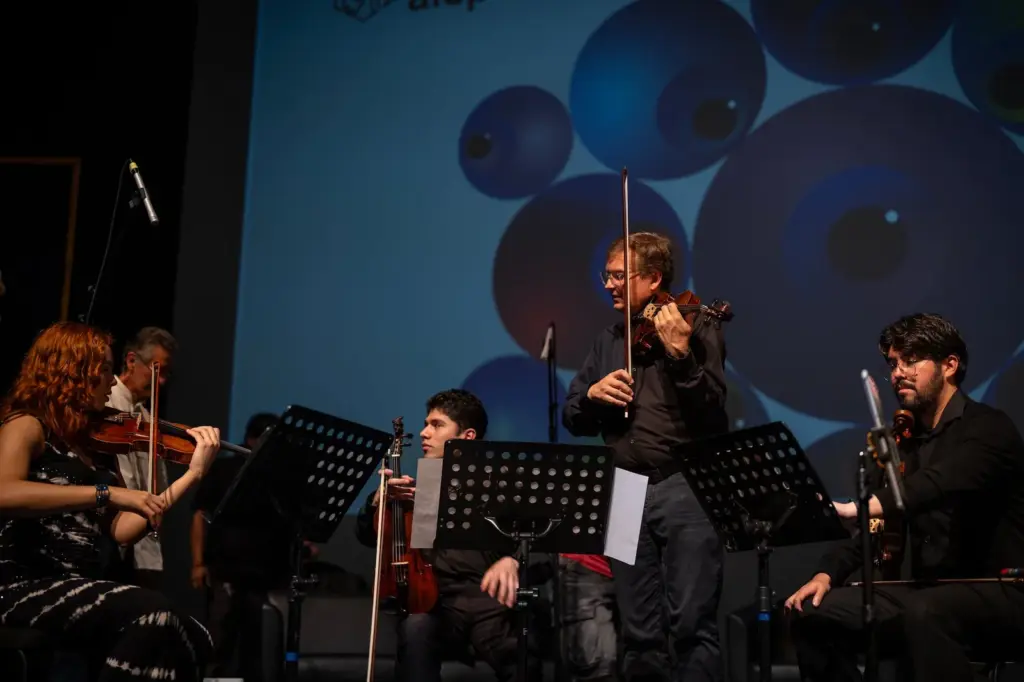
Elaine Bearer (New Jersey, 76 years old) moves across the stage with lightness and concern. She has had a cold for several days, and although she usually lives in the New Mexico desert, she finds the heat of Mexico City even more intense. A few steps away, four young musicians rehearse the final details to perform three pieces written by Bearer in a brief concert following her talk The Music of the Universe and the Dance of Neurons, which opened the UNAM festival on art and science, El Aleph. The American neuroscientist and composer asks questions and gives some directions before an image of New Mexico appears on the giant screen, followed by a photograph of Moctezuma’s headdress.
The classical music scientist and composer has visited Mexico before. She has had research stays in Cuernavaca and San Miguel de Allende. For more than 30 years, she has been a close friend of Mexican neuroscientist Francisco Fernández de Miguel, a researcher at the UNAM Institute of Cellular Physiology. Bearer laughs that the only photos of her on the internet are precisely from an occasion when she was in Guanajuato, and she still wore glasses before undergoing the surgery that allowed her to stop using them.
She is also not unfamiliar with national current affairs and recounts that, the night before this conversation, she heard a statement from President Claudia Sheinbaum. “I liked her voice, her elegance, her calm, her articulation. Even I, as an American who knows only a little Spanish, could understand what she was saying,” she says enthusiastically.
She has recently read the book Elizabeth I, CEO: Strategic Lessons from the Leader Who Built an Empire, by her compatriot, historian Alan Axelrod, and says she has started memorizing several of the phrases contained in it: “One of the things she says is what your president did. What Elizabeth I says is that you have to speak to your people regularly, clearly, and say the same thing at least three times,” she notes, laughing and amazed.
Bearer grew up in her New Jersey home with her family and began playing music at six years old, practicing with her violin among transistors and machines her father had placed in the basement of their house in an improvised office when he worked as an electrical engineer for the legendary telecommunications company Bell Labs.
This woman, with enormous energy and latent generosity, is a researcher, scientist, composer, and much more. Since 2009, she has been a professor of pathology, neurosurgery, and music at the University of New Mexico. Her scientific studies range from analyzing how fear produces trauma in young people’s brains to the existence of microplastics in the brain and even possible connections between these substances and diseases like Alzheimer’s.
She has also contributed numerous academic studies on brain circuits, mental development, tumors, and brain cancer, just to name a few. But if there is one thing that can unify her entire career, it is the connection she has in her life, mind, and work with music. “For me, music and science have never been separate,” she says.
During her lecture at UNAM on May 8, she spoke in detail about how music reaches brain circuits and how those impulses later become complex emotions. A concern that has pursued her since she began creating music and when her infinite curiosity made her want to explain to herself how all that was executed in her brain and then in her body and daily life. “I studied music very seriously and wrote music. Then I wanted to know what was happening in my head and needed to study biology and neuroscience to understand how it worked,” she assures.
Bearer had an urgent need to explain what those musical effects did to bodies, the human mind, and emotions, so when she finished all her courses in school, as there was no way to advance further, she stayed in the music room to practice. Then, she moved to New York, where she took classes at the exclusive, prestigious, and demanding Juilliard Conservatory.
During the first part of her life, Bearer devoted herself body and soul to music. After a few years, she went to Carnegie Tech, now Carnegie Mellon University (CMU), in Pennsylvania, where she studied computer science and music. “Then I went to Paris and studied with Nadia Boulanger, and from that moment until I returned to university to study sciences, I did not use computers. I did not do adapted music. And I think if I had to advise a student like me now, I realize there are very few who dedicate themselves to both things at the same time; I would advise them to dedicate their time to music when they are young. They can learn sciences later,” she reflects.
On stage, Bearer explains Albert Einstein’s work and compares it to that of Austrian composer and painter Arnold Schoenberg; at the same time, she plays one of her musical pieces composed to try to explain the feeling of sadness; she also recounts that she has a kind of addiction to music, alluding to what some substances do to the brain with what certain melodies cause: “There are people who hear voices in their heads telling them things; I don’t have that problem, instead I hear music all the time. It’s as if there were a radio turned on there. And apparently, Einstein had that too,” she says.
Everything interests her, and she can—and wants to—transform almost everything into music. She explains that Moctezuma’s headdress encloses years of culture, art, and science that also become symbols of power, politics, and a form of organization we have not yet fully understood. She asserts that it is a mistake for scientists, musicians, artists, researchers, and other individuals with different talents to work as if they were “islands,” separately, as if all the knowledge produced by humans were not linked and connected to each other, to the universe, to bodies, and to minds and emotions.
Regarding the endless questions about different topics involving the human brain and its development in times of screens and hyperconnectivity, there are a couple in particular that many people ask her. Should we be worried or encouraged about the use of new technologies? Is the future hopeful or should it concern us? Bearer considers it more of a political issue, and that scientists can only provide knowledge.
“These are difficult questions. I was, maybe 10 years before the pandemic, at the University of Cambridge in England, and there was a big sign on one of the walls that said: ‘Should we do it just because we can?’ So, what we often do in technology is not think about the consequences of the things we do. Does that mean we shouldn’t do them? I suppose my opinion is divided on that,” she says.
Read more Sentenced to 15 years in prison a defendant accused of planning an attack at a Taylor Swift concert