









Over time and through the vicissitudes of the Silicon Valley tech world, we better understand every day the reasons for the success of the neoreactionary (NRx) galaxy. What defines this galaxy is the enormous boldness to imagine the future from the acceleration produced by technology. It consists of bloggers and computer engineers (Curtis Yarvin), billionaire oligarchs (Peter Thiel, Marc Andreesen), and a philosopher (Nick Land) who write whatever comes to mind, without experiencing any kind of restriction: the media used, of course, are not peer-reviewed scientific journals, nor books published by major publishers, but rather self-published texts and manifestos, with periodic interventions in personal blogs that can become very popular. The result is an unusual political and futuristic imagination, where a fascination with the Middle Ages, the fantasy universe of J.R.R. Tolkien, the denigration of progressivism and all kinds of leftism, contempt for liberals, and rejection of democracy in the name of freedom converge.
Read more Public Account 2026 in Chile, live | José Antonio Kast delivers his first speech before Congress
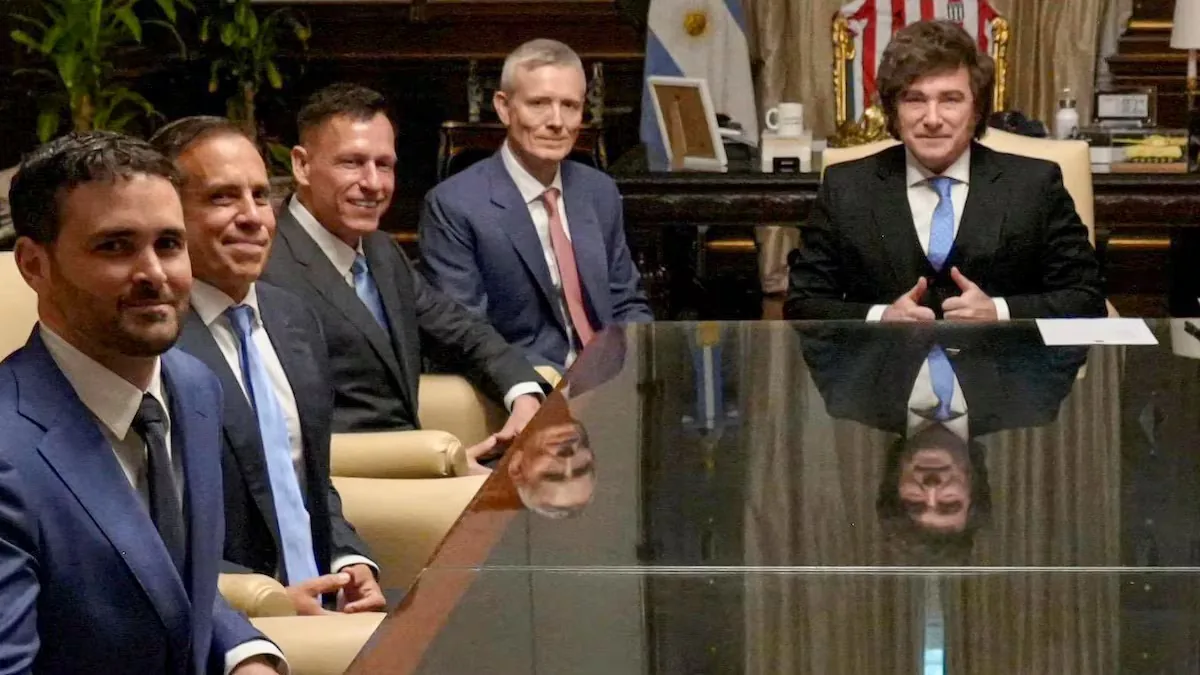
The political influence that this neoreactionary galaxy is acquiring in the high spheres of Washington is undeniable, and more indirectly in various governments around the world, especially in Latin America, recently in Argentina and Chile. It is no coincidence that Peter Thiel is settling in Javier Milei’s Argentina and meets quietly with Chilean President José Antonio Kast. But there is also a more intellectual influence involved: not because many people read these public neoreactionary intellectuals, but because many are exposed to their ideas through the use of social networks and the internet.
There are two coups d’état that explain the growing influence of this very strange and aggressive world, highly infectious.
At the origin of neoreactionary success is what Marietjee Schaake called a technological coup d’état, in her book The Tech Coup: How to Save Democracy From Silicon Valley. In that book, Schaake argues about the enormous power that large tech companies have been developing through data accumulation and the establishment of contracts with the states of the main developed countries, recently in the defense sector (for example by Palantir, Peter Thiel’s company). The extractive capacity of personal data and its shaping through surveillance programs have awakened the interest of states, whose contracts allow these companies to enter state operations, control them, and thus colonize states from within. This explains the huge battles these companies are fighting to prevent states from introducing regulations on the use of technology, especially regarding Artificial Intelligence. The thesis of this specialist, who is now director of international policy at the Cyber Policy Center of Stanford University after becoming familiar with these battles as a member of the European Parliament, is fascinating: her book is full of situations she personally experienced, where each was another episode in the exponential growth of the power of these large tech companies. Thus, this technological coup d’état is an invisible coup, which does not occur at a single moment but proceeds through small successive blows, capturing more and more political and economic power.
But there is a second coup d’état involved, which I call a symbolic coup d’état. Control of information media has allowed the neoreactionary movement to largely dominate social conversation, introducing topics to think about as well as ways of thinking. Yarvin’s fierce criticism of the “Cathedral” (that network of university institutions and newspapers that defined what is politically correct, “progressive,” from Harvard to the New York Times) is part of this symbolic coup d’état. Once the coup is established, it then becomes possible to think and publish without rules or restrictions, making indiscipline a virtue and disciplinary thinking the great evil to defeat. This explains why these new-type public intellectuals allow themselves all kinds of freedoms, citing philosophers and historians (rarely sociologists, and very occasionally political scientists) with complete indifference to relevance.
Read more Jordi Martí Galbis, on the struggle of candidates in the Junts primaries: “We must transcend labels”
These are the two great conditions of possibility and success of the neoreactionary movement: it is not an entirely homogeneous movement (for example, there are many divergences regarding transhumanism), but there are essential consensuses about what to detest and where to accelerate at any cost.
Hence the importance of Pope Leo XIV’s first encyclical, Magnifica Humanitas, which is a true treatise on the human condition, but also a severe warning about Artificial Intelligence. What this magnificent encyclical is about is “disarming” AI, which “means removing it from monopolies, making it debatable, refutable, and therefore inhabitable, restoring in it the plurality of human cultures and ways of life.” But as important as the encyclical was the presence of Christopher Olah, one of the founders of Anthropic, at the moment the pope announced it. This speaks to us of several struggles being fought on various fronts within the tech world: the legal front where Sam Altman of Open AI and Elon Musk have just clashed, and the symbolic front where Olah, together with Pope Leo XIV, show themselves favorable to regulations on artificial intelligence (against Palantir and Peter Thiel). How can one not see that these regulations constitute a brake on the accelerationist current that predominates in the NRx world?
We will have to watch very closely what happens in the Silicon Valley world. Politics cannot be a mere spectator of the main technological disruption of our era.
Read more Dozens dead after an explosives depot explodes in Myanmar