







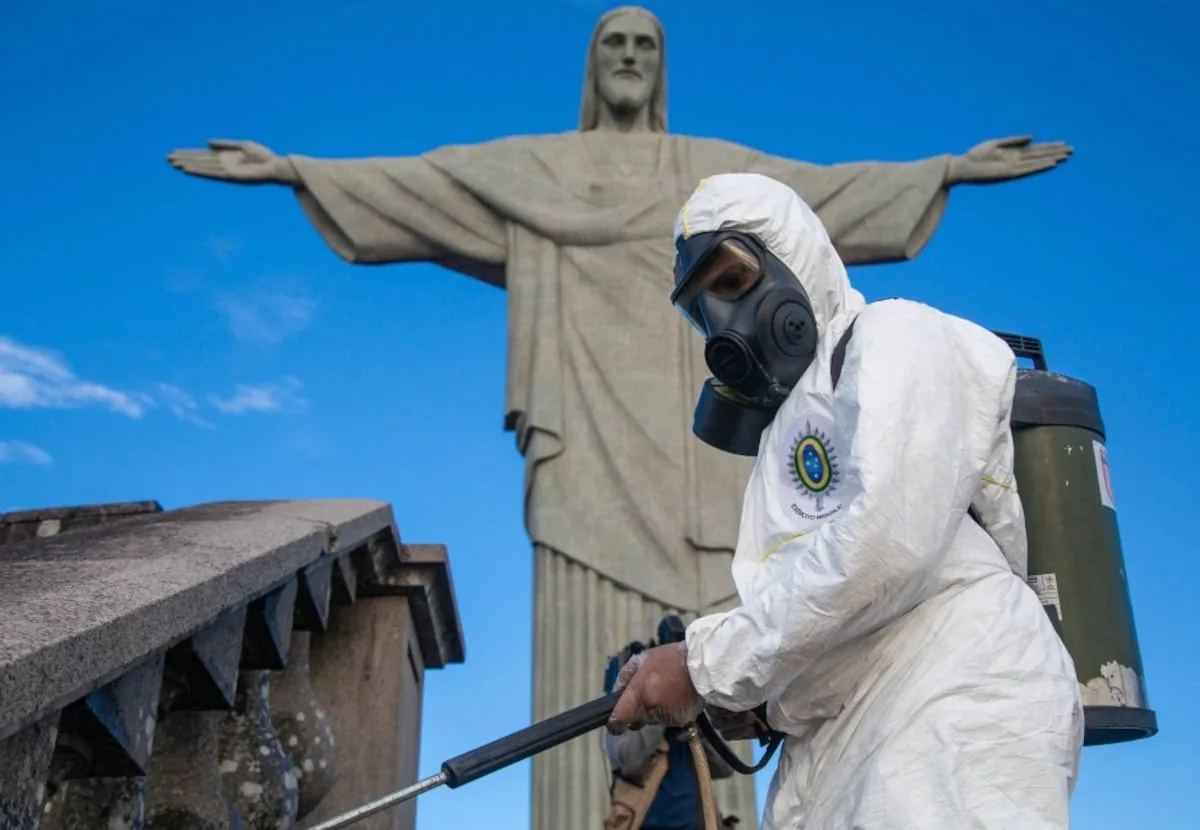
It is one of the most common cartoons in the Carioca press: Christ the Redeemer holding his head, covering his face, ashamed, or directly throwing in the towel and flying away from the top of Corcovado. The atmosphere of permanent political crisis, to which the Brazilians of the state of Rio de Janeiro (17 million inhabitants, the second economy of Brazil) have become accustomed in recent years, has worsened these weeks, due to the lack of a governor elected from the polls.
Read more You don’t have to swallow toads and snakes
The Bolsonaro supporter Cláudio Castro, elected in 2022, resigned at the end of March to save himself from a judicial process and launch his candidacy for senator. Shortly after, he was disqualified. And there is no clear formula on how to replace him, because the situation created is so unlikely that it was not even foreseen in the law. As a backdrop, the October elections, when Brazilians will choose the president, renew Congress, and elect the 27 governors as well as the state assemblies.
Aware that his moment was ending, Castro, a politician with little charisma who reached the front line by chance, decided that in 2026 he would try to extend his political career by running for the Senate. It did not seem difficult for this evangelical gospel singer in his spare time. Despite not being a popular figure, being the representative of the far right in a very conservative state promised him a campaign without surprises.
After resigning, the electoral court disqualified Castro for having used the office to inflate his 2022 electoral campaign. The sentence added to a long and sad tradition: in the last ten years, five former governors of Rio have gone to jail. Those who have been saved have either resigned or been removed.
His departure created a power vacuum due to vacancies in the line of succession. The logical step was to turn to his vice governor, but he resigned in 2025 to take a lifelong and well-paid position in a Court of Auditors. The next in the line of succession was the president of the Legislative Assembly, a position vacant since the holder resigned after being accused of links to drug trafficking.
Result: at this moment the governor is Ricardo Couto, the president of the Rio Court of Justice, a gray man unknown to most, with little power because he does not have a majority in the assembly. It is the provisional solution.
The definitive one is unknown. The question hovers: Who should choose the next governor? The decision will be made a thousand kilometers away, in Brasilia, at the Supreme Court. It must decide whether to hold an indirect election (voted by the parliamentarians of the Rio Assembly) or to call elections to choose a temporary governor until the October vote. The judicial resolution has no date, which prolongs the institutional crisis and the judicialization of politics.
Read more Luis Manuel Otero and the hunger strike appeal
This is the umpteenth crisis of a state in permanent crisis, some will say since the capital was moved to Brasilia in 1960. The problems began to become chronic in 2016: the fireworks of the Olympic Games hid an administration that had just decreed the “state of financial calamity.” After narrowly avoiding bankruptcy, Rio has been in trouble ever since, renegotiating debts and with the constant crutch of federal aid.
The then governor, Sérgio Cabral, was sentenced to 400 years in prison for corruption in the pharaonic Olympic works. He spent barely six years behind bars. He now lives under precautionary measures in a luxury apartment by the sea. His successor was imprisoned for the same crime in 2018. And the next one was removed, accused of profiting from the field hospitals of the covid-19 pandemic.
It is not only the governors: in recent years prosecutors and practically all the counselors of the court that theoretically watches over the integrity of the state accounts have fallen for corruption. One of them was Domingos Brazão, convicted of ordering the murder of councilwoman Marielle Franco. That homicide revealed that the fine line separating Rio’s politics from organized crime is practically imperceptible. Many deputies of the Rio assembly represent paramilitary militias, and a Supreme Court judge recently stated that, according to the Federal Police, about thirty parliamentarians receive monthly payments from the jogo do bicho, a traditional illegal lottery.
The absence of leadership is noticeable, especially in public security, the main responsibility of a governor: publicly, a hard line is promised and police operations such as the one last year that ended with 122 dead, the deadliest police massacre in Brazil’s history, are boasted about, but the truth is that in recent years, both paramilitaries and drug trafficking have gained territorial control and now control 20% of the metropolitan area of Rio. Four million people live under the control or influence of armed groups, according to a study by the Fluminense Federal University (UFF).
The economic challenges are enormous: Rio de Janeiro is the most indebted state in Brazil, and that despite being the one that produces the most oil, which means generous income. There lies another Achilles’ heel and another possible drama around the corner: in the coming weeks the Supreme Court could force the sharing of that wealth — coming from wells off the coast of Rio — with the rest of Brazil. Dozens of cities accustomed to inflating their budgets with petrodollars would go bankrupt.
Eduardo Paes, mayor of Rio for 12 years, is emerging as the man who will manage that uncertain horizon. He leads the polls for the governor elections. Mayor of Rio capital for 12 years, he has a moderate profile that manages to gather votes from left and right, and boasts that, although he has been investigated on some occasions, his cases have always been archived.
Read more Half of the homicides in Bogotá are contract killings