







Where is the fire raging in the southwest sierra of Madrid expected to evolve this Saturday? What happened during the night and what is the current situation? “A tremendous effort has been made by the crews to contain the advance tonight. But the serious, serious problem comes from the Ávila fire. It looks bad, very bad,” summarizes a very experienced Madrid firefighter this Saturday morning, with full knowledge of the situation and access to data, who asks to speak on condition of anonymity because part of his information is “confidential.”
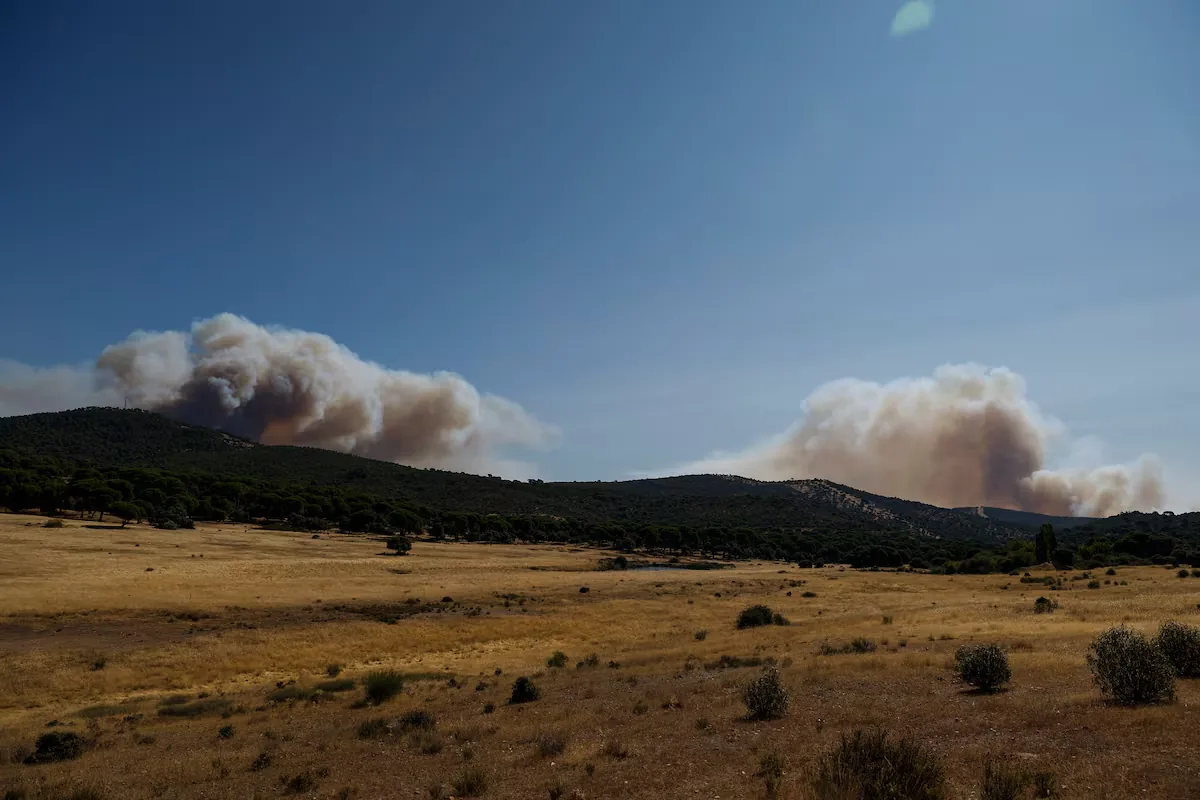
The fire, unified into a single one since Friday afternoon, remains uncontrolled and uncontained this morning, but during the night the flames “have advanced very little and have decreased in intensity,” according to the Ministry of Interior’s account, thanks to an improvement in meteorological conditions: less wind, more humidity, and lower temperature. With the weather enemy loosening its grip, the emergency services have managed to prevent the Ávila front from crossing into Madrid, the main fear, but it has advanced in the towns of Cebreros and El Tiemblo, while the Madrid front has advanced “less during the night.” The head of the Madrid monster is located between Robledo de Chavela and Fresnedillas de la Oliva, after overcoming the M-521.
Although they have not merged, “at an operational scale, it is now being treated as a single fire, both the one in Ávila and the one in the Community of Madrid,” explains the same firefighter. In fact, the Military Emergency Unit (UME) has announced the creation of a Unified Emergency Command to coordinate the response to both fires.
“The night has improved meteorological conditions, but the wind is expected to return to Friday’s levels throughout the day,” fears the firefighter. The day’s meteorological scenario is complicated. The forecast for this Saturday indicates that “temperature and humidity conditions improve, but not wind conditions,” confirms Javier Armenteros, delegate in Madrid for the State Meteorological Agency (Aemet).
The maximum temperature forecast drops to 29 degrees from Friday’s 32, and “humidity during the night has risen to even reach 60%.” Now [ten in the morning] it is decreasing, it’s at 50% and, in the central hours of the day, it will stay around 30%.” “It’s an improvement in humidity compared to previous days, where it was below 20%,” emphasizes Armenteros.
🚨Populations of Cadalso de los Vidrios, Urbanización Entrepinos (Cadalso) and Rozas de Puerto Real evacuated and ES-Alert sent due to the evolution of #IFSierraOeste.
The inhabitants of Las Rozas de Puerto Real are being evacuated to Sevilla La Nueva, those of the…
pic.twitter.com/6yFFZ1CAtx
— 112 Comunidad de Madrid (@112cmadrid) July 25, 2026
As for the wind, very bad news: during the morning “it turns towards the northwest and in the afternoon it intensifies, with gusts that can exceed 50 kilometers per hour.” The most lethal combination for a fire, which makes it advance like a greyhound and become uncontrollable, is the 30-30-30 rule: more than 30 degrees, less than 30% humidity, and more than 30 kilometers per hour. That’s where things stand. By Sunday, the weather general is expected to collaborate with extinction efforts instead of hindering them, as “it will be a much more favorable day meteorologically, the wind will no longer be strong.”
Read more The flames fuel unrest in El Encinar del Alberche: residents feel abandoned by their mayor
The Secretary General for Civil Protection and Emergencies, Virginia Barcones, has warned that the change in meteorological conditions expected in the coming hours could complicate the evolution of the fire. Barcones explained that a change in wind direction is expected during the morning, with gusts of up to 60 kilometers per hour, which will require adapting the extinction strategy. “Changes in wind direction add new scenarios,” she stated, insisting that “the priority is to protect people.”
If there is a change in wind direction, comments the firefighter, “it is possible that this right flank that has been anchored, that has been controlled, will become the head of the fire and we would have to see where it evolves.” And from there, it’s a toss-up. “If we’re lucky, it won’t advance much because the work done tonight was good. If we’re unlucky…”.
With these elements and without mincing words, the firefighter indicates that the forecast for the fire’s evolution this Saturday “is bad.” The Community of Madrid “has held its right flank of the fire during the night and has done very well, but what is coming from Ávila is out of control.”
According to the consulted sources, “the objective of the day will be to defend San Martín de Valdeiglesias, the town, and also to control the evolution of the fire towards the area of Cadalso de Los Vidrios and Cenicientos to protect the populations.”
At this time, 29,488 people have been evacuated from Chapinería, Navas del Rey, Colmenar del Arroyo, Fresnedillas de la Oliva, Robledo de Chavela, Navalagamella, Valdemaqueda, Aldea del Fresno, Zarzalejo, and Peralejo, joined in the early afternoon by Rozas de Puerto Real, Cadalso de los Vidrios, and Cenicientos, from where even the fire command post itself has to be evacuated, finally moving to Navalcarnero. Another 20,262 residents are confined in San Martín de Valdeiglesias, Pelayos de la Presa, and Villa del Prado, joined in the early afternoon by Valdemaqueda (870) and San Martín de Valdeiglesias (9,324). Property damages are substantial and remain unevaluated.