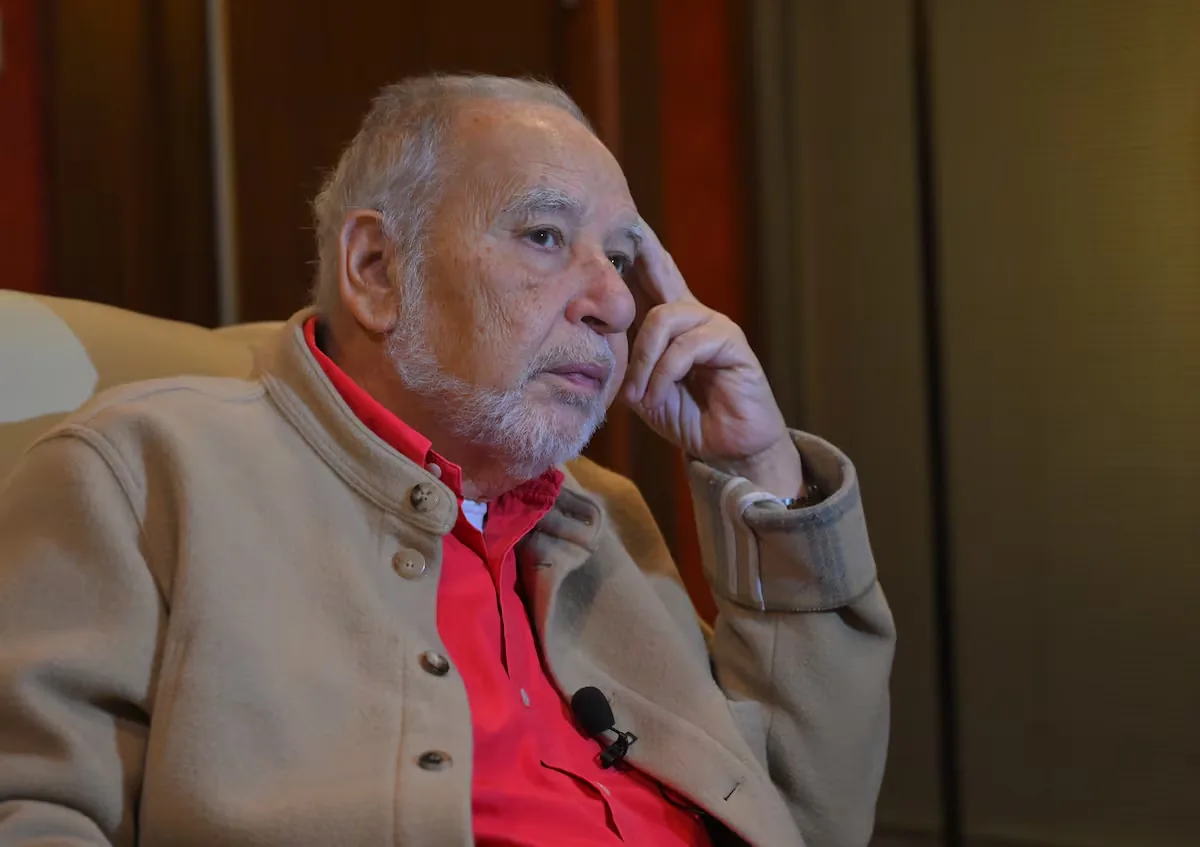
When he left the reception of the Throne Day at the royal residence of M’diq (Medik’s Corner, in the era of the Spanish Protectorate) he felt that his country was emptying. Thousands of young people were walking in the darkness on the night of July 30 from nearby Tetouan towards the border of Ceuta, barely 30 kilometers to the north. Tahar Ben Jelloun (Fez, 81 years old), the most recognized Moroccan writer, thinks that the Mediterranean is no longer the calm sea —the white sea, as it is called in Arabic— but a sea stained by the blood of illegal immigration.
Read more This is how the far right exploits the crisis in Ceuta: hyperboles, hoaxes, and viral videos
The author of The Sacred Night, a novel for which he received the Goncourt Prize in 1987, has since lived in France but spends summers in Tangier, the capital of the Strait where he was raised. He does not feel nostalgia for his country’s past. In the sixties, the so-called years of lead, he was interned for 19 months in a military prison and suffered mistreatment under the repression of Hassan II. He acknowledges that despite the great transformation experienced in the last quarter of a century under the reign of Mohamed VI, Morocco still has serious problems.
What strikes him above all is the coincidence of Throne Day with the migratory exodus of tens of thousands of young people “incited from social networks to march towards Ceuta.” Although what shocked him most was that the Moroccan police did not block their way. “On the road I saw that the officers let them head towards Ceuta,” he recounts in a phone conversation from Tangier. “I don’t understand why they didn’t block them in Tetouan. We have the most powerful police in the Maghreb. It would have been enough to send them back home and tell them they had nothing to do in Ceuta. Political intelligence was lacking.”
He was also shocked by the “hysterical way” in which Giorgia Meloni, in Italy, and leaders of other countries like Finland and Denmark wanted to punish Spain. “Europe needs to fill many vacant jobs. Italy has also regularized migrants quietly. But when Spain has done the same, it has been talked about as a pull effect. There is a lot of hypocrisy,” he questions.
“Ceuta and Melilla are not Schengen territory of free movement without controls, and from Ceuta you cannot go directly to Europe without a visa,” he recalls. “There has been no threat against Europe nor any possibility of invasion. There has been an unfair and false settling of scores with Spain because the aim is to punish Pedro Sánchez’s policy for having disobeyed (Donald) Trump and (Benjamin) Netanyahu on the Gaza issue and for having the courage to support the Palestinian people,” he argues.
He also considers that Sánchez will probably lose the next elections in Spain because of everything that has happened in Ceuta. “There is an American and European will that the Socialist Party no longer governs in Spain. This has nothing to do with Morocco. It is scandalous,” he analyzes the consequences of the migratory crisis.
He points out that the visit of the Spanish Prime Minister to Algiers, 10 days before the avalanche of young people towards the Spanish autonomous city, was not the central trigger of the crisis. “I doubt it, but if the Moroccan government allowed the passage of migrants towards Ceuta to punish Spain for its rapprochement with Algeria, it was a mistake. Spain only defends its interest in buying cheaper gas,” he warns.
Read more The new era of social networks and artists: they no longer share their lives like before
“Now, Morocco claims the return of Ceuta and Melilla to Moroccan territory, which is legitimate for cities occupied for five centuries, and which represents a geographical aberration. They are the last colonial bridgeheads in Africa,” he explains, in line with the hegemonic political discourse in the Maghreb country. “Spain cannot continue living as in the time of Isabella the Catholic. Conclusions must be drawn and negotiations held to find a peaceful and friendly solution regarding Ceuta and Melilla.”
“The events of July 30 and 31 can serve to facilitate dialogue, although I know well that the Spanish are not willing to give in. A long time ago, I had a conversation with Felipe González about this matter, and he told me that in Spain there is an emotional attachment to Ceuta and Melilla, so it seemed unlikely to him that any government would give up those two cities. Maybe things have changed now,” he interprets.
Battle for the 2030 World Cup
Asked about those who demand excluding Morocco from the 2030 World Cup because of what happened at the Tarajal border with Castillejos, the Franco-Moroccan writer considers it would be “very unfair.” “It would be revenge by those who do not want Morocco, which has become an emerging country, to gain more importance in the current context. The country has evolved and is growing economically. And there are those who do not want it to continue like this,” he argues. “Obviously, there are still many flaws. Education remains a central problem, and many young people have been left aside and unemployed.”
Asked about it, Ben Jelloun sees the nationality concession law for Sahrawis born under Spanish administration, in advanced processing in Parliament, as “a concession.” “Its approval would be a diplomatic victory for the Algerians that would pose problems. It would be a nuisance,” he openly expresses his opinion on a matter on which Rabat officially remains silent.
He is among those who think that relations between Morocco and Spain will continue despite everything after the migratory crisis. “We have many common interests, investments. That will not change, even if the Popular Party comes to power. There will be a difficult moment now. But dialogue will resume,” he predicts.
Morocco emerges from the tragedy of the Ceuta breakwater, which according to Moroccan NGOs has claimed 141 lives, with a serious loss of image, concludes the author of The Sand Child. “The waiters of the restaurants on the coast south of Ceuta abandoned their posts to break into the border in search of employment. There is a fascination with Europe among young people. They believe it is paradise,” he argues. “But it is incomprehensible that they stupidly risk their lives to work in Spain, in a Europe that does not want them. The far right now centers all its policy on rejecting immigration. I felt sad and outraged to see them march towards a destiny full of uncertainty,” he concludes. “Is no one waiting for them in Morocco? Does no one need them?”
Read more Democratic primaries show the declining political influence of Israel in the United States