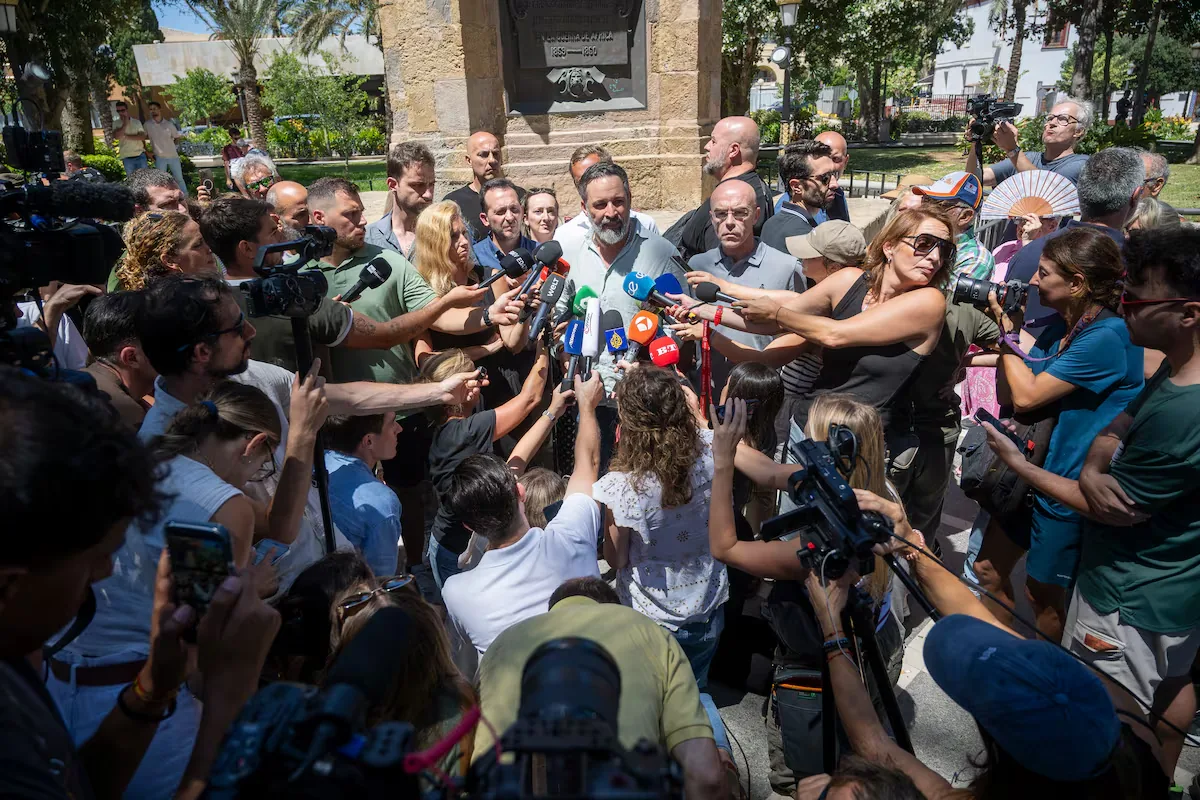
Just a week ago, Santiago Abascal, leader of Vox, responded to the media in Ceuta:
Read more The new era of social networks and artists: they no longer share their lives like before
—You mentioned Trump, who has described the Spanish Government as far-left radical and the event as an invasion. What do you think of his statements?
—What do you attribute the Government’s inaction to and what message do you send to the people of Ceuta?
—Juan Jesús Vivas, who governs here with the PSOE, has at all times tolerated the migration policies imposed by Pedro Sánchez’s Government from Madrid. We also see that in Europe it is the PP that governs and has implemented migration laws that are causing this. What do you think of the PP in this whole crisis we are experiencing?
—Do you think the law should be changed so that those who have entered illegally can be returned immediately, as is now said cannot be done?
The sequence has more information than it seems and is less about the answers than about the setting and the way the far right occupies it. The first, third, and fourth questions, with a clear ideological charge, were asked by a Bipartidismo correspondent, which defines itself as “the alternative against the real hoaxes of the mainstream media.” The second, EDA TV, which, according to its owner, Javier Negre, aims to “fight the cultural battle against the shitty leftists.”
Abascal, leader of the third party in Parliament, did not go to Ceuta because he had to coordinate an operation or because he played any role in managing the crisis, but to viralize videos in which he announces a health and housing “collapse” due to “mass immigration”; he criticizes the weakness of a rival fishing in the same waters — “The PP of Ceuta makes pacts with socialists and Islamists” — and insists that “Spain is defenseless.” That is, only he and his party can save it. “The message to the people of Ceuta I have already sent: I am here,” he replies. The MEP and ultra agitator Alvise Pérez or Vito Quiles also traveled to the autonomous city to “defend” Spaniards. The visit to the epicenter of the event, which also fits with his main banner, a hard line on immigration, actually speaks of a much more sophisticated strategy than the words he uses. And it is working for them. In the videos of Abascal’s appearance, several rounds of applause can be heard. No poll indicates that the far-right party will lose votes compared to 2023. On the contrary: it is the one that rises the most.
“Vox,” explains political scientist Pablo Simón, “has shifted to become an almost single-issue party focused on immigration, leaving aside other banners. They know there is fertile ground for this all over Europe and they take advantage of it. The traction is very strong. Ten years ago, in Spain, we debated very local issues, like the procés, but now we do not debate anything that is not debated in Europe and it is the far right that sets the agenda. At the same time, the immigration issue lends itself easily to sensationalist framing, and in a context of attention competition, that gives audience and allows you to generate viral videos. It’s a perfect cocktail. The other element of these kinds of visits, like in the flood, is that they allow them to generalize the idea that the State does not work and that they are the only ones who can fix it, the only ones on the people’s side.”
As happened in the flood in Valencia, the migration crisis has multiplied hoaxes and hyperbolic discourses. José Julio Fernández Rodríguez, professor of Constitutional Law, graduate in Political Science and Journalism and head of the University of Santiago de Compostela project Information manipulation as a problem of security and democratic quality, highlights that with what happened in Ceuta “all disinformation techniques have been reproduced.” “On one hand, real videos have been spread, but from other places or times, like riots in Nador. There have also been videos made with artificial intelligence very difficult to detect without the right tools; in certain programs, false experts have been encouraged, who differ from mere experts in that they are not neutral, they have a political or hate agenda; reports have been falsified, such as one in which the UN supposedly considers Ceuta and Melilla as colonies… But in this case, there is also an element that worsens the consequences: the fact that it is an open problem, that is, the temptation to make prospective and conspiratorial analyses.”
José María Figaredo, Vox spokesperson on “deregulation, energy, and economy,” declares on Antena 3: “We must not care about the Constitutional Court or the Supreme Court. We are talking about the security of Spaniards. They are calling all of Africa to come invade Spain. Today it was Ceuta, but tomorrow we will have them in Málaga, and the next day, in Murcia… We have to catch them all, one by one. We are seeing the beginning of the fall of Europe. Either we do something now, forcefully, or we are dead.”
Samuel Vázquez, Vox spokesperson on security and immigration issues, also traveled to Ceuta. “This city has been invaded and everyone has the right to defend themselves when the Government does not defend you,” he says to the cameras. “The instinct of survival and protection of offspring has belonged to humans for centuries. If a family father has to defend his children or his business, Vox will be with him without fear of anything. We are not the PP, we will not back down. Let everyone defend their family with everything they have at hand.”
Citizens have the right to defend themselves. pic.twitter.com/D3m9p3MdTX
— Samuel (@guidoprincesa) August 1, 2026
Before traveling to the autonomous city, far-right agitator Vito Quiles justified the trip as follows: “I am heading to Ceuta with a security team and personnel to carry out surveillance and controls on streets, buildings, and homes. The intention is to prevent thefts, looting, and assaults. If the Government abandons Spaniards, Spaniards will have to protect themselves.”
We just arrived from 15,000 kilometers away.
If you see us with some Jet Lag… now you know why. From the runway to the #Horizonte set. No anesthesia.— Iker Jiménez (@navedelmisterio) July 31, 2026
Iker Jiménez interrupted his vacation to do a special of Horizonte. Throughout the program, they talk about brawls, knives, guns… The “Colonel Baños” insists that “most, if not all,” of those who arrived in Ceuta, “are young men of military age and not exactly scrawny” and at one point comments: “You have to be very careful because what King Mohamed VI would like most is for us to start killing those who are invading us.”
Read more Democratic primaries show the declining political influence of Israel in the United States
I am heading to Ceuta with a security team and personnel to carry out surveillance and controls on streets, buildings, and homes. The intention is to prevent thefts, looting, and assaults.
If the Government abandons Spaniards, Spaniards will have to protect themselves.
— Vito Quiles 🇪🇸 (@vitoquiles) July 31, 2026
Professor Rodríguez explains that, of all the disinformation messages related to the Ceuta crisis, the most dangerous are the prospective ones. “There are political sectors that pit freedom against security to encourage adopting disproportionate militaristic positions. They generate hatred and a perception not adjusted to reality to change security policies in the medium term. They play with emotions, but obviously, in a democracy, it is the State’s security forces and bodies that must take care of security, not the citizens.”
The far-right discourse is full of hyperboles and contradictions, such as insisting that those who arrived in Ceuta are “men of military age” and then publicly rejecting the reception of minors, or questioning that migrants arrived by swimming when there are more than 100 drowning deaths and Abascal himself has referred to them; or summarizing what happened at the border as a response to a “call” from the Prime Minister to have “hitmen” with whom to “stay in power” shouting “Long live Pedro Sánchez through the streets of Spain.”
But it does not cost them. “The success of the far right,” explains Simón, “is having generated, with a fine drizzle, a kind of immunization with hyperboles, having inverted common sense. They have opened the Overton window [referring to the theory of the American political scientist who explained how politicians legislate on ideas society considers acceptable]. When extreme positions gain space, the middle ground also shifts, leaning, in this case, towards anti-immigration positions.”
When you hear a politician or journalist saying that Moroccans enter Ceuta after swimming for 4 hours, you have to know that that is the enemy. pic.twitter.com/9W8pxxnG1a
— David Santos (@davidsantosvlog) July 30, 2026
The PP shift and Europe’s shift
To displace public opinion, the far right first had to displace European leaders of different political colors, starting with classic conservative parties until contaminating part of the social democracy. The PP leader, Alberto Núñez Feijóo, also visited Ceuta during the migration crisis. “I would like to make a heartfelt statement,” he announced.
“This is the result of failed political decisions that have prevented fulfilling the first duty of any Government: guaranteeing the security of our people. The one responsible for promoting a permissive migration policy and sending the message that in Spain you can enter in any way and be regularized is the Government. [….] I am in contact with European leaders, I share their concern […]. Spain extinguished. Spain burned, Spain invaded. This is the commitment I want to assume today, from Ceuta, with all Spaniards: Spain will become a safe country again, it will have a functioning State again.”
Journalist Ana Rosa Quintana, who has also interrupted her vacation to cover the migration crisis in Ceuta, announces an interview with the PP leader: “Feijóo is very worried, as we all are. Everything he says must be listened to.”
Feijóo and Abascal left practically identical phrases in Ceuta. And the Spanish competition between the PP and Vox is reproduced in some way in Europe, which has progressively hardened its discourse and whose first reaction to what happened in the autonomous city was very different from that of 2021, when Belarus caused a similar crisis at the border with the Baltic countries and Poland. Then, most governments denounced that an external actor, ally of Vladimir Putin, Aleksandr Lukashenko, was using migration to destabilize a member State and the entire EU. This time, however, discourses proliferated linking what happened with the Spanish Government’s regularization of immigrants.
Jesús Á. Núñez Villaverde, co-director of the Institute of Studies on Conflicts and Humanitarian Action, explains: “It was about sending a message to the president, who goes his own way and makes an extraordinary regularization. To give him a warning. But Italy itself approved a regularization in the past and if we can be sure of anything, it is that this had nothing to do with it. The immigration issue is serving as an electoral banner in practically all countries, and there has been a shift towards approaches of greater police control that covers not only the right but also social democracy.”
But the Executive has also favored the proliferation of hoaxes and hyperbolic discourses, as well as the European reaction, agree the experts consulted for this report. “If the Government had said that this was Morocco’s fault,” says Simón, “it would not have a letter from 22 countries blaming it for its migration policy, because it would have forced others to position themselves in solidarity against the attack of a third party. But it did not say it because it would have meant admitting that the appeasement policy has not worked. Sánchez is paying the price for being the only social democrat who maintains the same positions that social democrats defended on immigration issues, with an approach that covers not only security but humanitarian aspects. The rest have already shifted.”
José Julio Rodríguez insists that part of the conspiracy theories are due to “the Government’s lack of transparency.” “It has not done self-criticism nor been transparent in explaining what happened, because there are also contradictory versions between one ministry and another. That is also disinformation, and when citizens do not trust the public power, it is easier for them to sit and listen to the analyst of the exaggeration program on television because lies often attract more attention than the truth.”
Read more City comes back against Atlético and ruins Kang-in Lee’s party in Seoul